2 weeks in Thailand is enough to explore Bangkok, discover Chiang Mai’s temples and enjoy Krabi’s stunning beaches without rushing through the country. But planning your first trip can feel overwhelming when there is so much to see.
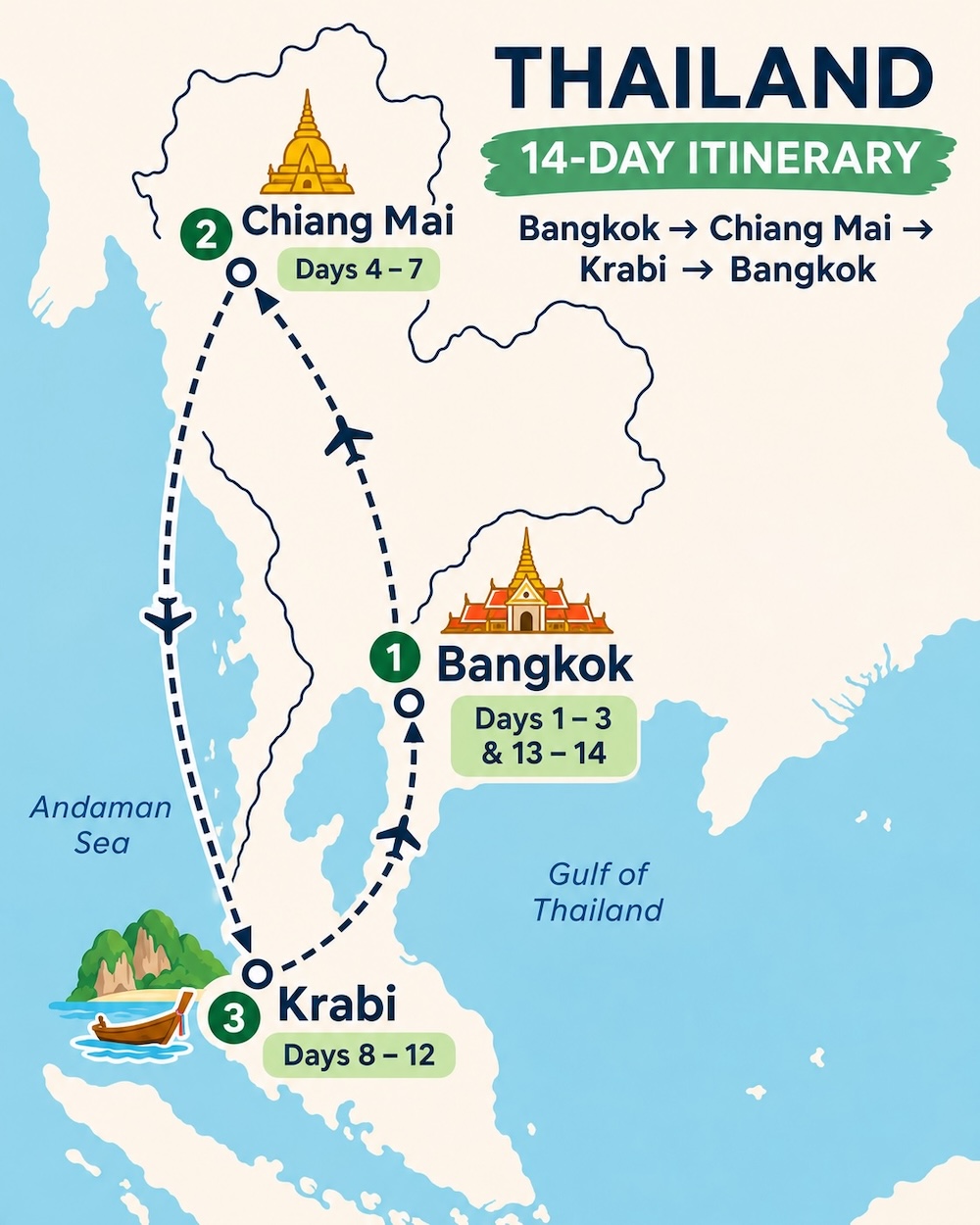
This 14-day Thailand itinerary takes you through three unforgettable destinations: Bangkok, Chiang Mai and Krabi. Discover what to see each day, how to travel between destinations, where to stay and how much to budget for your adventure.
14-day Thailand itinerary at a glance
This route works especially well for first-time visitors who want a mix of city life, northern Thai culture and Andaman Sea beaches. It includes 13 nights over 14 days and three domestic flights if you choose the fastest connections.
| Days | Base | Nights | Highlights |
|---|---|---|---|
| 1–3 | Bangkok | 3 | Grand Palace, Wat Pho, Wat Arun, canals and markets |
| 4–7 | Chiang Mai | 4 | Old City temples, elephants, cooking and Doi Suthep |
| 8–12 | Krabi | 5 | Ao Nang, Phi Phi Islands, Railay and boat trips |
| 13–14 | Bangkok | 1 | Final evening, shopping and international flight |
When to go: November to February is generally the best period for this route, with favourable conditions in Bangkok, Chiang Mai and Krabi. Weather varies by region, so check the seasonal conditions before booking.
Days 1–3: Bangkok — temples, markets and city life
Start your journey in Thailand’s capital, where royal temples, street-food stalls, river boats and modern shopping centres sit side by side. Three days give you time for the major highlights without rushing every stop. For more ideas, see our Bangkok travel guide.
Day 1: Arrive in Bangkok and settle in
After landing at Suvarnabhumi Airport (BKK) or Don Mueang Airport (DMK), make your way to your hotel and take it easy, especially after a long international flight. Explore the neighbourhood, try a local street-food meal and, if you still have energy, enjoy the city’s skyline from a rooftop bar or riverside terrace.
Staying near a BTS or MRT station can make the next two days much easier. If your flight arrives late, move the sightseeing to the following morning rather than forcing too much into your first evening.
To stay connected from the moment you arrive, check our guide to the best eSIMs for Thailand, including data plans and coverage options.
Day 2: Grand Palace, Wat Pho and Wat Arun
Devote the day to Bangkok’s most famous cultural attractions. Begin at the Grand Palace and Wat Phra Kaew, home to the revered Emerald Buddha. Continue to nearby Wat Pho to see its enormous Reclining Buddha, then cross the Chao Phraya River by boat to visit Wat Arun, the Temple of Dawn.
Start early, carry water and wear clothing that covers your shoulders and knees. Most of these sights are close enough to group into a single day, but allow time for queues and the heat. For more advice on respectful behaviour at temples, see our guide to Thai etiquette and customs.

Day 3: Floating market, canals and local Bangkok
See a quieter side of the capital with a long-tail boat ride along Bangkok’s khlongs (canals). Depending on the day of the week and opening times, you could visit a floating market such as Khlong Lat Mayom or Taling Chan. Not all floating markets operate every day, so check before travelling.
Later, stop at Pak Khlong Talat, Bangkok’s famous flower market, or spend the evening sampling food in Chinatown. This is a flexible day: a canal tour and one market are plenty if you prefer a slower pace.
Days 4–7: Chiang Mai — northern culture and mountain scenery
Swap Bangkok’s busy streets for the historic temples and greener landscapes of northern Thailand. Four days in Chiang Mai allow you to explore the Old City, join a local experience and visit Doi Suthep. Read our Chiang Mai travel guide for neighbourhoods, markets and day-trip options.
Day 4: Fly to Chiang Mai and explore the Old City
Take a morning flight from Bangkok to Chiang Mai; the flight itself takes roughly 1 hour 15 minutes. Alternatively, the overnight train can be an enjoyable experience if you rearrange your schedule and book a sleeper in advance.
After checking in, explore the Old City and its temples, particularly Wat Chedi Luang and Wat Phra Singh. In the evening, browse the Night Bazaar or a local night market and try northern Thai dishes such as khao soi.
Day 5: Visit elephants responsibly
Seeing elephants can be a memorable part of a Thailand trip, but the type of experience matters. Choose a venue that prioritises the animals’ welfare, allows them space to behave naturally and does not offer riding, performances or forced interactions.
Observation-focused visits are preferable to programmes built around bathing, touching or feeding elephants for photos. Research the venue before booking, and use our guide to elephants in Thailand and responsible tourism to understand the warning signs.

Day 6: Thai cooking class and a relaxing afternoon
Join a Thai cooking class to learn how local ingredients and spices are used in popular dishes. Many classes begin with a market visit before you prepare a few recipes and enjoy what you have cooked.
Keep the afternoon open for a traditional Thai massage, a café or a slow walk through Chiang Mai’s lanes. This less structured day makes the itinerary more comfortable after several full days of sightseeing.
Day 7: Wat Phra That Doi Suthep
Head into the hills above Chiang Mai to visit Wat Phra That Doi Suthep, one of northern Thailand’s most significant Buddhist temples. The climb up the naga-lined staircase leads to a golden chedi and, when visibility allows, views across the city.
A shared red songthaew or private driver can take you up the mountain. If you have extra time, consider a stop at Wat Pha Lat, subject to trail access and weather conditions. During the northern burning season, particularly from February to April, air quality can affect outdoor plans.
Days 8–12: Krabi — beaches, limestone cliffs and islands
Now it is time for Thailand’s Andaman coast. Krabi is known for towering limestone cliffs, beaches and boat excursions. Ao Nang is a convenient base, with plenty of places to eat and boats departing for nearby beaches. Our Krabi travel guide covers the wider region.
Day 8: Fly from Chiang Mai to Krabi and check in at Ao Nang
Direct flights between Chiang Mai (CNX) and Krabi (KBV) are available on some schedules, with a flight time of around two hours. Services and fares change, so check your travel dates; connecting flights through Bangkok may also be an option.
After arriving, transfer to Ao Nang, settle into your hotel and enjoy an easy beachside evening. Avoid booking a tightly timed excursion on the same day as your flight.
Day 9: Boat trip to the Phi Phi Islands
Take a full-day boat trip to the famous Phi Phi Islands, known for clear water, high limestone cliffs and beautiful lagoons. Depending on the trip, stops may include Pileh Lagoon, swimming and snorkelling spots, and the area around Maya Bay.
Important: Maya Bay and other protected sites may have seasonal closures, visitor restrictions or no-swimming rules. Check our Thailand island closures guide and confirm current conditions before booking your boat trip.
Day 10: Railay Beach and Phra Nang
Reach Railay by boat from Ao Nang. Its dramatic limestone formations make it one of the most distinctive landscapes in southern Thailand. Spend time on Railay West and Phra Nang Beach, or try a beginner-friendly rock-climbing session with a qualified guide.
Wear shoes suitable for paths and steps if you plan to explore beyond the main beaches. Boat services depend on weather and sea conditions.

Day 11: Free day for kayaking, climbing or relaxing
Keep this day flexible: kayak through mangroves, try rock climbing or simply relax on the beach. It also provides a useful buffer if an earlier boat excursion needs to be rescheduled because of bad weather.
Day 12: Phang Nga Bay or an easier Krabi boat trip
For another spectacular day on the water, consider Phang Nga Bay, famous for its limestone sea stacks and the rock near Khao Phing Kan commonly called James Bond Island. Some tours include sea-canoeing through sheltered caves and a visit to a stilted fishing village such as Koh Panyee.
Travel-time tip: Phang Nga Bay can make for a long day trip from Ao Nang, depending on the departure pier and itinerary. If you would rather stay closer to Krabi, choose a Four Islands trip or a shorter excursion to nearby beaches instead.

Days 13–14: Return to Bangkok and fly home
Spending your final night back in Bangkok provides some breathing room before an international departure, especially when a domestic connection is involved.
Day 13: Fly from Krabi to Bangkok
Take a domestic flight from Krabi to Bangkok and spend your last evening enjoying a favourite Thai meal, shopping or relaxing beside the Chao Phraya River. Check which Bangkok airport your domestic flight uses: Suvarnabhumi (BKK) and Don Mueang (DMK) are separate airports.
Day 14: Last-minute shopping and departure
Depending on your international flight time, you might visit MBK Center, a shopping mall or Chatuchak Weekend Market if it is Saturday or Sunday. Leave enough time to reach the airport; Bangkok traffic can be unpredictable.
If you have an early flight, skip shopping and keep the morning stress-free.
How to adapt this two-week Thailand itinerary
Bangkok, Chiang Mai and Krabi make a well-rounded first trip, but the best itinerary depends on your season, interests and preferred travel pace.
- More time in Thailand: With three weeks, add a few nights in the North or a second southern base rather than constantly changing hotels. For a different, more active route, see our 21-day Thailand itinerary.
- Only 10 days: Choose Bangkok plus one other region, or focus on southern Thailand if beaches are your priority.
- Travelling with children: Reduce the number of full-day excursions and leave longer breaks between transfers.
- Interested in nature: Consider replacing part of your Krabi stay with Khao Sok National Park, allowing enough time for transport and an overnight stay.
- More history: Add Sukhothai on a longer route instead of squeezing it into an already full 14-day schedule.
- Looking for quieter islands: Consider Koh Yao Noi instead of one of the busiest boat excursions, depending on ferry routes.
- Prefer fewer domestic flights: Spend more time around Bangkok and the South, and skip the northern leg.
- Travelling in the rainy season: Compare regional conditions. Krabi’s sea conditions may be less favourable during the southwest monsoon, while the Gulf islands follow a different pattern.
For a route tailored to your month, trip length and budget, use our free Thailand itinerary planner.
Planning your trip: Budget, accommodation and transport
Getting the logistics right is just as important as choosing what to see. The figures below are planning estimates rather than guaranteed prices; accommodation and airfare vary by season.
Before you travel, check the limits and exclusions for medical treatment, hospitalisation, emergency assistance, evacuation and any activities you plan to do. Compare coverage as well as price.
How much does a two-week trip to Thailand cost?
Costs vary considerably by travel style and season. For everyday expenses such as accommodation, meals and local transport, budget travellers can aim for roughly €25–€35 per person per day, while a comfortable mid-range trip may cost around €50–€80 per person per day. Domestic flights, major excursions and peak-season hotels can increase the total.
For this particular route, allow additional funds for the flights between Bangkok, Chiang Mai and Krabi and for several guided excursions. For full cost breakdowns and examples, read our Thailand travel budget guide. Prices are indicative and exchange rates change.
ATM fees and currency conversion can also affect your expenses. Read our guide to withdrawing money in Thailand to avoid unnecessary charges.

Where should you stay along the route?
- Bangkok: Sukhumvit is practical for BTS access and restaurants; the Riverside area suits travellers who want river views and access to historic attractions; the Khao San and Soi Rambuttri area is popular for budget stays and nightlife.
- Chiang Mai: The Old City is convenient for temples and walking, while Nimmanhaemin (Nimman) offers modern cafés, restaurants and shops.
- Krabi: Ao Nang has the widest choice of practical services and boat departures. Railay is an attractive alternative if you prefer to stay closer to the beaches and do not mind boat-only access.
Book accommodation with enough flexibility for your season and arrival time. If you are visiting during the December–February peak, popular rooms can sell out early.
What to pack for two weeks in Thailand
- Lightweight, breathable clothes: Quick-drying fabrics, T-shirts, shorts and dresses for tropical conditions.
- Temple-appropriate clothes: Something to cover your shoulders and knees when visiting religious sites.
- Rain protection: A compact umbrella or lightweight waterproof jacket, especially in the wetter months.
- Beach essentials: Swimwear, sandals and suitable sun protection.
- Health essentials: Mosquito repellent, personal medication and a basic first-aid kit. Our Thailand travel health guide explains what to check before departure.
- Universal travel adapter: Useful because sockets differ by accommodation; check that your devices support local voltage.
Getting between destinations: Transport overview
| Route | Best options | Typical travel time | What to know |
|---|---|---|---|
| Bangkok → Chiang Mai | Flight or overnight train | Flight around 1 hr 15 min; train often 12–14 hrs | Flights save time; sleeper berths can be booked in advance. |
| Chiang Mai → Krabi | Direct flight when available; connection via Bangkok otherwise | Direct flight around 2 hrs; longer with a connection | Confirm availability on your exact dates. |
| Getting around Krabi | Long-tail boat, shared transfer, taxi or organised tour | Varies by destination | Boat schedules depend on the sea. Only rent a scooter with the correct licence, experience and insurance. |
| Krabi → Bangkok | Domestic flight | Flight around 1 hr 20 min | Check BKK versus DMK before an international connection. |
Travel-time tip: The flight durations above do not include airport transfers, check-in, security procedures or baggage collection. Allow additional time when planning each travel day.
Frequently asked questions about two weeks in Thailand
Is 14 days enough for Thailand?
Yes, provided you limit the number of destinations. This itinerary includes three main bases and three domestic flights, leaving enough time to explore without changing hotels every night. If you prefer slower travel, consider visiting just two regions instead.
Do I need a visa for a 14-day trip to Thailand?
As of November 2026, ordinary passport holders from many countries, including the United Kingdom, United States, Canada, Australia and France, may enter Thailand for tourism under the 30-day visa exemption introduced on 15 September 2026, subject to immigration requirements. Rules vary by nationality and passport type, so check the current conditions before travel.
Most foreign visitors must also complete the free Thailand Digital Arrival Card (TDAC) within the three days before arrival. The TDAC is not a visa. For details and the official registration website, see our Thailand Digital Arrival Card guide.
When is the best time for this 14-day route?
November to February generally offers a good combination of conditions for Bangkok, Chiang Mai and Krabi, while the Andaman coast is often favourable through April. From February to April, Chiang Mai may have poor air quality due to seasonal burning. From approximately May to October, rain and rougher seas may disrupt Andaman boat trips. See our regional rainy-season guide before booking.
How much money should I budget for two weeks?
Your total budget depends on accommodation, domestic flights, activities and the season. Budget travellers can spend considerably less than visitors choosing mid-range hotels and organised excursions.
Is Phuket or Krabi better for a first trip?
Both can work. Krabi is a strong choice for limestone scenery, Railay and island boat trips. Phuket offers a larger range of resorts, beaches, restaurants and nightlife. Our Phuket travel guide explains what to see and where to stay. This itinerary chooses Krabi for its scenery and relatively convenient day trips, but Phuket is an alternative if it better suits your interests.
Can I do this route without renting a scooter?
Yes. You can use Bangkok’s trains and river boats, taxis or songthaews in Chiang Mai, and shared transfers, organised tours and long-tail boats around Krabi. A scooter is not necessary for this itinerary.
Final thoughts: Your first 14 days in Thailand
Two weeks give you enough time to experience Thailand’s diversity without trying to see everything. The key is to keep your route manageable, allow time for transfers and adapt your activities to the season.
Before booking, check current flight schedules, weather conditions and entry requirements. Want to explore a different route? Use our free Thailand itinerary planner to create a trip that matches your interests and travel dates.