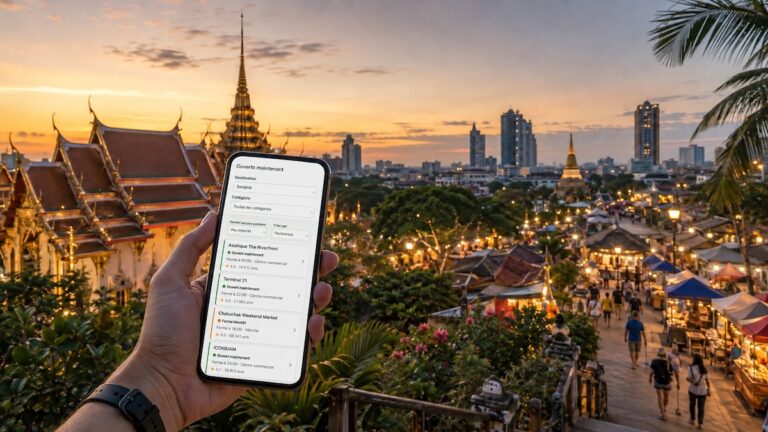
Create your ideal trip with our Thailand itinerary planner. Choose your travel month, trip length, budget, preferred pace and interests to generate a personalised route, including the recommended number of nights in each destination.
The planner is completely free, requires no registration and takes seasonal conditions and travel distances into account.
Plan your Thailand itinerary
How to use the Thailand itinerary planner
The planner works in three steps and helps you create a route that matches your travel preferences.
- Choose your travel month. Conditions can vary considerably between Northern Thailand, the Andaman Sea and the Gulf of Thailand.
- Enter your trip length. The planner distributes the available nights between the different destinations.
- Select your arrival airport. Your route may differ depending on whether you arrive in Bangkok, Phuket, Chiang Mai or another location supported by the tool.
- Choose who you’re travelling with. You can plan a solo trip, a couple’s holiday, a family adventure or a getaway with friends.
- Set your budget. Your preferred budget level helps guide the recommendations.
- Choose your travel pace. A relaxed pace limits the number of stops, while a faster pace allows you to explore more destinations.
- Select your priorities. Beaches, culture, nature, relaxation, food, diving, nightlife and adventure can all influence your suggested itinerary.
You can choose one to three travel priorities. These preferences help the planner select suitable destinations and balance your trip.
Once you’ve entered your preferences, click “Create my itinerary” to generate your personalised route.
How does the itinerary planner work?
The planner compares your preferences with a selection of carefully prepared itineraries based on our destination guides for Thailand. Rather than simply combining cities and islands, it aims to suggest a realistic route that fits your available travel time.
The recommendations take several factors into account:
- Your travel month and the seasonal conditions in different regions.
- The minimum and maximum recommended number of nights in each destination.
- The practicalities of travelling between stops.
- Your budget and preferred travel pace.
- The experiences and activities you want to prioritise.
- Your arrival point in Thailand.
The available nights are then distributed between the selected destinations. Your priorities also influence which places are included and how much time you spend in each location.
For example, an interest in diving may favour destinations known for underwater activities, while a preference for culture may lead to an itinerary featuring more historical cities and temples.
The results may also include general or destination-specific seasonal warnings. These highlight conditions such as extreme heat, heavy rainfall, rough seas or changes in air quality that could affect your plans.
Which Thailand itinerary should you choose for your trip length?
The length of your stay largely determines how many destinations you can reasonably visit. Trying to fit too many stops into a short holiday can leave you spending more time travelling than exploring.
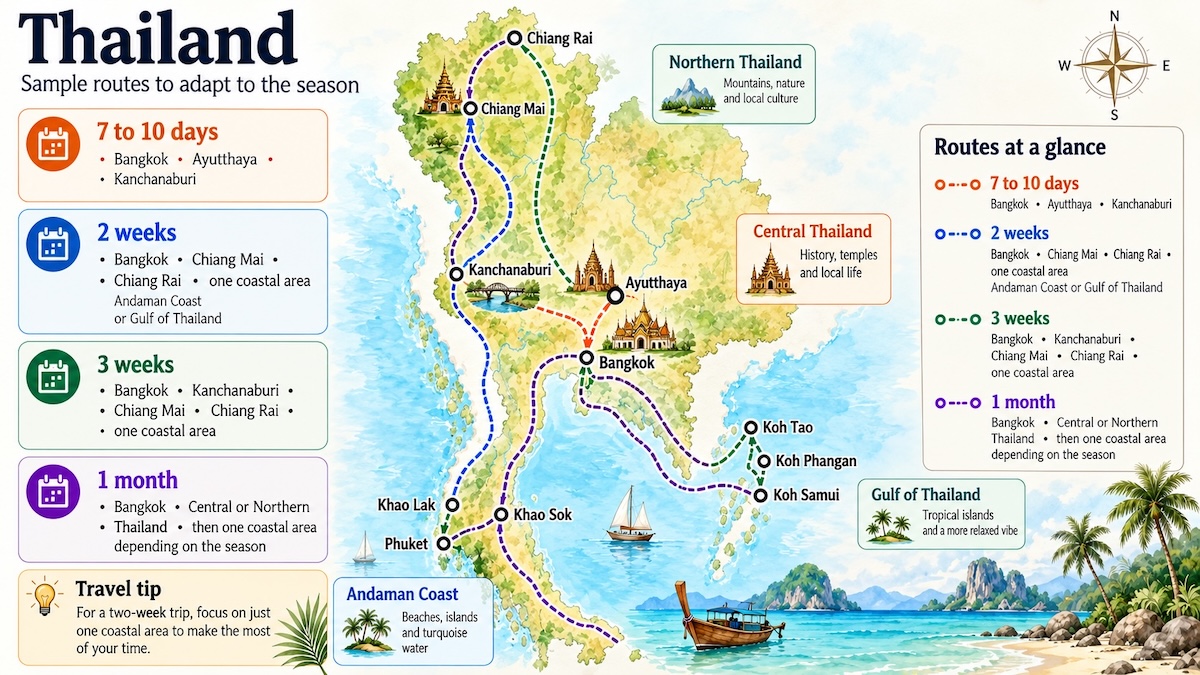
7 to 10 days in Thailand
For a short trip, it’s generally best to focus on one or two regions. Depending on the month and your arrival airport, Bangkok can be combined with Northern Thailand, Phuket, Krabi or Koh Samui.
A 10-day itinerary works best when you limit long transfers and give yourself enough time to enjoy each destination. For ideas on exploring the capital, start with our Bangkok travel guide.
Two weeks in Thailand
Two weeks usually give you enough time to combine Bangkok, a cultural or natural destination and several days by the sea. However, choosing one main coastal region is generally more practical than trying to visit several widely separated islands.
Depending on the season, you might combine the capital with the north and a beach destination, or focus on Bangkok and Southern Thailand.
If you’re considering the Andaman coast, our Krabi travel guide explains what to see around Ao Nang, Railay and the surrounding islands.
Three weeks in Thailand
With three weeks, you can explore several regions while allowing enough time in each destination. A possible route could include Bangkok, Kanchanaburi, Northern Thailand and a final beach stay.
This longer format is particularly useful for combining cultural attractions, nature and relaxation without rushing through every stop.
For a northern stop, our Chiang Mai travel guide provides practical information about temples, markets and excursions in the surrounding mountains.
One month in Thailand
A month in Thailand allows you to discover several sides of the country without maintaining an exhausting travel schedule.
Your itinerary can be adapted to the season, with an emphasis on the Andaman coast, the Gulf islands or a journey focused on Central and Northern Thailand.
The planner includes 30-day itineraries for all 12 months of the year, with different routes designed around seasonal conditions.
If your itinerary includes the Andaman coast, our Phuket travel guide can help you plan your beaches, sightseeing and excursions.
Travelling to Thailand with family
A family itinerary often works best with longer stays in each hotel and fewer consecutive transfers. Easily accessible destinations, calm beaches and activities suitable for children can make the journey more enjoyable.
The planner takes your traveller profile and preferred pace into account, helping you find routes that balance sightseeing, activities and relaxation.
When is the best time to visit Thailand?
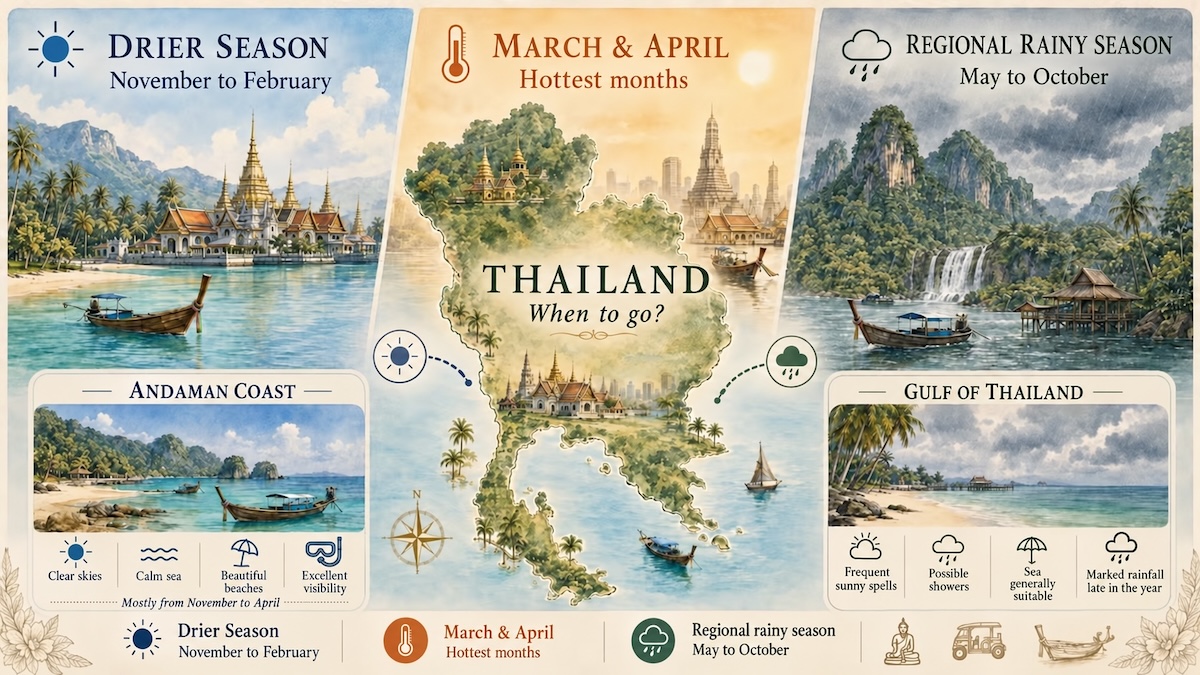
Thailand can be visited throughout the year, but there is no single dry season that applies to every region. Much of the country experiences generally drier weather from November to February, while the Gulf islands, particularly Koh Samui, can receive significant rainfall from October to December. The best region for your itinerary therefore depends on your travel month.
November to February
This is generally one of the most popular periods for visiting Thailand, thanks to more moderate temperatures and drier weather across much of the country. However, the Gulf islands can still experience heavy rainfall in November and sometimes December.
It is also the peak tourist season, with higher visitor numbers and accommodation prices in popular destinations.
January and February are particularly suitable for itineraries combining Bangkok, Northern Thailand, Khao Sok and the Andaman coast.
March and April
Temperatures rise significantly during these months, especially in April. Outdoor sightseeing is often more comfortable early in the morning or later in the afternoon.
Air quality in Northern Thailand can also deteriorate during the agricultural burning season, particularly around Chiang Mai and Chiang Rai.
For this period, the planner may recommend routes focusing on Bangkok, Kanchanaburi, Khao Sok and Southern Thailand rather than spending too much time in the north.
May to October
The rainy season does not mean that it rains continuously. Showers can be short and localised, although their frequency and intensity vary by month and region.
Gulf islands such as Koh Samui, Koh Phangan and Koh Tao can be appealing alternatives during part of the summer. The Andaman Sea is generally more exposed to rainfall and rougher sea conditions, which can lead to reduced ferry services or the cancellation of some boat excursions.
Keep in mind that October can also bring increasingly wet conditions to parts of the Gulf, particularly as the region approaches its late-year rainy period.
For a better understanding of regional differences, read our guide to the rainy season in Thailand.
How to understand your personalised itinerary
The trip length entered in the form refers to the total number of travel days, while the itinerary distributes the nights spent in accommodation.
For example, a 14-day trip includes 13 nights in the planner, while a 30-day journey includes 29 nights.
For each destination, the result may display:
- The recommended number of nights.
- A short introduction to the destination.
- A link to our detailed travel guide, when an English version is available.
- Any seasonal warnings relevant to your selected travel month.
The suggested itinerary is a starting point rather than a fixed programme. You can use it to plan your own route, spending longer in one destination, skipping a stop or changing the travel order according to transport schedules and personal preferences.
You may also need an extra night near your departure airport before an early international flight.
Whenever possible, avoid scheduling a long ferry crossing or domestic flight on the same day as your international departure.
Tips before booking your Thailand itinerary
Check travel times between destinations
Two destinations that appear close together on a map are not always directly connected. Some journeys require a combination of ferries, minivans, trains, buses or domestic flights.
Always check the actual travel time, including transfers and waiting periods, before confirming your route.
Allow extra time before your return flight
Ferries, boat excursions and some domestic flights can be affected by weather conditions.
It’s generally advisable to return to your international departure city at least one day before your flight, particularly after visiting an island.
Book your trip in stages
International flights and some accommodation can be booked well in advance. However, keeping part of your itinerary flexible makes it easier to adjust your plans if the weather changes or you discover somewhere you’d like to stay longer.
This flexibility can be especially useful during the rainy season or when travelling between islands.
Plan your travel budget
Your accommodation standard, travel season, domestic flights and activities will have a significant impact on the overall cost of your trip.
Our Thailand travel budget guide can help you estimate your main expenses before making reservations.
Check entry requirements and travel insurance
Before departure, verify the entry requirements that apply to your nationality, your passport’s validity, any required travel documents and the medical coverage included with your existing insurance or credit card.
Our Thailand travel checklist can help you prepare the essential steps before leaving.
It’s also worth reviewing your medical and travel protection. You can compare available options in our Thailand travel insurance guide.
For official safety information, entry requirements and current travel advisories, consult the UK government’s travel advice for Thailand. Travellers of other nationalities should also check the recommendations issued by their own government.
Frequently asked questions about the itinerary planner
Is the Thailand itinerary planner free?
Yes. The planner is completely free to use, and you don’t need to create an account or register to see your recommended itinerary.
Is the suggested itinerary really personalised?
Yes. The result depends on your travel month, trip length, traveller profile, budget, preferred pace, arrival airport and selected priorities.
The planner selects from carefully prepared editorial itineraries and distributes the available nights according to your preferences. It does not generate an entirely new route using artificial intelligence.
Can I change the suggested itinerary?
Yes. The suggested route is a starting point for organising your trip, not a fixed schedule. You can use it as a reference and adjust the number of nights, destinations or travel order when making your own arrangements.
Remember to check transport connections and seasonal conditions before finalising any changes.
Why are there fewer nights than travel days?
The total number of travel days includes both your arrival and departure days, while the number of nights is generally one fewer.
For example, a 10-day trip includes 9 nights, a 14-day trip includes 13 nights, and a 30-day trip includes 29 nights in the planner.
Can I plan a one-month trip to Thailand?
Yes. The planner includes 30-day itineraries for all twelve months, with routes adapted to seasonal conditions in different regions of Thailand.
Why do some itineraries include seasonal warnings?
Seasonal warnings highlight conditions that may affect certain destinations, such as extreme heat, heavy rain, rough seas, changing ferry conditions, slippery hiking trails or air pollution.
These warnings help you anticipate potential difficulties without automatically ruling out a destination.
Does the planner include transport between destinations?
The planner considers travel distances and the main types of transfer when assessing the overall feasibility of an itinerary.
However, it does not check transport timetables, ticket prices or real-time availability. You should verify these details before booking any journey.
Continue planning your trip to Thailand
Once you’ve found an itinerary that suits your travel style, you can explore the destination guides linked directly in your results, wherever an English guide is available.
To complete your travel preparations, you may also find these resources useful:
- Our maps of Thailand to understand the country’s regions and plan your journey.
- Our guide to Thailand’s weather for a broader overview of regional climate conditions.
- Our free What’s Open Now in Thailand? tool to discover attractions, temples and markets that are open during your stay.
Your itinerary is a useful starting point, but the best trip is one that leaves enough time to enjoy each destination rather than rushing from one place to another.