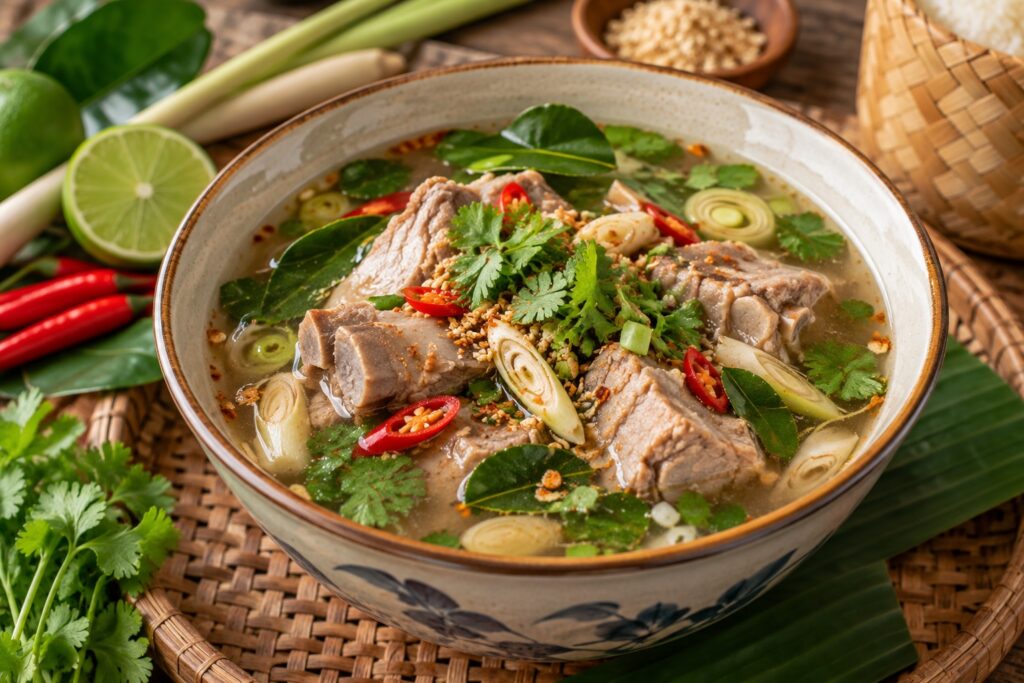
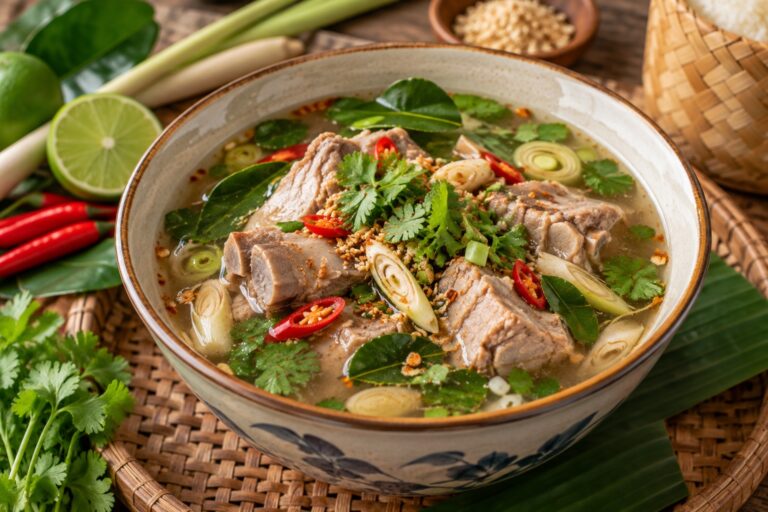
Tom Saap (ต้มแซ่บ) is a clear, hot and sour soup from Isan in northeastern Thailand. It is often made with pork ribs simmered until tender, then flavoured with lemongrass, galangal, makrut lime leaves, shallots, chilli and fresh herbs.
Toasted ground sticky rice, or khao khua, adds the distinctive roasted flavour associated with Isan cooking. Fresh lime juice is added off the heat to preserve its bright, fresh taste.
At the table with Portail Asie
Traditional Tom Saap
Make traditional Tom Saap, a hot and sour Isan soup with pork ribs, lemongrass, galangal, makrut lime leaves, chilli and toasted ground rice.
- Prep time
- 20 min
- Cooking time
- 90 min
- Total time
- 110 min
- Servings
- 4
- Difficulty
- Easy
- Spice level
- 4/5
- Cuisine
- Thailand
- Region
- Isan
- Dish type
- Soup
Last checked: September 24, 2026
About this recipe
Version: Traditional
Tom Saap is an iconic soup from Isan in northeastern Thailand. The pork rib version combines a clear broth flavoured with lemongrass, galangal and makrut lime leaves with a sharp seasoning of lime juice, fish sauce and chilli. Khao khua reinforces its distinctive Isan character.
Do not substitute: Do not add coconut milk: traditional Tom Saap is a clear soup. Do not omit the lime juice or khao khua either, as both are important to the balance and characteristic Isan flavour of the dish.
Ingredients
Adjust servings to suit your needs.
For the soup
- 700 g Pork ribscut into pieces
- 1.5 l Water
- 2 stalks Lemongrassbruised and cut into sections
- 5 slices Galangal
- 5 Makrut lime leavestorn
- 4 Shallotscrushed
- 2 tbsp Fish sauceadjust to taste
- 3 tbsp Fresh lime juiceadd off the heat
- 1 tbsp Toasted ground sticky rice (khao khua)
- 1 tbsp Toasted ground dried chilliadjust to taste
- 2 to 4 Thai bird’s eye chilliescrushed, optional for extra heat
- 2 tbsp Fresh corianderroughly chopped
- 2 tbsp Spring onionsliced
- 4 leaves Culantrosliced, optional but traditional
Preparation steps
Place the pork ribs in a saucepan, cover with cold water and bring to the boil. Boil for 5 minutes, then drain and rinse the ribs to produce a clearer broth.
Return the ribs to a clean saucepan with 1.5 litres of water. Add the lemongrass, galangal, makrut lime leaves and shallots.
Bring to a gentle simmer, skim if necessary, then cook slowly for 60 to 75 minutes, until the meat is tender and beginning to pull away from the bone.
Add the fish sauce and toasted ground dried chilli. Stir and simmer for another 5 minutes.
Remove the saucepan from the heat. Add the fresh lime juice, khao khua and Thai bird’s eye chillies if you want a hotter soup.
Add the coriander, spring onion and culantro. Stir briefly, then taste.
Adjust the balance with a little more fish sauce, lime juice or chilli. Tom Saap should be distinctly sour, salty, herbaceous and spicy.
Serve immediately while piping hot, ideally with sticky rice.
Common mistakes and how to avoid them
The broth is cloudy
Probable cause: The ribs were boiled too vigorously or were not blanched first.
Solution: Blanch them for a few minutes, rinse them, then continue cooking at a gentle simmer.
The meat remains tough
Probable cause: The simmering time is too short.
Solution: Continue cooking over low heat until the meat begins to pull easily away from the bone.
The soup lacks acidity
Probable cause: There is not enough lime juice or it was added too early.
Solution: Gradually add fresh lime juice off the heat until the soup has a pronounced sourness.
The soup is too spicy
Probable cause: Too much ground chilli or too many bird’s eye chillies were added.
Solution: Add a little unseasoned broth, then readjust the fish sauce and lime juice.
The khao khua forms lumps
Probable cause: Too much was added at once or it was not stirred in properly.
Solution: Add it gradually while stirring just before serving.
Portail Asie tips
Simmer the pork ribs gently to keep the meat tender and the broth clear. Add the lime juice only after removing the soup from the heat to preserve its fresh flavour. Add the khao khua and toasted chilli towards the end, starting with a small amount and adjusting to taste. Tom Saap should remain a clear, highly aromatic soup with pronounced sourness and heat.
Substitutions and alternatives
- Pork ribs
- You can use pork cartilage or bone-in pork shoulder. Pork ribs remain the most classic version.
- Culantro
- If unavailable, use additional fresh coriander. The aroma will be slightly different.
- Toasted ground dried chilli
- Use toasted chilli flakes if Thai chilli powder is unavailable.
- Toasted ground sticky rice (khao khua)
- It is best not to replace it, as it provides the characteristic toasted flavour of Isan-style Tom Saap.
Watch the preparation
The video is loaded from YouTube after you click.
Order this dish in Thailand
Thai name:ต้มแซ่บกระดูกหมู
Say it simply:Tom Saap Kradook Moo
Show this:ขอต้มแซ่บกระดูกหมูหนึ่งที่ครับ/ค่ะ
Meaning:One pork rib Tom Saap, please.
Where to find the ingredients
Lemongrass, galangal, makrut lime leaves, sticky rice and fish sauce are available in most Asian grocery stores. Khao khua can also be made at home by dry-toasting uncooked sticky rice and grinding it into a powder.