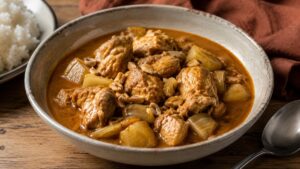
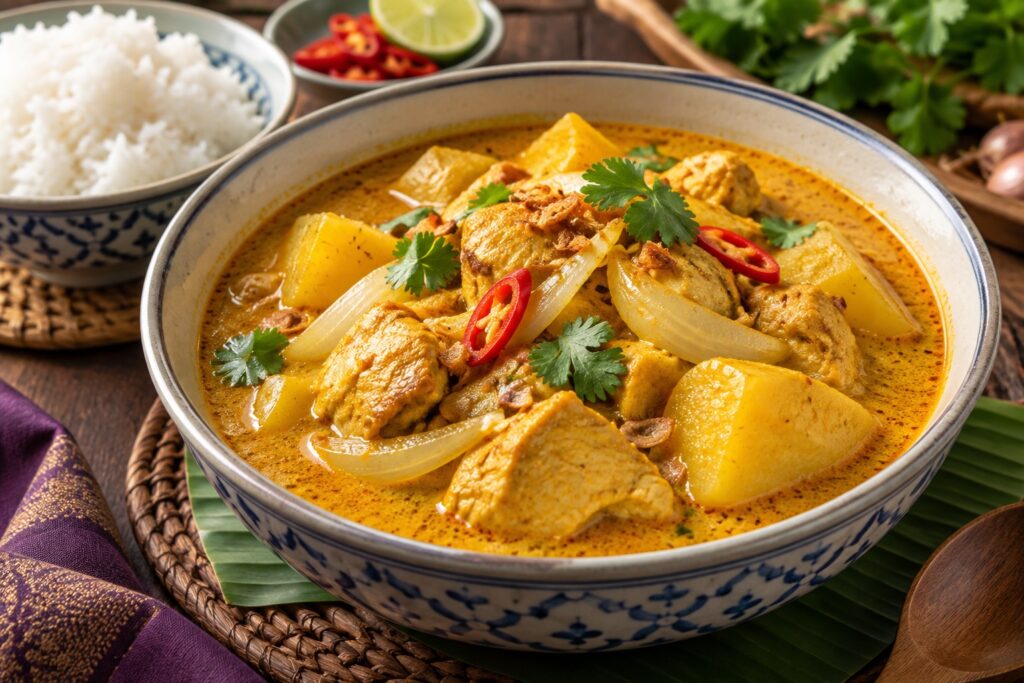
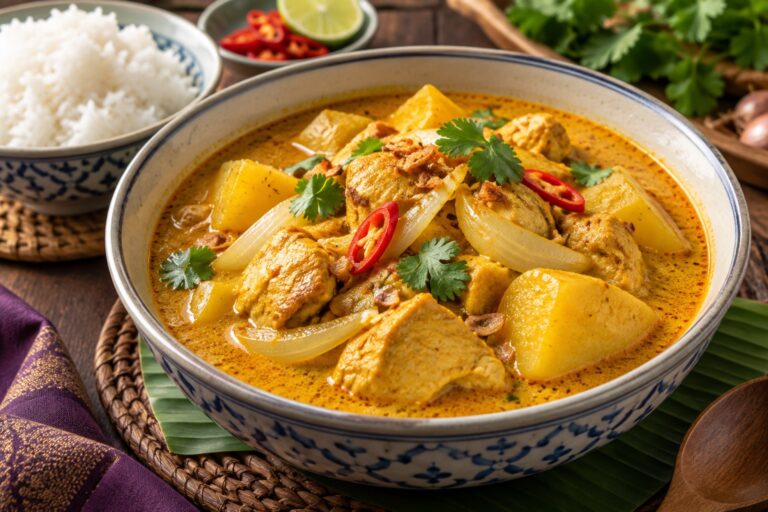
Thai yellow curry with chicken, or Gaeng Kari Gai (แกงกะหรี่ไก่), is one of Thailand’s milder curries. It is characterised by yellow curry paste flavoured with turmeric and dried spices, combined with a rich coconut milk sauce.
This traditional version combines chicken with potatoes and onion, then balances the sauce with fish sauce, palm sugar and a light touch of tamarind. Serve it with jasmine rice.
At the table with Portail Asie
Thai Yellow Curry with Chicken
Make a traditional Thai yellow curry with chicken, coconut milk, potatoes, onion, yellow curry paste, fish sauce, palm sugar and tamarind.
- Prep time
- 20 min
- Cooking time
- 60 min
- Total time
- 80 min
- Servings
- 4
- Difficulty
- Easy
- Spice level
- 2/5
- Cuisine
- Thailand
- Dish type
- Curry
Last checked: September 23, 2026
About this recipe
Version: Traditional
Gaeng Kari is a mild Thai coconut milk curry characterised by turmeric and dried spices in the curry paste. In Thailand, it is particularly associated with Thai Muslim communities and is commonly prepared with chicken or beef, potatoes and onion.
Do not substitute: Do not confuse Gaeng Kari with Southern Thai Gaeng Lueang, which is a sour, very spicy yellow curry made without coconut milk. Also avoid relying on curry powder alone: Thai yellow curry paste is the base of the dish.
Ingredients
Adjust servings to suit your needs.
For the curry
- 5 to 6 tbsp Thai yellow curry pasteadjust according to the brand and desired heat level
- 900 g Chicken thighspreferably bone-in
- 480 ml Coconut milkfull-fat, unsweetened
- 300 g Potatoeswaxy, cut into chunks
- ½ Onionsliced
- 240 ml Waterapproximately, adjust as needed
- 1 to 2 tbsp Fish sauceadjust at the end of cooking
- 1½ tbsp Palm sugarfinely chopped
- 1 to 2 tbsp Tamarind pastebrown and runny, Thai- or Vietnamese-style
- 100 g Cherry tomatoesoptional
To serve
- Thai jasmine ricecooked
- Fried shallotsoptional
Preparation steps
Pour about 180 ml of coconut milk into a saucepan and bring to a gentle simmer. Add the yellow curry paste and mix thoroughly.
Cook the curry paste over medium heat, stirring, until the mixture thickens considerably and becomes very aromatic. Depending on the coconut milk used, a little oil may begin to separate.
Add the remaining coconut milk, the chicken, 1 tablespoon of fish sauce, 1 tablespoon of palm sugar and 1 tablespoon of tamarind paste.
Add just enough water for the chicken to be almost submerged. Bring to a gentle simmer and cook slowly for about 30 minutes.
Add the potatoes and onion. Continue cooking for about 15 minutes, or until the chicken is tender and the potatoes are fully cooked.
If using cherry tomatoes, lightly prick them and add them near the end of cooking so they heat through without bursting.
Taste and adjust with the remaining fish sauce, palm sugar or tamarind. The curry should be mild, savoury, slightly sweet and subtly tangy.
Serve hot with jasmine rice and, if desired, a few fried shallots.
Common mistakes and how to avoid them
The curry lacks aroma
Probable cause: The curry paste was diluted too quickly.
Solution: Cook it first in a small amount of coconut milk until it thickens and becomes very aromatic.
The sauce is too salty
Probable cause: The curry paste already contained a lot of salt and too much fish sauce was added.
Solution: Add the fish sauce gradually and always taste before making the final adjustment.
The potatoes fall apart
Probable cause: They were cooked for too long or are too floury.
Solution: Use waxy potatoes and add them after the chicken has completed its initial simmer.
The chicken remains tough
Probable cause: The curry was simmered for too little time or at too high a heat.
Solution: Simmer gently until the meat is tender without allowing the curry to boil vigorously.
The curry is too spicy
Probable cause: The curry paste used is hotter than expected.
Solution: Start with less curry paste and increase gradually. You can also add a little more coconut milk.
Portail Asie tips
Cook the curry paste in part of the coconut milk before adding the rest, as this develops the aromas. Commercial curry pastes vary considerably in salt and heat, so start with the lower amount. Add the fish sauce gradually towards the end of cooking. Use waxy potatoes so they keep their shape during simmering.
Substitutions and alternatives
- Bone-in chicken thighs
- Boneless chicken thighs also work. Reduce the cooking time slightly.
- Palm sugar
- If unavailable, use coconut sugar or a small amount of light brown sugar.
- Tamarind paste
- It provides the characteristic acidity. If you cannot find it, use a smaller amount rather than replacing it with vinegar.
- Yellow curry paste
- Use a Thai paste labelled “yellow curry” or “karee curry”. Avoid pastes labelled “yellow sour curry”, which are used for a different Thai curry.
Watch the preparation
The video is loaded from YouTube after you click.
Order this dish in Thailand
Thai name:แกงกะหรี่ไก่
Say it simply:Gaeng Kari Gai
Show this:ขอแกงกะหรี่ไก่หนึ่งที่ครับ/ค่ะ
Meaning:One yellow chicken curry, please.
Where to find the ingredients
Thai yellow curry paste, coconut milk, fish sauce, palm sugar and tamarind are available in most Asian grocery stores. Check the curry paste label carefully: “yellow curry” or “karee curry” is suitable, while “yellow sour curry” is used for a different Thai curry.