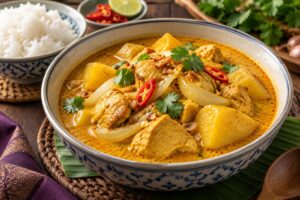
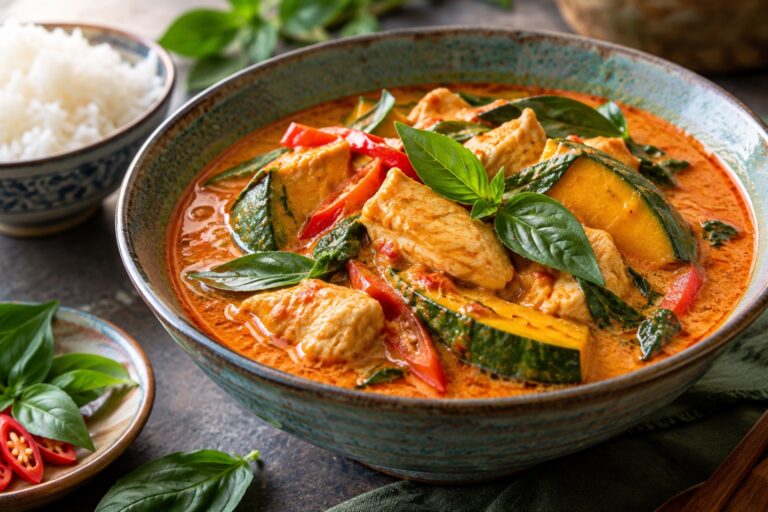
Thai red curry with chicken, or Gaeng Phet Gai (แกงเผ็ดไก่), is a classic Thai curry. Red curry paste, coconut milk, fish sauce and palm sugar create a rich sauce that balances heat, saltiness and a touch of sweetness.
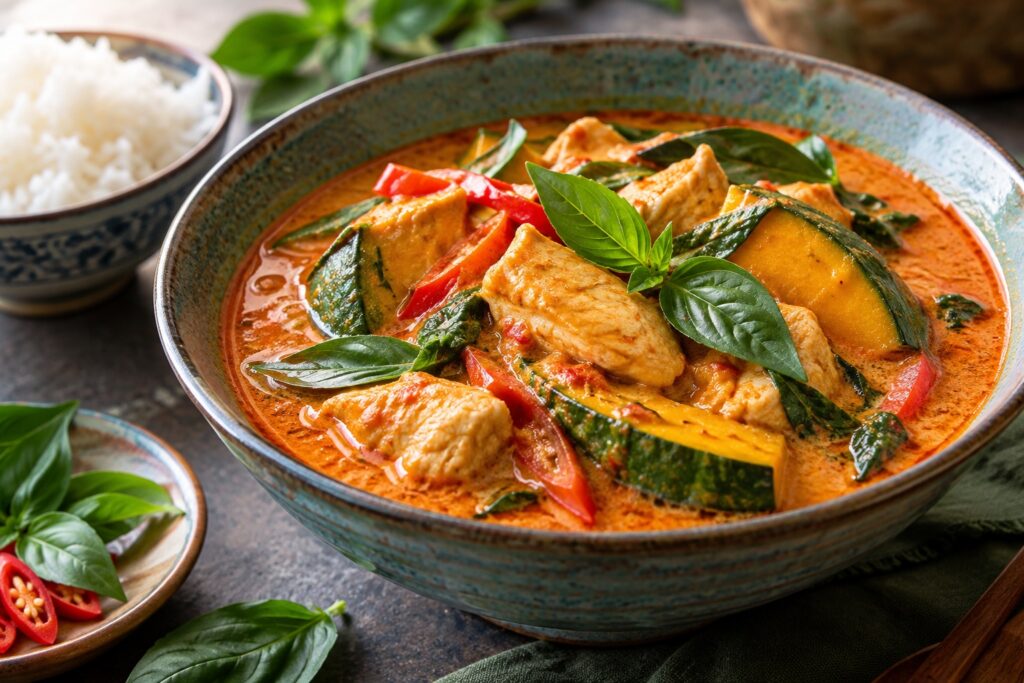
This version combines chicken with kabocha squash, whose natural sweetness works particularly well with red curry. Serve it with jasmine rice and finish with fresh Thai basil.
At the table with Portail Asie
Thai Red Curry with Chicken
Make Thai red curry with chicken, coconut milk, red curry paste, kabocha squash and Thai basil for a rich and aromatic classic Thai curry.
- Prep time
- 20 min
- Cooking time
- 25 min
- Total time
- 45 min
- Servings
- 4
- Difficulty
- Easy
- Spice level
- 3/5
- Cuisine
- Thailand
- Region
- Central Thailand
- Dish type
- Curry
Last checked: September 22, 2026
About this recipe
Version: Traditional
Gaeng Phet is a Thai red curry based on red curry paste and coconut milk. Chicken can be combined with different vegetables depending on the recipe; kabocha squash is a classic pairing whose sweetness balances the heat of the curry paste.
Do not substitute: Red curry paste, coconut milk, fish sauce and Thai basil define the character of the dish. Avoid adding cream, curry powder or thickeners, which would significantly change the result.
Ingredients
Adjust servings to suit your needs.
For the curry
- 350 g Kabocha squashcut into medium-sized pieces
- 400 ml Coconut milkfull-fat, good quality
- 3½ to 5 tbsp Thai red curry pastedepending on the brand and desired heat level
- 450 g Boneless chicken thighskinless, cut into pieces
- 240 ml Chicken stockunsalted or low-sodium
- 2 tbsp Fish sauceadjust at the end of cooking
- 2 to 3 tbsp Palm sugarfinely chopped
- 1 cup Thai basil leaves
- ¼ Red bell pepperthinly sliced, optional for color
To serve
- Thai jasmine ricecooked
Preparation steps
Wash the kabocha squash, remove the seeds and any damaged parts of the skin, then cut it into evenly sized pieces. The edible skin can be left on.
Pour about one third of the coconut milk into a saucepan or wok and bring to a simmer. Add the red curry paste and stir until smooth.
Continue cooking over medium-high heat for a few minutes, stirring regularly, until the mixture becomes very thick and fragrant. Depending on the coconut milk, some oil may begin to separate.
Add the chicken pieces and stir to coat them thoroughly with the curry paste. Pour in the remaining coconut milk and the chicken stock.
Add about half of the fish sauce and the palm sugar. Stir and simmer over medium heat for about 8 minutes.
Add the kabocha squash and continue cooking for 6–8 minutes, until it is tender when pierced with a fork but still holds its shape.
Taste the sauce and gradually add the remaining fish sauce if needed. The curry should be well seasoned enough to serve with plain jasmine rice.
Remove from the heat, add the Thai basil and the red bell pepper if using. Stir briefly and serve immediately with jasmine rice.
Common mistakes and how to avoid them
The curry lacks depth
Probable cause: The curry paste was diluted too quickly in all the liquids.
Solution: Cook the paste first with a small amount of coconut milk until the mixture is thick and very fragrant.
The sauce is too thin
Probable cause: The coconut milk did not reduce enough or too much stock was added.
Solution: Simmer uncovered for a few more minutes before adding the final ingredients.
The curry is too salty
Probable cause: The curry paste was already very salty and all the fish sauce was added at the beginning.
Solution: Add only part of the fish sauce first, then taste before the final adjustment.
The squash falls apart
Probable cause: It was cut too small or cooked for too long.
Solution: Cut evenly sized, fairly large pieces and stop cooking as soon as they are tender throughout.
The chicken is dry
Probable cause: Chicken breast cooked too long or the pieces were too small.
Solution: Prefer chicken thigh, or significantly reduce the cooking time if using breast.
Portail Asie tips
Cook the curry paste thoroughly in part of the coconut milk before adding the remaining liquids. This develops the aromas and prevents a raw curry-paste flavor. Commercial curry pastes vary in saltiness and heat, so begin with the lower amount and adjust as needed. Add the fish sauce gradually toward the end of cooking. Watch the squash carefully: it should be tender without breaking apart in the sauce.
Substitutions and alternatives
- Kabocha squash
- Thai eggplants or bamboo shoots can be used instead. Simply adjust the cooking time for the vegetable you choose.
- Chicken thigh
- Chicken breast can also be used, but cook it for less time to prevent it from becoming dry. Shrimp can also be used with a very short cooking time.
- Palm sugar
- Use a small amount of light brown sugar if palm sugar is unavailable.
- Thai basil
- Thai basil is preferable. If unavailable, regular basil can be used, although its flavor is different.
Watch the preparation
The video is loaded from YouTube after you click.
Order this dish in Thailand
Thai name:แกงเผ็ดไก่
Say it simply:Gaeng Phet Gai
Show this:ขอแกงเผ็ดไก่หนึ่งที่ครับ/ค่ะ
Meaning:One chicken red curry, please.
Where to find the ingredients
Red curry paste, coconut milk, fish sauce, palm sugar and Thai basil are available in most Asian grocery stores. In Thailand, these ingredients are common in markets and supermarkets. Check the ingredients in the red curry paste, as many traditional Thai curry pastes contain shrimp paste.