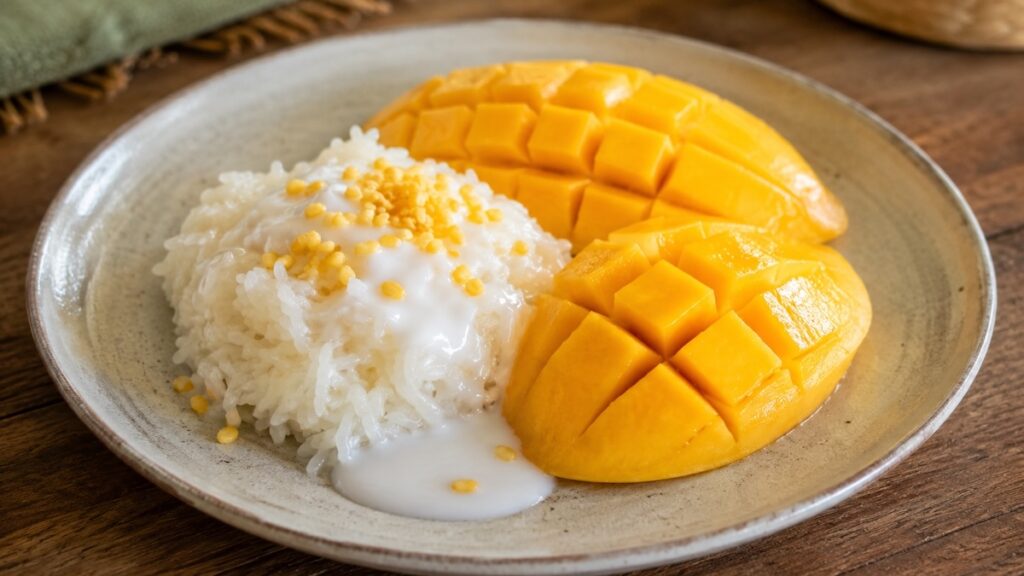
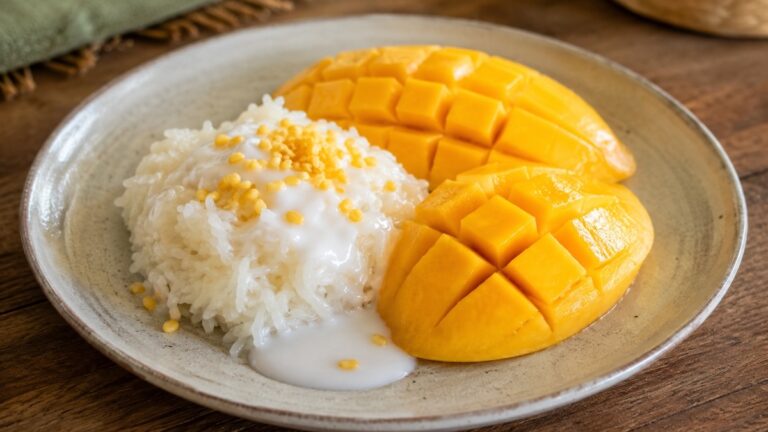
Mango Sticky Rice (ข้าวเหนียวมะม่วง), known in Thai as Khao Niao Mamuang, is one of Thailand’s best-known desserts. It combines steamed sticky rice soaked in sweet coconut milk with ripe mango and a lightly salted coconut sauce.
The recipe uses only a few ingredients, but choosing the right rice and a perfectly ripe mango is essential. Allow at least 4 hours of soaking for the sticky rice before cooking.
At the table with Portail Asie
Mango Sticky Rice
Make Thai Mango Sticky Rice with steamed sticky rice, coconut milk, ripe mango and a lightly salted coconut sauce.
- Prep time
- 15 min
- Cooking time
- 60 min
- Total time
- 75 min
- Servings
- 6
- Difficulty
- Medium
- Spice level
- 0/5
- Cuisine
- Thailand
- Dish type
- Dessert
Last checked: September 4, 2026
About this recipe
Version: Close to traditional
Mango Sticky Rice combines Thai sticky rice that is steamed and soaked with sweetened coconut milk, ripe mango, a lightly salted coconut sauce and often a crunchy mung bean topping.
Do not substitute: Do not replace Thai sticky rice with jasmine rice or sushi rice. They absorb the coconut syrup differently and do not produce the characteristic texture of the dessert.
Ingredients
Adjust servings to suit your needs.
For the coconut sticky rice
- 1 cup Thai white sticky ricelong-grain sticky rice, soaked for at least 4 hours
- 160 ml Coconut milkfull-fat, good quality
- ½ tsp Fine salt
- 100 g White sugar
For the salted coconut sauce
- 120 ml Coconut milk
- ¼ tsp Fine salt
- 1 tsp Rice flouror cornstarch
- 1 tbsp Water
To serve
- 2 tbsp Split yellow mung beansfor crunch
- 3 Ripe sweet mangoesideally Nam Dok Mai, Ok Rong or Ataulfo
Preparation steps
Rinse the sticky rice 4–5 times, until the water is almost clear. Soak it in plenty of room-temperature water for at least 4 hours, or overnight.
Drain the rice very thoroughly. Place it on a damp thin cloth in a steamer basket, then steam over boiling water for 20–25 minutes, until tender and translucent.
While the rice is steaming, prepare the coconut syrup: combine 160 ml coconut milk, the sugar and ½ teaspoon salt in a saucepan. Heat until it just begins to simmer, then remove from the heat without reducing it.
As soon as the rice is cooked, transfer it to a bowl and pour the hot coconut syrup over it. Gently mix to break up any clumps, cover and let rest for 20 minutes.
After 20 minutes, gently lift the rice from the bottom to redistribute the liquid. Cover again and let rest for at least another 20 minutes, until all the coconut syrup has been absorbed.
Prepare the salted coconut sauce: mix the rice flour with the water. Combine with 120 ml coconut milk and ¼ teaspoon salt, then heat while stirring until it reaches a boil. Remove from the heat and let cool; the sauce will thicken as it cools.
Rinse the mung beans, cover them with water and bring just to a simmer. Immediately remove from the heat, cover for 10 minutes, then drain, rinse with cold water and dry. Toast them in a lightly oiled pan until dry, crisp and lightly golden.
Peel the mangoes and slice the flesh. Serve the sticky rice with the mango, spoon over a little salted coconut sauce and sprinkle with the crispy mung beans.
Common mistakes and how to avoid them
The rice remains hard in the center
Probable cause: The rice was not soaked long enough or was not steamed long enough.
Solution: Soak the rice for at least 4 hours and steam it slightly longer until the grains are tender.
The rice becomes mushy or waterlogged
Probable cause: The rice was cooked in too much water or the coconut syrup ratio was incorrect.
Solution: Steam the rice only, drain it thoroughly after soaking and use the specified amount of coconut syrup.
The rice does not absorb the coconut milk properly
Probable cause: The rice or coconut syrup was not hot enough when combined.
Solution: Pour the very hot coconut syrup over the rice immediately after steaming, then cover it at once.
Portail Asie tips
Sticky rice must be steamed rather than cooked like regular rice in a pot of water. Both the rice and the coconut syrup should be very hot when combined so the liquid is absorbed properly. Do not reduce the coconut syrup while heating it. Use a perfectly ripe mango, as its quality has a major impact on the final result. The stated preparation time does not include the minimum 4-hour soaking time.
Substitutions and alternatives
- Thai white sticky rice
- Use Thai long-grain sticky rice, sometimes sold as sticky rice, sweet rice or glutinous rice. Jasmine rice, sushi rice and regular short-grain rice do not produce the same texture.
- Thai mangoes
- Choose a very ripe, sweet, juicy and low-fiber mango. Ataulfo or Manila mangoes are good alternatives outside Thailand.
- Rice flour
- A small amount of cornstarch can thicken the coconut sauce in a similar way.
- Crispy mung beans
- They can be omitted, but they provide a pleasant crunchy contrast that is common with this dessert.
Watch the preparation
The video is loaded from YouTube after you click.
Order this dish in Thailand
Thai name:ข้าวเหนียวมะม่วง
Say it simply:Khao Niao Mamuang
Show this:ข้าวเหนียวมะม่วง 1 ที่
Meaning:One Mango Sticky Rice.
Where to find the ingredients
Thai sticky rice, coconut milk and split yellow mung beans are available in Asian grocery stores and Thai supermarkets. Make sure the rice is Thai long-grain sticky rice. For the mangoes, choose very sweet, low-fiber varieties; in Thailand, Nam Dok Mai and Ok Rong are particularly well suited to this dessert.