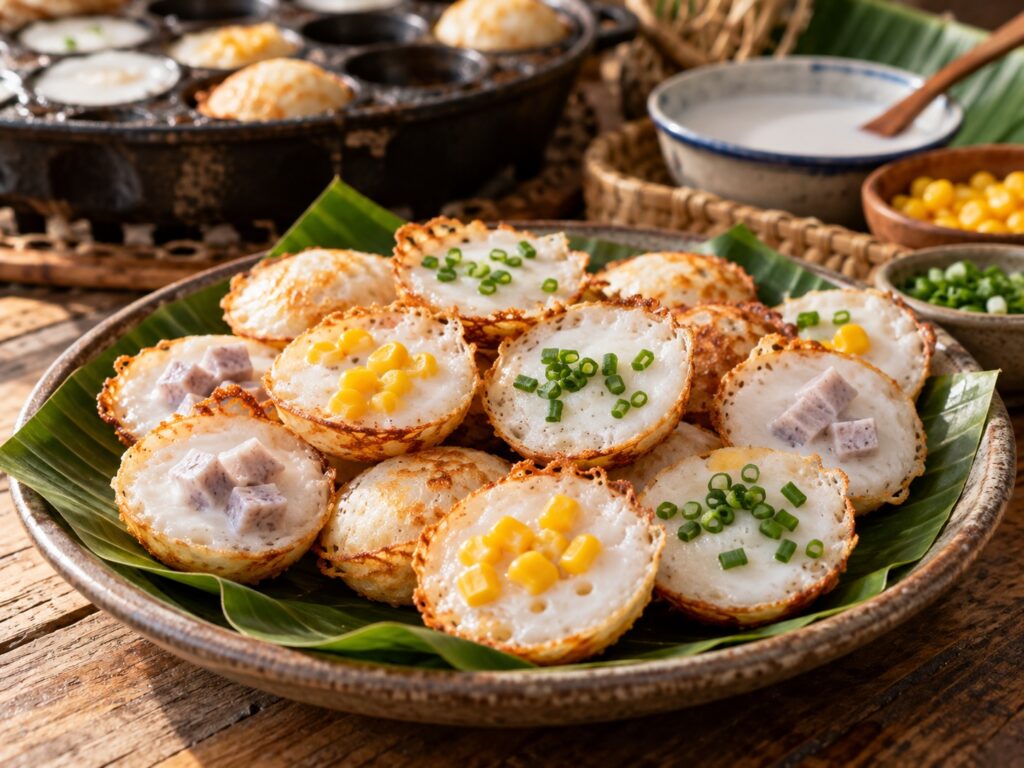
Khanom Krok (ขนมครก), also spelled Kanom Krok, is a classic Thai street-food snack. These small rice and coconut pancakes are cooked in a special dimpled pan, giving them a golden, crisp base and a soft, creamy, slightly sweet centre.
The traditional version uses two mixtures: a rice batter for the outer shell and a richer coconut milk topping for the centre. They can be served plain or topped with spring onion, sweetcorn or small pieces of taro.
At the table with Portail Asie
Traditional Khanom Krok
Make traditional Khanom Krok, small Thai coconut pancakes with a crisp golden base and a soft, creamy centre.
- Prep time
- 20 min
- Cooking time
- 25 min
- Total time
- 45 min
- Servings
- 6
- Difficulty
- Medium
- Spice level
- 0/5
- Cuisine
- Thailand
- Dish type
- Dessert
Last checked: September 23, 2026
About this recipe
Version: Traditional
Khanom Krok is a widely enjoyed Thai dessert and street-food snack. The traditional version combines a batter made with rice, rice flour and coconut milk with a richer coconut milk centre. The characteristic texture is crisp underneath and soft, almost creamy, in the middle.
Do not substitute: Do not use wheat flour as the main flour and do not use glutinous rice flour. Khanom Krok should also not be cooked like flat pancakes: their small cup-like shape is an important part of their characteristic texture.
Ingredients
Adjust servings to suit your needs.
For the crispy shell
- 50 g Cooked jasmine ricecooled
- 50 g Thai rice flournon-glutinous
- 240 ml Water
- 60 ml Coconut milkfull-fat, good quality
- 60 ml Unsweetened grated coconutdried or fresh
- 30 g Palm sugarfinely chopped
- ¼ tsp Salt
For the coconut centre
- 240 ml Coconut milkfull-fat
- 2 tbsp White sugaradjust to taste
- ¼ tsp Salt
- 2 tbsp Thai rice flournon-glutinous
For cooking and toppings
- Coconut oil or neutral oilfor greasing the pan
- Spring onionfinely sliced, classic topping
- Cooked sweetcornoptional
- Cooked tarocut into very small cubes, optional
Preparation steps
Prepare the shell batter: place the cooked jasmine rice, rice flour, water, coconut milk, grated coconut, palm sugar and salt in a blender. Blend until smooth.
Prepare the coconut centre: combine the rice flour, white sugar and salt, then gradually whisk in the coconut milk until smooth.
Prepare the toppings. If using taro, cook it first and cut it into very small cubes. Drain the sweetcorn well and finely slice the spring onion.
Heat a Khanom Krok pan or takoyaki pan over medium heat. When the pan is thoroughly hot, lightly grease each cavity with oil.
Stir the shell batter, then pour about ½ tablespoon into each cavity. Stir the coconut topping and add about 1 teaspoon to the centre of each pancake.
Cook for 1 to 2 minutes, then add your chosen toppings as the surface begins to set: spring onion, sweetcorn or taro.
Continue cooking for about 5 minutes, until the bottoms are golden and crisp and the tops are no longer liquid. If necessary, cover the pan for 1 to 2 minutes to finish cooking the centres.
Carefully remove the Khanom Krok with a small spoon or wooden pick. Let them rest for a few minutes on a wire rack, then serve while still warm, crisp on the outside and soft in the centre.
Common mistakes and how to avoid them
The bottoms are not crispy
Probable cause: The pan was not hot enough or the pancakes were removed too early.
Solution: Preheat the pan thoroughly and continue cooking until the bottoms are clearly golden.
The centres remain liquid
Probable cause: The heat is too high or too much coconut topping was added.
Solution: Reduce the heat slightly and cover the pan for 1 to 2 minutes to finish cooking the tops.
The Khanom Krok stick to the pan
Probable cause: The cavities were not greased sufficiently or the pan is not well seasoned.
Solution: Lightly grease each cavity before cooking and use a well-seasoned or non-stick pan.
The pancakes soften too quickly
Probable cause: They were stacked or left sitting for too long after cooking.
Solution: Place them on a wire rack and serve them warm without stacking them.
The batter becomes too thick or uneven
Probable cause: The rice flour settled at the bottom while the batter was resting.
Solution: Stir both mixtures thoroughly before each batch.
Portail Asie tips
Stir both mixtures before each batch because rice flour tends to settle. The pan should be thoroughly hot before adding the batter to create a crisp base. Do not remove the Khanom Krok too early: the bottoms should be deeply golden. Serve them quickly because they soften as they cool. Spring onion is one of the most traditional toppings, and its slightly savoury flavour balances the sweetness of the coconut milk particularly well.
Substitutions and alternatives
- Thai rice flour
- Use regular non-glutinous rice flour. Avoid glutinous rice flour, which produces a different texture.
- Palm sugar
- If unavailable, use white sugar or coconut sugar, although the flavour will be slightly different.
- Khanom Krok pan
- A takoyaki pan works very well at home. However, the cavities should not be too large.
- Dried grated coconut
- Freshly grated coconut can be used if available.
Watch the preparation

The video is loaded from YouTube after you click.
Order this dish in Thailand
Thai name:ขนมครก
Say it simply:Kha-nom Krok
Show this:ขอขนมครกหนึ่งชุดครับ/ค่ะ
Meaning:One serving of Khanom Krok, please.
Where to find the ingredients
Thai rice flour, coconut milk, palm sugar and taro are available in most Asian grocery stores. For cooking, a traditional Khanom Krok pan is ideal, while a takoyaki pan is an excellent alternative for home use.