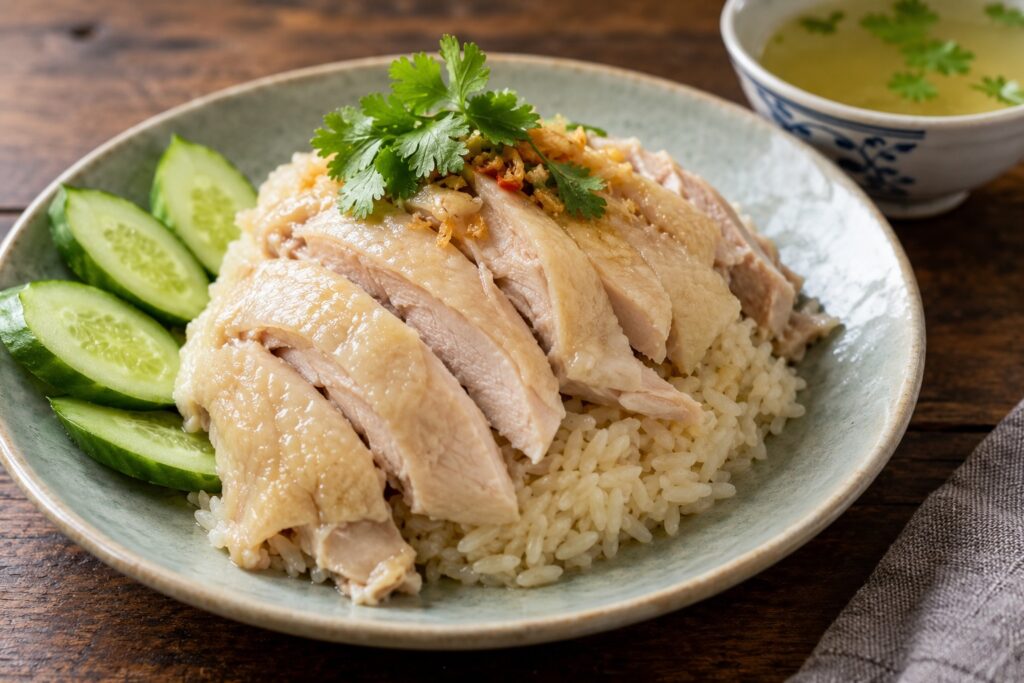
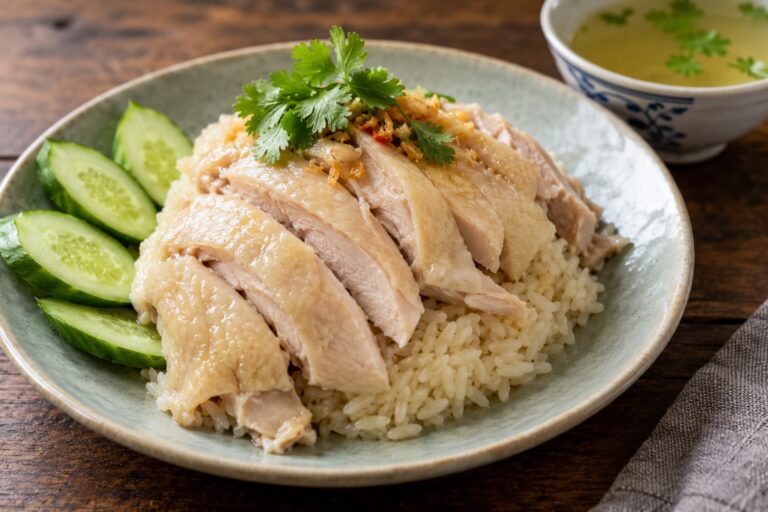
Khao Man Gai (ข้าวมันไก่) is one of Thailand’s classic street-food dishes. Thailand’s take on Hainanese chicken rice combines tender poached chicken, jasmine rice cooked in aromatic broth, and a punchy sauce made with fermented soybean paste, ginger and chili.
The character of the dish comes as much from the rice as from the chicken: traditionally, the rice is cooked with chicken broth and rendered chicken fat. Served with cucumber, a spicy dipping sauce and a small bowl of broth, Khao Man Gai looks simple but is deeply flavorful.
At the table with Portail Asie
Traditional Khao Man Gai
Make Khao Man Gai, Thailand’s classic chicken rice with tender poached chicken, fragrant jasmine rice and a ginger-chili fermented soybean sauce.
- Prep time
- 25 min
- Cooking time
- 65 min
- Total time
- 90 min
- Servings
- 4
- Difficulty
- Medium
- Spice level
- 2/5
- Cuisine
- Thailand
- Dish type
- Main dish
Last checked: September 22, 2026
About this recipe
Version: Close to traditional
Khao Man Gai is Thailand’s adaptation of Hainanese chicken rice. In Thailand, it is distinguished by jasmine rice cooked with chicken broth and chicken fat, together with a dipping sauce made from tao jiew, ginger, garlic and chili. It is typically served with cucumber and a small bowl of broth.
Do not substitute: If you want the characteristic flavor of the dish, avoid cooking the rice in plain water. The Thai fermented soybean dipping sauce should also not simply be replaced with sweet chili sauce.
Ingredients
Adjust servings to suit your needs.
For the chicken and broth
- 1 Whole chickenabout 1.3–1.5 kg
- 2.5 L Wateror enough to cover the chicken
- 40 g Fresh gingersliced
- 4 cloves Garliclightly crushed
- 3 Cilantro rootsor 6 cilantro stems
- 1 Onionroughly chopped
- 1 tsp White peppercornscoarsely crushed
- 1½ tsp Fine saltadjust to taste
For the rice
- 300 g Thai jasmine ricerinsed and well drained
- 2 tbsp Chicken fatreserved from the chicken; use neutral oil if unavailable
- 3 cloves Garlicfinely chopped
- 450 ml Chicken brothreserved from the poaching liquid
Thai dipping sauce
- 3 tbsp Tao jiewThai fermented soybean paste
- 2 tbsp Fresh gingerfinely chopped
- 2 cloves Garlicfinely chopped
- 1–3 Thai chilieschopped, to taste
- 1 tbsp Light soy sauce
- 1 tsp Dark soy saucefor color and deeper flavor
- 1 tbsp Rice vinegar or mild white vinegar
- 1 tbsp Sugaradjust to taste
- 2 tbsp Chicken brothto loosen the sauce if needed
To serve
- 1 Cucumbersliced
- Fresh cilantrooptional
- Chicken brothserved hot on the side
Preparation steps
Trim any excess fat from around the chicken cavity and neck and reserve the fat for the rice. Pat the chicken dry.
Place the water, ginger, garlic, cilantro roots, onion, white pepper and salt in a large pot. Bring to a gentle simmer, then lower the chicken into the broth. The liquid should almost completely cover the chicken.
Keep the broth at a very gentle simmer for about 35–45 minutes, depending on the size of the chicken. Avoid a hard boil, which can make the meat firmer and drier. Make sure the chicken is fully cooked through before removing it.
Remove the chicken and let it rest. Strain the broth and reserve some for cooking the rice and preparing the sauce. Keep the remaining broth hot to serve alongside the dish.
Render the chicken fat in a saucepan or rice-cooker pot. Add the garlic and cook gently until fragrant, without letting it burn.
Add the rinsed and well-drained jasmine rice. Stir for 1–2 minutes to coat the grains in the chicken fat and garlic, then add about 450 ml of broth. Cook as you would regular jasmine rice, either in a saucepan or rice cooker.
Make the sauce by mixing the tao jiew, ginger, garlic, chilies, light soy sauce, dark soy sauce, vinegar and sugar. Add a little broth if the sauce is too thick. Taste and adjust the balance of salty, sour, sweet and spicy flavors.
Debone or cut the chicken into even pieces. Keep the skin on for a more traditional presentation if you like, then arrange the chicken over the hot rice.
Serve the Khao Man Gai with the dipping sauce on the side, sliced cucumber, optional fresh cilantro and a small bowl of hot chicken broth.
Common mistakes and how to avoid them
The chicken is dry
Probable cause: The broth boiled too vigorously or the chicken cooked for too long.
Solution: Keep the broth at only a gentle simmer and adjust the cooking time to the size of the chicken. Remove it as soon as it is cooked through.
The rice lacks flavor
Probable cause: It was cooked with water or a weak broth and without chicken fat.
Solution: Sauté the rice with chicken fat and garlic, then cook it in the chicken poaching broth.
The rice turns mushy
Probable cause: There is too much liquid, or the rice was not drained thoroughly after rinsing.
Solution: Drain the rice thoroughly and measure the broth carefully. If your rice is very fresh or your rice cooker loses little moisture, slightly reduce the amount of liquid.
The sauce is too salty
Probable cause: Tao jiew and soy sauces are already very salty.
Solution: Add the soy sauces gradually and loosen the sauce with a little broth, vinegar or sugar depending on the balance you need.
The sauce tastes flat
Probable cause: It needs more fresh ginger, acidity or chili.
Solution: Adjust it at the end with chopped fresh ginger, a little vinegar and fresh chili rather than simply adding more salt.
Portail Asie tips
Poach the chicken at a very gentle simmer: a hard boil can dry out the meat and make the skin more fragile. For truly fragrant rice, cook it with the chicken broth and, if possible, rendered chicken fat. The tao jiew sauce is an essential part of the Thai version, so taste it before serving because fermented soybean pastes vary considerably in saltiness between brands. Serve the rice piping hot; the chicken can be slightly warm rather than hot.
Substitutions and alternatives
- Whole chicken
- You can use skin-on, bone-in chicken thighs for a simpler version, although the broth will usually be less rich than when using a whole chicken.
- Tao jiew
- Chinese fermented soybean paste or a fairly salty miso can work in a pinch, but the flavor will differ from the traditional Thai sauce.
- Chicken fat
- Use a neutral oil if necessary, but the rice will lose some of the characteristic flavor of Khao Man Gai.
- Cilantro roots
- Use the thick cilantro stems instead, which are easier to find outside Thailand.
Watch the preparation
The video is loaded from YouTube after you click.
Order this dish in Thailand
Thai name:ข้าวมันไก่
Say it simply:Khao mun gai
Show this:ขอข้าวมันไก่หนึ่งที่ครับ/ค่ะ
Meaning:One Khao Man Gai, please.
Where to find the ingredients
Jasmine rice, soy sauces, ginger and chilies are easy to find in most supermarkets. Tao jiew, the Thai fermented soybean paste used in the dipping sauce, is more commonly available at Asian grocery stores. In Thailand, it is widely sold in supermarkets and markets. Cilantro roots can be difficult to find outside Thailand; use the thicker cilantro stems instead.