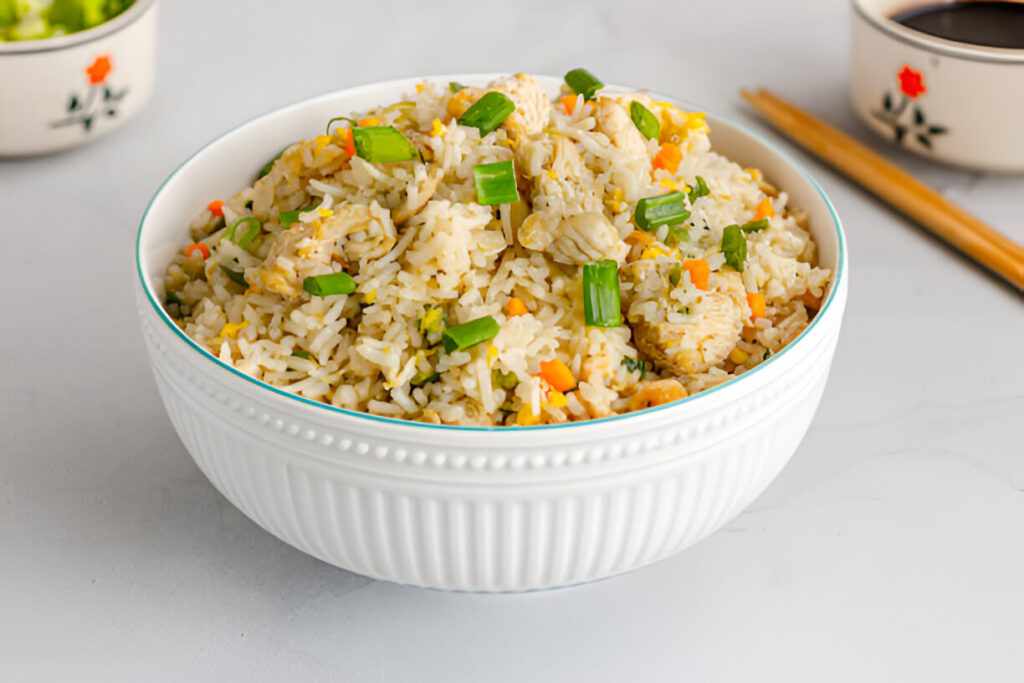
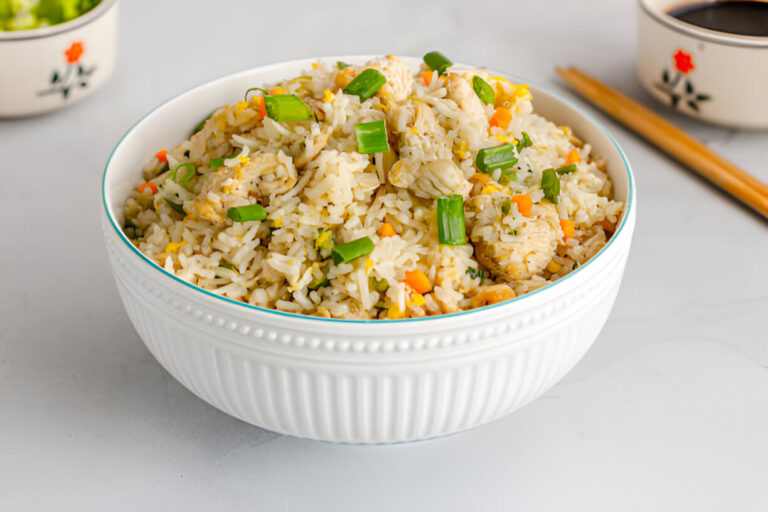
Khao Pad (ข้าวผัด) is Thailand’s classic fried rice dish, found everywhere from street food stalls to local restaurants. It combines jasmine rice, eggs, garlic and vegetables with a savoury seasoning made from fish sauce and soy sauce. Chicken, pork, prawns or crab can be used depending on the variation.
This Khao Pad recipe uses chicken and cold cooked jasmine rice, which helps the grains stay separate during stir-frying. The key is to work quickly in a hot wok, avoid adding too much sauce and serve the fried rice immediately with fresh cucumber and lime.
At the table with Portail Asie
Thai Fried Rice (Khao Pad)
Make traditional Khao Pad, Thai fried rice with jasmine rice, chicken, eggs, garlic and a savoury fish sauce seasoning. A quick wok-fried classic served with fresh cucumber and lime.
- Prep time
- 14 min
- Cooking time
- 6 min
- Total time
- 20 min
- Servings
- 2
- Difficulty
- Easy
- Spice level
- 0/5
- Cuisine
- Thailand
- Dish type
- Main dish
Last checked: October 15, 2026
About this recipe
Version: Traditional
Khao Pad is one of Thailand’s most common everyday dishes. It is made by stir-frying cooked rice with egg, aromatics, seasoning and a choice of protein. The chicken variation is known as Khao Pad Gai. Thai fried rice is typically served with fresh cucumber and lime, and diners may add additional seasoning at the table.
Do not substitute: For the characteristic texture, use cooked rice that is relatively dry rather than freshly cooked, wet rice. Avoid adding excessive sauce, as Khao Pad should be savoury and fragrant without becoming soggy. Cook the ingredients quickly over high heat while ensuring that the chosen protein is fully cooked.
Ingredients
Adjust servings to suit your needs.
For the fried rice
- 2 tbsp Vegetable oilsunflower, canola or peanut oil
- 2 cloves Garlicfinely chopped
- ½ White or yellow oniondiced
- 150 g Chickenthinly sliced; prawns, crab or tofu can also be used
- 3 Spring onionscut into approximately 4 cm pieces
- 2 Eggslightly beaten
- 3 cups Cooked jasmine ricecold, ideally cooked the day before and refrigerated promptly
- ½ tbsp Soy sauce
- ½ tbsp Oyster sauce
- 2 tbsp Fish sauce
- 1 tsp Sugar
To serve
- Fresh coriander, tomatoes and cucumberto serve; add lime wedges if desired
Preparation steps
Heat the vegetable oil in a wok over medium-high heat.
Add the finely chopped garlic and stir-fry for approximately 20 seconds until fragrant.
Add the diced onion and stir-fry for about 1 minute.
Add the sliced chicken, or your chosen protein, and the spring onions. Stir-fry until the chicken is cooked through, adjusting the time as necessary rather than relying on a fixed one-minute cooking time.
Push the ingredients to one side of the wok. Pour the beaten eggs into the centre and scramble them quickly.
Add the cold jasmine rice and stir-fry, separating the grains with a spatula.
Add the soy sauce, oyster sauce, fish sauce and sugar. Toss and stir-fry for about 2 minutes until the rice is evenly coated and thoroughly heated.
Serve hot, garnished with fresh coriander, tomato wedges and cucumber slices. Add a lime wedge if desired.
Common mistakes and how to avoid them
The fried rice becomes sticky
Probable cause: The rice was too wet or too soft when added to the wok.
Solution: Use cold cooked jasmine rice that has been properly cooled and refrigerated. Separate the grains gently while stir-frying.
The rice steams instead of frying
Probable cause: The wok is overcrowded or the cooking temperature is too low.
Solution: Use a sufficiently hot wok and cook in smaller batches if necessary.
The Khao Pad is too salty
Probable cause: Too much fish sauce, soy sauce or oyster sauce was added.
Solution: Measure the sauces carefully and taste before adding extra seasoning. Adjust future batches according to the saltiness of the sauces used.
The chicken becomes dry
Probable cause: The chicken was cut unevenly or cooked for too long.
Solution: Cut the chicken into evenly sized pieces and cook only until thoroughly cooked, avoiding unnecessary additional cooking.
The garlic burns
Probable cause: The garlic was left in an excessively hot wok for too long before the other ingredients were added.
Solution: Stir-fry the garlic only briefly until fragrant, then promptly add the next ingredients.
Portail Asie tips
For the best texture, use cooked jasmine rice that has been cooled promptly and stored in the refrigerator. Cold rice is easier to separate into individual grains during stir-frying. Prepare all the ingredients before heating the wok, work over fairly high heat and avoid overcrowding the pan. Add the sauces gradually so the rice remains lightly seasoned rather than wet. Serve immediately with cucumber and a lime wedge.
Khao Pad has several popular variations: Khao Pad Gai with chicken, Khao Pad Goong with prawns, Khao Pad Moo with pork and Khao Pad Poo with crab.
Substitutions and alternatives
- Chicken
- Use prawns, crab, pork or firm tofu instead of chicken. Adjust the cooking time to the chosen protein.
- Jasmine rice
- Cold, cooked long-grain white rice can be used if jasmine rice is unavailable. Avoid very soft or freshly cooked, wet rice, which can make the dish sticky.
- Fish sauce
- For a vegetarian version, replace fish sauce with a suitable soy-based seasoning and adjust the saltiness to taste.
- Oyster sauce
- For a vegetarian version, use vegetarian mushroom-based oyster sauce.
Watch the preparation
The video is loaded from YouTube after you click.
Order this dish in Thailand
Thai name:ข้าวผัดไก่
Say it simply:Khao Pad Gai
Show this:ขอข้าวผัดไก่หนึ่งจานครับ/ค่ะ
Meaning:One plate of chicken fried rice, please.
Where to find the ingredients
Jasmine rice, fish sauce, oyster sauce and soy sauce are available in most Asian grocery stores and many supermarkets. For a more traditional flavour, look for Thai fish sauce and good-quality jasmine rice. Fresh coriander, cucumber and lime are widely available. In Thailand, all these ingredients are commonly found in local markets and supermarkets.