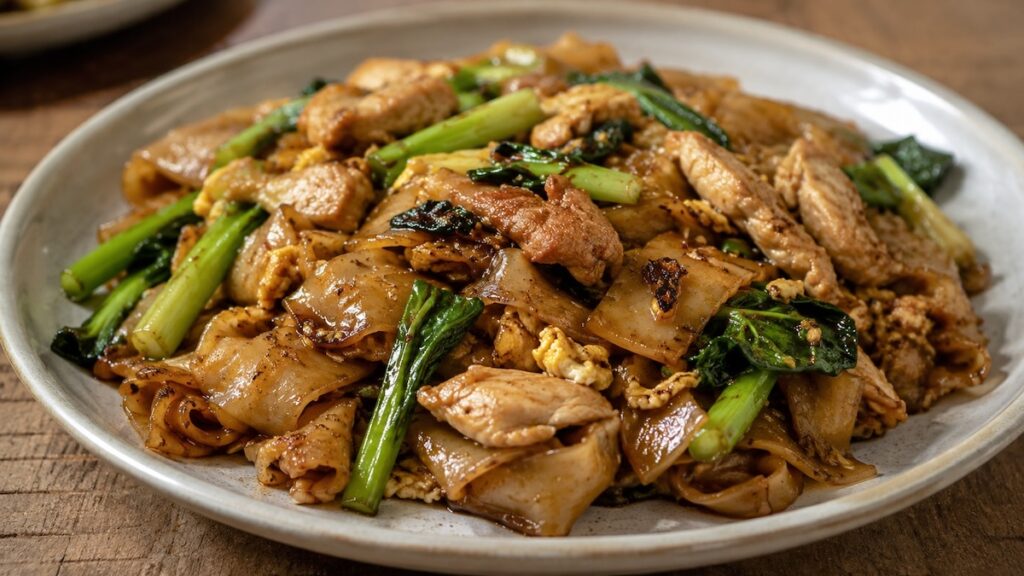
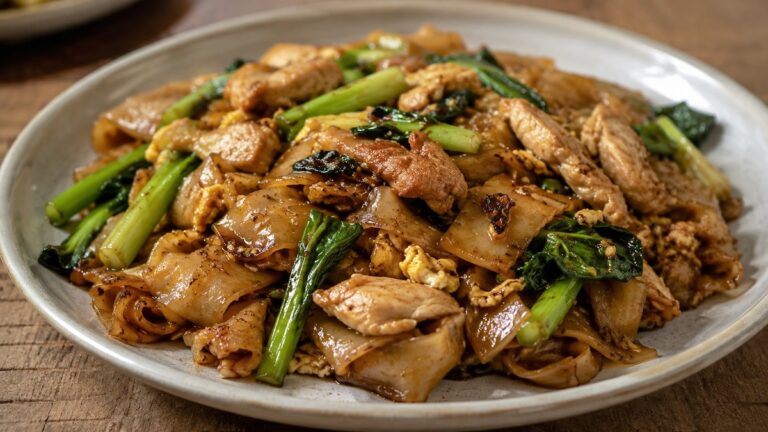
Pad See Ew (ผัดซีอิ๊ว) is a classic Thai stir-fried noodle dish. It combines wide rice noodles, chicken, eggs and Chinese broccoli in a rich, savoury and slightly sweet soy sauce seasoning.
The key to a successful Pad See Ew is cooking quickly over high heat. The noodles should remain soft while developing lightly caramelised, charred patches. This chicken Pad See Ew recipe includes the traditional sauces, step-by-step instructions and practical alternatives for ingredients that can be difficult to find outside Thailand.
At the table with Portail Asie
Traditional Pad See Ew
Make traditional Pad See Ew with chicken, wide rice noodles, eggs, Chinese broccoli and a rich soy sauce seasoning, stir-fried in a hot wok.
- Prep time
- 20 min
- Cooking time
- 10 min
- Total time
- 30 min
- Servings
- 2
- Difficulty
- Easy
- Spice level
- 0/5
- Cuisine
- Thailand
- Dish type
- Main dish
Last checked: October 15, 2026
About this recipe
Version: Traditional
Pad See Ew is a classic Thai dish, particularly popular at street food stalls and small local restaurants. Its name refers to the soy sauce used to season the noodles. It is traditionally prepared with wide rice noodles (sen yai), Chinese broccoli (gai lan), eggs and a choice of meat, often chicken or pork. Quick, high-heat wok cooking allows parts of the noodles to develop a distinctive lightly charred flavour while remaining soft and tender.
Do not substitute: Whenever possible, use fresh wide rice noodles, which give Pad See Ew its characteristic texture. Soy sauces, particularly Thai black soy sauce, contribute to its colour and flavour. Chinese broccoli adds a slight bitterness that balances the seasoning. Avoid drowning the noodles in sauce or stirring them constantly: sufficiently high heat and brief contact with the hot wok are essential for developing their lightly charred flavour. The substitutions listed in this recipe remain suitable when traditional ingredients are unavailable.
Ingredients
Adjust servings to suit your needs.
For the chicken
- 225 g Chickenthinly sliced
- 2 tsp Light soy saucefor the marinade
- ¼ tsp Sugarfor the marinade
For the sauce
- 2 tbsp Oyster sauce
- 1 tbsp Light soy sauce
- 1½ tsp Fish sauce
- 1½ tsp Golden Mountain seasoning sauceor Maggi seasoning sauce
- 2 tsp Thai black soy sauce
For the Pad See Ew
- 450 g Fresh wide rice noodlessen yai or ho fun
- 150 g Chinese broccoligai lan
- 4 cloves Garlicchopped
- 2 Eggs
- 3 tbsp Vegetable oilplus a little extra if needed
- 4 tsp Sugar
- Ground white pepperto taste
Preparation steps
Combine the chicken with 2 teaspoons of light soy sauce and ¼ teaspoon of sugar. Leave it to marinate while preparing the remaining ingredients.
In a small bowl, mix the oyster sauce, light soy sauce, fish sauce, Golden Mountain seasoning sauce and Thai black soy sauce. Keep the mixture near the wok.
Gently separate the fresh rice noodles. If they are cold and stuck together, warm them slightly before separating them to prevent tearing. Cut the Chinese broccoli stems into thin pieces and leave the leaves in larger sections.
Heat a wok or large frying pan over high heat with a little oil. Stir-fry the chicken until just cooked, then remove it from the wok and set aside.
Add a little more oil to the wok, followed by the garlic. Stir-fry for a few seconds. Add the eggs and scramble them roughly until almost cooked.
Add the Chinese broccoli, briefly stir-frying the stems first and then the leaves. Return the chicken to the wok.
Add the noodles, prepared sauce and sugar. Toss gently to coat the noodles without breaking them.
Spread the noodles against the hot surface of the wok and let them sear briefly without stirring so they develop lightly charred patches. Turn them over and briefly repeat on the other side.
Add a little ground white pepper, toss once more and serve immediately. Pad See Ew can be accompanied by chilli vinegar at the table for anyone who prefers a spicier dish.
Common mistakes and how to avoid them
The noodles break during cooking
Probable cause: The fresh rice noodles were separated too roughly or stirred too vigorously in the wok.
Solution: If the noodles are cold and stuck together, warm them slightly before separating them. Toss gently with a wide spatula during cooking.
The noodles do not develop a charred flavour
Probable cause: The wok is not hot enough, it is overcrowded or the noodles are stirred constantly.
Solution: Cook over high heat, ideally one portion at a time if your wok is small. Let the noodles remain in contact with the hot surface for a few moments before turning them.
The Pad See Ew is too salty
Probable cause: The soy sauces, oyster sauce and fish sauce were incorrectly measured or substituted without accounting for their salt content.
Solution: Measure the sauces carefully before cooking. If using Chinese dark soy sauce instead of Thai black soy sauce, adjust the other seasonings as explained in the substitutions.
The noodles become soft and sticky
Probable cause: They were overcooked, too much sauce was added or they spent too long in a wok that was not hot enough.
Solution: Use fresh rice noodles whenever possible, follow the sauce quantities and cook quickly over high heat. If using dried noodles, keep them slightly firm before adding them to the wok.
The Chinese broccoli is too hard or too soft
Probable cause: The stems and leaves were cooked for the same amount of time despite requiring different cooking times.
Solution: Cut the stems into thin pieces and stir-fry them before adding the leaves, which cook much faster. The Chinese broccoli should be tender while retaining a slight crunch.
Portail Asie tips
Prepare all your ingredients before heating the wok, as the cooking process is very fast. To achieve lightly charred noodles rather than simply steaming them, cook over high heat and avoid overcrowding the wok. If your wok is small, ideally prepare one portion at a time. Do not stir the noodles constantly: leave them in contact with the hot surface for a few moments to encourage caramelisation.
Substitutions and alternatives
- Fresh wide rice noodles
- Use dried wide rice noodles if fresh noodles are unavailable. Prepare them according to the packet instructions, keeping them slightly firm before adding them to the wok.
- Chinese broccoli (gai lan)
- Broccolini is the closest commonly available substitute. Alternatively, use regular broccoli, choosing small florets and thinly sliced stems.
- Thai black soy sauce
- Chinese dark soy sauce can be used instead. As it may be saltier, omit the Golden Mountain seasoning sauce and adjust the seasoning at the end of cooking.
- Chicken
- Pad See Ew can also be prepared with pork, beef, prawns or firm or fried tofu.
Watch the preparation
The video is loaded from YouTube after you click.
Order this dish in Thailand
Thai name:ผัดซีอิ๊วไก่
Say it simply:Pad See Ew Gai
Show this:ขอผัดซีอิ๊วไก่หนึ่งจานครับ/ค่ะ
Meaning:One plate of chicken Pad See Ew, please.
Where to find the ingredients
Fresh wide rice noodles, often sold as sen yai or ho fun, are mainly available in Asian grocery stores, usually in the refrigerated section. Chinese broccoli (gai lan), Thai soy sauces, fish sauce and oyster sauce are also commonly stocked in these shops. In Thailand, these ingredients are easy to find in markets and supermarkets. Outside Thailand, dried wide rice noodles and broccolini make good alternatives when fresh ingredients are unavailable.