Have you ever seen the year 2569 on a Thai calendar or document and wondered what it means? It is not a mistake. Thailand uses the Thai solar calendar, which is based on the Buddhist Era and runs 543 years ahead of the Gregorian calendar.
This guide explains why Thailand uses a different year, how to convert dates, where travelers may see Buddhist years, and which mistakes to avoid when reading Thai documents.
How to Convert Thai Dates to Gregorian (and Vice Versa)
Converting dates is the most common question travelers have. It’s actually very simple.
To convert a year from the Gregorian calendar, like 2026, to the Thai Buddhist calendar, just add 543. That means 2026 becomes 2569 B.E..
To convert from a Thai year back to a Gregorian year, simply subtract 543. For example, 2570 B.E. becomes 2027.
To convert a year instantly: use the converter below.
Thai calendar converter
Enter a year to get the automatic conversion.
Gregorian year + 543 = Thai Buddhist year
Thai Buddhist year – 543 = Gregorian year
⚠️ Warning: Some travelers confuse the two systems and enter the wrong year format on documents. Always check whether the form asks for B.E. or C.E..
Quick Thai Year Conversion Table
Here are some useful Thai Buddhist years travelers may encounter on documents, event dates, or official forms:
| Gregorian Year | Thai Buddhist Year |
|---|---|
| 2024 | 2567 B.E. |
| 2025 | 2568 B.E. |
| 2026 | 2569 B.E. |
| 2027 | 2570 B.E. |
| 2028 | 2571 B.E. |
| 2029 | 2572 B.E. |
| 2030 | 2573 B.E. |
Common Mistakes Travelers Make with Thai Dates
The conversion is easy, but mistakes can still happen when filling out forms, checking expiry dates, or reading official documents in Thailand.
- Writing the year in the wrong system: A Thai form may expect 2569, not 2026.
- Misreading expiry dates: If a visa or document says 2570, it usually means 2027.
- Confusing Songkran with the official New Year: Songkran is the traditional Thai New Year in April, but the official calendar year starts on January 1.
- Ignoring Thai numerals: The year may appear as ๒๕๖๙ instead of 2569.
- Assuming all Thai festivals use the same calendar: Some holidays follow the solar calendar, while Buddhist events often depend on the lunar calendar.
Where Travelers May See Thai Buddhist Years
You may encounter Thai Buddhist years in many everyday situations, especially if you stay in Thailand for more than a short holiday.
- Visa papers and immigration documents
- Hotel registration forms
- Thai driving licenses
- Government websites
- School or university documents
- Event posters and temple announcements
- Medical documents or appointment forms
- Contracts, receipts, and official letters
For short-term travelers, the most common situations are visa dates, event dates, hotel forms, and public holiday announcements.
Thai Solar Calendar vs. Lunar Calendar: What’s the Difference?
Thailand uses two important calendar systems, each with a distinct purpose.
The Thai Solar Calendar (The Official One)
In 1888, King Rama V introduced the solar calendar in Thailand, drawing inspiration from the Gregorian model. At that time, it used the Rattanakosin Era, counted from the founding of Bangkok. In 1912, King Rama VI replaced it with the Buddhist Era (B.E.), traditionally associated with the Buddha’s passing, or Parinirvana. It wasn’t until 1941 that January 1st officially marked the start of the year. In everyday use, the Thai Buddhist year is always 543 years ahead of the Gregorian year.
This is the calendar you’ll see on official documents, in schools, and for business contracts. For instance, the year 2026 becomes 2569 B.E., often written with Thai numerals: ๒๕๖๙.
The Thai Lunar Calendar (The Traditional One)
The Thai lunar calendar is a luni-solar system deeply rooted in Buddhism. It tracks moon phases and is essential for determining religious events like Makha Bucha, Visakha Bucha, and Asalha Bucha. Temples organize rituals based on this calendar, and many Thai families use it to choose auspicious dates for weddings or other milestones.
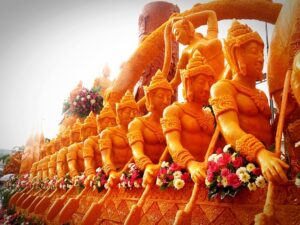
🕯️ Events such as the Ubon Ratchathani Candle Festival follow this lunar system, especially during observances like Khao Phansa, the start of Buddhist Lent.
Thai Numbers Used in Calendar Dates
Sometimes the Buddhist year is written using Thai numerals. This can be confusing at first, but the numbers are easy to recognize once you know them.
| Western Number | Thai Number |
|---|---|
| 0 | ๐ |
| 1 | ๑ |
| 2 | ๒ |
| 3 | ๓ |
| 4 | ๔ |
| 5 | ๕ |
| 6 | ๖ |
| 7 | ๗ |
| 8 | ๘ |
| 9 | ๙ |
For example, ๒๕๖๙ means 2569, which corresponds to 2026 in the Gregorian calendar.
Thai vs. Western Calendars: A Quick Comparison
Here’s a side-by-side comparison of the Gregorian, Thai solar, and Thai lunar calendars:
| Element | Gregorian | Thai Solar | Thai Lunar |
|---|---|---|---|
| Current Year | 2026 | 2569 B.E. | Varies |
| Starting Point | Common Era dating system | Traditional date of Buddha’s passing (Parinirvana) | Moon cycles |
| New Year | January 1 | January 1 (Songkran: April 13–15) | Varies (e.g. Makha Bucha) |
| Usage | Global standard | Government & legal documents | Religious ceremonies |
Key Thai Holidays & Major Events
The Thai calendar dictates many of the country’s most important holidays and major events.
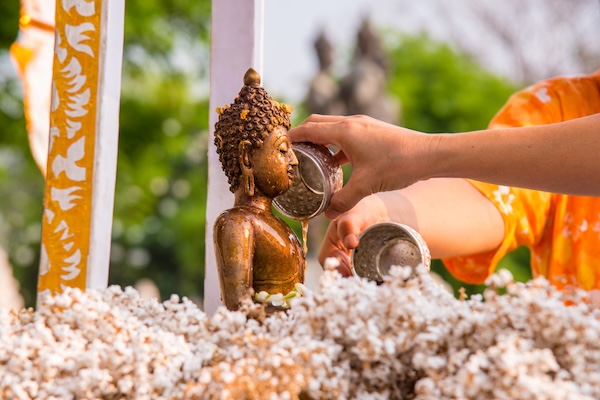
- Songkran (April 13–15): The traditional Thai New Year celebration.
- Makha Bucha: A Buddhist holiday on the full moon of the third lunar month, usually February or March.
- Visakha Bucha: Celebrates Buddha’s birth, enlightenment, and death on the full moon of the sixth lunar month, usually May.
- Loi Krathong: Thailand’s Festival of Lights, held on the full moon of the 12th lunar month, usually in November.
- Modern events: concerts, festivals, and major events may also display dates using the Thai Buddhist year on local announcements.
- Other key dates include King’s Birthday, National Day, and Constitution Day.
📍 Take note: During religious holidays, alcohol sales are restricted, and nightlife venues may close temporarily.
The Thai Calendar in Everyday Life: Where You’ll See It
Most Thai schools operate on the solar calendar, starting in May. However, holidays and local events often follow the lunar calendar.
Documents like birth certificates, driver’s licenses, or visa papers usually only mention the B.E. year. So if you see “expiry: 2570” on a visa—it’s totally normal!
Many Thai people also rely on astrology tied to the lunar system, picking favorable days to get married, move house, or start a new venture.
FAQ about the Thai Calendar
Why does Thailand have more than one New Year?
Thailand observes three different New Year events: the official one on January 1st, the traditional Songkran festival in April, and Chinese New Year, which follows the lunar calendar and varies each year.
What is a Buddhist year exactly?
It is based on the Buddhist Era, traditionally associated with the Buddha’s passing, or Parinirvana. In Thailand, the Buddhist year is calculated as the Gregorian year plus 543. So, 2026 + 543 = 2569 B.E.
How do I know if a Thai year is B.E. or C.E.?
If the number is above 2500, it’s almost certainly B.E. The context is also a key indicator: official Thai documents, contracts, and government websites use the Buddhist system.
What year is it in Thailand in 2026?
In 2026, the year in Thailand is 2569 B.E.
What is 2570 in the Western calendar?
2570 B.E. corresponds to 2027 in the Gregorian calendar.
Why is Thailand 543 years ahead?
Thailand uses the Buddhist Era for official dates, counted from the Buddha’s Parinirvana — traditionally placed 543 years before the Gregorian calendar begins.
Do Thai people use the Buddhist year every day?
Yes, the Buddhist year is commonly used on official documents, government forms, school papers, IDs, and public notices. In casual conversation, many people also understand and use Gregorian years, especially in tourism and international contexts.
Is the Thai lunar calendar still used today?
Yes. The Thai lunar calendar is still important for Buddhist holidays, temple ceremonies, auspicious dates, and traditional festivals.
📖 Final Thoughts
Understanding the Thai calendar gives you a real edge—whether you’re traveling, relocating, or just curious about Thai culture. Once you remember the simple +543 / -543 rule, most Thai dates become much easier to understand.
The key is to pay attention to the context. A date on a government document, visa, school paper, or local announcement may use the Buddhist Era, while international bookings and tourist services often use the Gregorian calendar.
Once you get used to it, the Thai calendar becomes more than a conversion trick. It shows how Thailand connects official life, Buddhist tradition, lunar festivals, and modern events in one unique system.
🔄 Last updated on May 1, 2026