
Looking for basic Thai phrases for your trip to Thailand? This guide brings together useful words and expressions to greet people, order food, ask for directions, and deal with everyday situations more easily.
Your travel phrasebook, ready to use!
Download our complete Thai-English phrasebook in PDF format and keep essential phrases with you at all times, even offline.
Even a few Thai words can make a real difference during your trip. They help you connect with locals, avoid misunderstandings, and show respect for Thai culture.
To prepare for your trip, you can also check out our maps of Thailand for a better overview of the country’s regions and main travel routes.
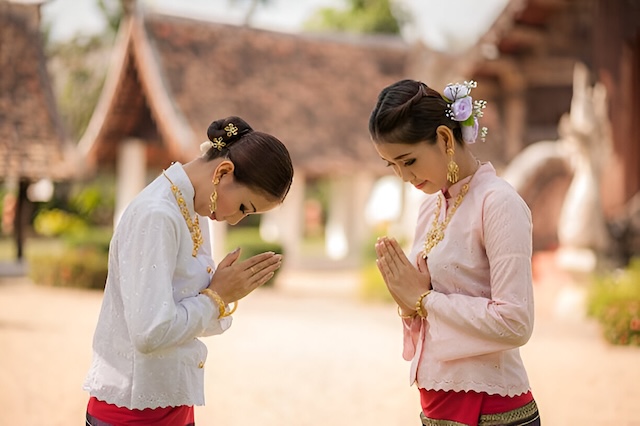
The Thai Language: Background and Useful Tips
Thai is the national language of Thailand and is spoken by tens of millions of people across the country. Standard Thai, based on the Bangkok variety, is understood nationwide, although regional speech and vocabulary can differ from one area to another.
Thai has been influenced over time by Khmer, Pali, Sanskrit, and, more recently, English. It is also a tonal language, which means that the tone of a syllable can change the meaning of a word.
Thai also has a special formal vocabulary used in royal and ceremonial contexts, known as rachasap. Travelers do not need to learn it, but it shows how rich and layered the language is.
For beginners, pronunciation and listening are much more important than learning to write right away. Thai script may look complex at first, but you can already communicate a lot with a few well-pronounced expressions.
Tips to make yourself understood:
- Always add kha (if you are a woman) or khrap (if you are a man) at the end of polite sentences.
- Thai pronunciation depends a lot on tone, but local people are usually patient and understanding with foreign speakers.
- Some sounds may vary slightly in everyday speech, so do not worry if what you hear does not match the romanization exactly.
- Good manners matter as much as vocabulary. A smile and a respectful attitude go a long way. To learn more, read our guide to Thai etiquette and customs.
Basic Thai Phrases for Everyday Travel Situations
- Hello: สวัสดี (sawasdee kha/khrap)
- Goodbye: ลาก่อน (laa gon)
- Hi! (informal): หวัดดี (watdee)
- Thank you: ขอบคุณ (khop khun kha/khrap)
- Yes: ใช่ (chai)
- No: ไม่ (mai)
- Excuse me / Sorry: ขอโทษ (kho thot)
- I don’t understand: ไม่เข้าใจ (mai khao jai)
- What is your name?: คุณชื่ออะไร (khun chue arai?)
- My name is…: ผมชื่อ… (phom chue…, male) / ฉันชื่อ… (chan chue…, female)
- Do you speak English?: พูดภาษาอังกฤษได้ไหม (phut phasa angkrit dai mai?)
There is no single everyday word that works exactly like the English word “please” in all situations. In spoken Thai, politeness is often expressed through tone, sentence particles such as kha and khrap, or words like noi depending on the context. The word karuna (กรุณา) exists, but it sounds more formal and is often seen in written instructions or announcements.
Mai (ไม่) is used to negate a verb or adjective, for example mai khao jai = “I don’t understand.”
Mai chai (ไม่ใช่) means “that’s not correct” or “that’s not the case,” and is often used to deny a statement or identify something as incorrect.
Example:
— Are you a doctor? → Khun pen mo chai mai?
— Yes: Chai | No: Mai chai
Thai people often use the word sanuk to describe something enjoyable or fun. It is a great little word to know when talking about travel, food, or daily life.
Emergencies and Health
- I am sick: ผมป่วย (phom puai, male) / ฉันป่วย (chan puai, female)
- Help me!: ช่วยด้วย! (chuai duai!)
- Emergency: ฉุกเฉิน (chuk choen)
- Doctor: หมอ (mo)
- Pharmacy: ร้านขายยา (ran khai ya)
- Hospital: โรงพยาบาล (rong phayaban)
- Danger: อันตราย (antrarai)
- I am allergic to…: ฉันแพ้… / ผมแพ้… (chan phae… / phom phae…)
Getting Around and Asking for Directions
- I am lost: ฉันหลงทาง / ผมหลงทาง (chan long thang / phom long thang)
- Where is the toilet?: ห้องน้ำอยู่ที่ไหน (hong nam yu thi nai?)
- Where is…?: …อยู่ที่ไหน (… yu thi nai?)
- Bank: ธนาคาร (thanakhan)
- Downtown / city center: ใจกลางเมือง (chai klang mueang)
- Hotel: โรงแรม (rong raem)
- Supermarket: ซูเปอร์มาร์เก็ต (supermarket)
- Train station: สถานีรถไฟ (sathani rot fai)
- Right: ขวา (khwa)
- Left: ซ้าย (sai)
- Straight ahead: ตรงไป (trong pai)
In some parts of Thailand, you may hear local vocabulary that differs slightly from standard Thai. Even so, standard Thai is usually understood everywhere in tourist areas.
At the Restaurant and Food
To go further, check out our dedicated guide on how to order food in Thailand for useful phrases, tips, and menu vocabulary.
- I’m hungry: ฉันหิว / ผมหิว (chan hiu / phom hiu)
- I’m thirsty: หิวน้ำ (hiu nam)
- Water: น้ำ (nam)
- Not spicy: ไม่เผ็ด (mai phet)
- Please don’t add chili: ไม่ใส่พริก (mai sai phrik)
- Breakfast: อาหารเช้า (ahan chao)
- Lunch: อาหารกลางวัน (ahan klang wan)
- Dinner: อาหารเย็น (ahan yen)
- Delicious: อร่อย (aroi)
- Very delicious: อร่อยมาก (aroi mak)
- The bill, please: เช็คบิลด้วยครับ/ค่ะ (check bin duai khrap/kha)
- Cheers!: ชนแก้ว! (chon kaeo!)
Questions, Time, and Days of the Week
- When?: เมื่อไหร่ (muea rai?)
- What time is it?: กี่โมงแล้ว (ki mong laeo?)
- Today: วันนี้ (wan ni)
- Tomorrow: พรุ่งนี้ (phrung ni)
- Yesterday: เมื่อวาน (muea wan)
- Weekend: สุดสัปดาห์ (sut sapda)
- Monday: วันจันทร์ (wan chan)
- Tuesday: วันอังคาร (wan angkhan)
- Wednesday: วันพุธ (wan phut)
- Thursday: วันพฤหัสบดี (wan pharuehatsabodi)
- Friday: วันศุกร์ (wan suk)
- Saturday: วันเสาร์ (wan sao)
- Sunday: วันอาทิตย์ (wan athit)
Days of the week are traditionally associated with colors in Thailand. For example, Monday is linked with yellow, a color you will often notice in cultural and religious contexts.
The Thai Script and Its Special Features
Thai is written from left to right. It usually does not put spaces between individual words in the same way English does, and it uses consonants, vowels, and tone markers that combine to form syllables.
For many travelers, learning the script is not essential at first. However, recognizing a few common signs, place names, or food words can already be very helpful.
Basic Thai Grammar and Sentence Structure
Thai grammar is often considered approachable for beginners. There are no verb conjugations like in many European languages, and words usually stay the same regardless of the subject.
- No verb conjugation: the verb does not change according to person or tense.
- No articles: Thai does not use articles like “a” or “the” in the same way English does.
- No grammatical gender in nouns: nouns themselves do not change for masculine or feminine gender.
- Basic sentence order: Thai often follows a Subject-Verb-Object structure.
- Negation: put mai (ไม่) before the verb or adjective.
- Questions: a yes/no question can often be formed by adding mai at the end of a statement.
- Politeness: add kha or khrap at the end of a sentence to sound polite.
Chan kin khao = I eat rice.
Phom mai kin phet = I do not eat spicy food.
Complete Sentence Examples for Common Situations
- Greeting someone: สวัสดี คุณสบายดีไหม (sawasdee, khun sabai di mai?) – Hello, how are you?
- Asking the price: อันนี้ราคาเท่าไหร่ (an ni rakha thao rai?) – How much is this?
- Ordering at a restaurant: ขอข้าวหนึ่งจานครับ/ค่ะ (kho khao nueng chan khrap/kha) – I would like one plate of rice, please.
- Asking for directions: สถานีรถไฟอยู่ที่ไหน (sathani rot fai yu thi nai?) – Where is the train station?
- Emergency: ช่วยด้วย! (chuai duai!) – Help me!
- Introducing yourself: ผมชื่อปอล / ฉันชื่อปอล (phom chue Paul / chan chue Paul) – My name is Paul.
- Closing politely: ไม่เป็นไร ขอบคุณ (mai pen rai, khop khun) – It’s okay, thank you.
- That’s too expensive: แพงไป (phaeng pai) – That’s too expensive.
- Can you lower the price?: ลดได้ไหม (lot dai mai?) – Can you lower the price?
Regional Variants and Everyday Expressions
- Isan (Northeast): you may hear forms influenced by the local Isan language and Lao.
- North: some polite particles and vocabulary differ from standard Thai.
- South: pronunciation and rhythm can sound noticeably different from Bangkok Thai.
- Common expression: สบายๆ (sabai sabai) = relaxed, easygoing.
- Useful phrase: ไม่เป็นไร (mai pen rai) = never mind / it’s okay / no problem.
- Everyday expression: กินเล่น (kin len) = to snack.
Using expressions like sabai sabai or mai pen rai can make your Thai sound more natural and help you connect more easily with local people.
What to Remember for Better Communication in Thailand
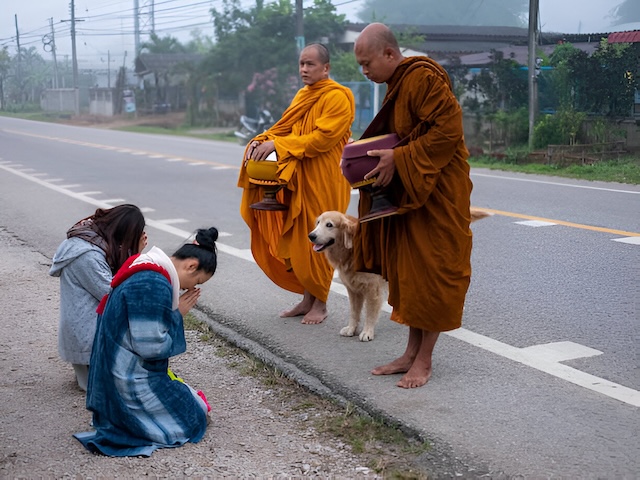
- Even a few Thai words can make a big difference, and the effort is usually appreciated.
- Adding kha or khrap is one of the easiest ways to sound polite.
- This phrasebook is a starting point, not a complete course, so real-life practice will help a lot.
- If you do not understand something, do not hesitate to ask people to repeat it more slowly.
This phrasebook is a great introduction for travelers. For a more structured and authentic approach, discover Olivia Thai and her method in our article: Learn Thai with Olivia Thai.
Enjoy your trip and have fun discovering the Thai language with this Thai-English phrasebook!
Useful resource:
- Lexilogos Thai-English dictionary: useful for looking up additional vocabulary and language tools.