
Philippines travel insurance is essential if you want to explore the islands with peace of mind and avoid costly surprises. In this guide, we compare the best options (Heymondo, ACS, Chapka) and help you choose the right coverage for your trip, budget, and activities.
Which travel insurance should you choose for the Philippines in 2026?
Our recommended travel insurance plans for the Philippines
Here is our selection of the best travel insurance options for the Philippines, based on our experience living in Asia.
- ✅ Heymondo: The best overall value for short trips and multi-island itineraries (5% discount through our link).
- ✅ Chapka: A reliable choice for families, active trips, and travelers looking for more comprehensive coverage.
- ✅ ACS: The most budget-friendly plans, ideal for travelers on a tighter budget and people under 40.
Get a Heymondo quote (5% off included)
Recommended for medical evacuation, inter-island transfers, and water activities.
This guide contains affiliate links. If you buy through our links, you support our work at no extra cost to you.
Is travel insurance mandatory for the Philippines?
Not always required, but strongly recommended
For a tourist trip to the Philippines, travel insurance is generally not required as an entry formality. However, traveling without coverage would be a mistake. In the event of hospitalization, an accident on an island, a transfer to Cebu or Manila, or medical repatriation, the bill can rise very quickly.
Several government travel advisory services — including the UK’s FCDO and the US State Department — strongly recommend carrying insurance covering medical expenses and repatriation. This is especially important in a country made up of thousands of islands, where healthcare quality can vary greatly depending on the region.
- Medical costs at private facilities can be high, especially in major cities and for foreign travelers.
- Advance payment or proof of funds is often required before treatment, particularly in private hospitals and clinics.
- Emergency services and ambulance availability are not consistent throughout the archipelago, which makes 24/7 assistance especially important.
- Medical evacuations or transfers between islands can be extremely expensive without suitable insurance.
In short, travel insurance for the Philippines is not just an optional comfort. It is an essential safety net for accidents, tropical illnesses, weather disruptions, and medical emergencies far from major hospitals.
Why travel insurance is essential: what risks are covered
Good insurance is not wasted money. It is real protection against the realities on the ground. In the Philippines, the main risks go beyond simply “getting sick.” You also need to consider the geography of the archipelago, water activities, boat travel, and weather conditions.
Medical expenses: the number one risk
This is the most important benefit. Even a basic consultation or hospitalization in a private clinic can quickly become expensive.

- Consultation at a private clinic: around €40 to €120 depending on the city and facility.
- Hospitalization for dengue, infection, or severe dehydration: often €2,000 to €8,000 depending on the length of stay and level of care.
- Scooter or boat accident: €5,000 to €20,000 or more if surgery, imaging, or medical transport is required.
- Medical evacuation from an island to a major hospital: potentially very expensive, especially if urgent coordination, specialized transport, or private aviation is needed.
🏝️ Risks specific to the Philippines
Archipelago and remoteness: depending on the island where you are staying, the nearest suitable hospital may be far away. Even a simple emergency can require a transfer to Cebu, Manila, or another major city.
Water activities: diving, snorkeling, island hopping, boating, kayaking… check that these activities are covered, especially if you plan to go scuba diving.
Scooter accidents: very common among travelers. Without a valid license and helmet, your insurer may reduce or refuse compensation.
Typhoons and rainy season (especially from July to November): these can cause cancellations, delays, maritime disruptions, and trip interruptions.
Medical repatriation and emergency evacuation: the life-saving guarantee
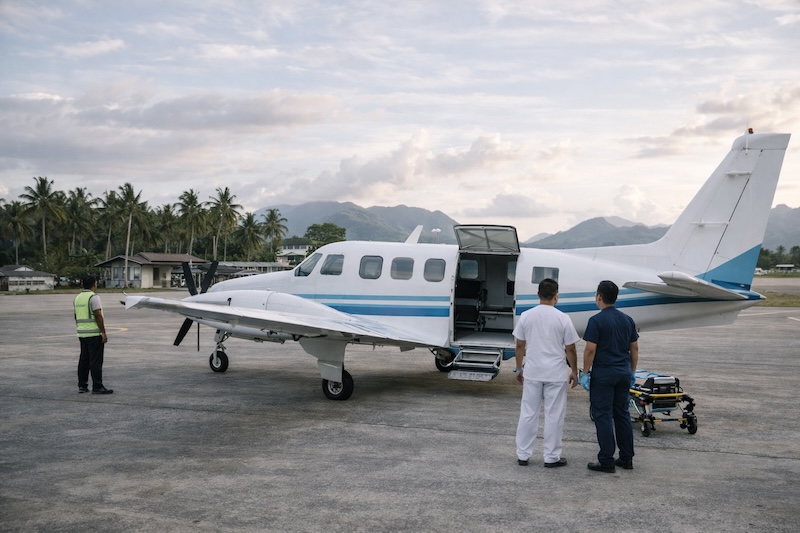
This is often underestimated by travelers. In the Philippines, it is not only about a possible return to your home country. Sometimes you may need a transfer between islands or to a better-equipped hospital. This medical logistics chain can cost several thousand, or even tens of thousands, of euros depending on urgency and distance.
Trip cancellation and interruption: protecting your budget
This benefit reimburses non-refundable costs such as flights, hotels, cruises, excursions, and diving stays if you need to cancel or cut short your trip for a covered reason: illness, accident, a serious family issue, or weather-related disruption affecting your trip.
Other essential benefits
- Personal liability: essential if you cause damage to another person or to property.
- Baggage and equipment: useful if you travel with a laptop, camera, or diving gear.
- Legal assistance: valuable in case of disputes or serious issues during your trip.
- Early return: helpful if you need to go home sooner because of a serious family emergency.
- Sports and activity coverage: very important if you plan to dive, ride a scooter, go boating, or join more adventurous excursions.
Bank cards: important limitations to know
Many travelers assume they are sufficiently covered by their premium bank card (gold or platinum tier). For the Philippines, that is often not enough, especially if your itinerary includes several islands or water activities.
- Coverage limits may be too low: a cap of €155,000 may sound high, but it can become insufficient in the event of long hospitalization, complications, or repatriation.
- Little or no direct payment guarantee: you often have to pay first and request reimbursement later.
- Limited duration: usually less than 90 days.
- Frequent exclusions: diving, scooters, water sports, driving without the proper license, and pre-existing conditions.
- Strict activation conditions: the trip often needs to have been paid with the card.
For a worry-free trip to the Philippines, dedicated travel insurance remains the most reliable solution.
How to choose the right travel insurance for the Philippines
To make the right decision, three criteria matter most.
✅ Before buying, make sure to check:
- Medical coverage limit (minimum €150,000, ideally €300,000 to €500,000+)
- Repatriation included with actual costs covered
- Emergency evacuation / medical transfer clearly included
- Low or no deductible
- Scooter / two-wheeler coverage if you plan to drive
- Diving and water activities covered if relevant
- Cancellation / interruption benefits, especially during rainy season or typhoon season
- Exclusions, age limits, and pre-existing medical condition rules
- Trip duration: under or over 90 days
Review the medical coverage limit
For the Philippines, we recommend at least €150,000 in medical coverage, but €300,000 to €500,000 or more is safer if you are traveling across several islands or doing moderate-risk activities.
Check the deductible
A high deductible greatly reduces the value of an insurance plan. It is better to choose a policy with no deductible or a low one.
Read the exclusions carefully
This is often where unpleasant surprises are hidden: riding a scooter without the correct license, diving, risk sports, pre-existing conditions, alcohol-related incidents, or weather-related claims. Read the terms carefully before purchasing.
Our selection of the best travel insurance plans for the Philippines
| Insurance | Best for | Trustpilot rating | Medical coverage | Main advantage | |
|---|---|---|---|---|---|
| Heymondo ⭐ Top pick |
Excellent value, easy assistance, strong choice for multi-island trips | 4.6 / 5 | Up to €500,000 | No upfront payment in many cases | View price |
| Chapka (Cap Assistance) |
Short trips, families, useful options for active travel | 4.5 / 5 | Up to €200,000 | Adventure-friendly coverage | View price |
| ACS (Globe Partner) |
Best low-cost option for under-40 travelers and budget-conscious trips | 4.4 / 5 | Up to €300,000 | Budget-friendly | View price |
Note: These insurance plans provide worldwide coverage, which is ideal if you combine your trip with Japan, Thailand, or Indonesia.
Heymondo: the best overall value
Heymondo is one of our top recommendations for the Philippines because it combines strong coverage limits, easy-to-use assistance, and plans that work well for travelers moving between several islands.
Best for: Trips under 90 days, couples, families, solo travelers, and itineraries covering several islands.
Strengths:
- 5% instant discount through our link.
- High medical coverage limits (up to €500,000).
- No upfront payment in many hospitalization cases, depending on the insurer’s terms.
- 24/7 assistance through the app, very useful when moving around frequently.
- A strong balance for travelers who want serious coverage without an overly complex plan.
Limitations:
- Less suitable than a true long-stay policy if you are traveling for several months.
Chapka: a flexible option for specific traveler profiles
Chapka remains a solid choice for travelers who want a reliable contract, especially families, long-term travelers, or more active itineraries.
Best for: Long stays, families, active travelers, and more complex itineraries.
Strengths:
- Interesting coverage for many active trips and some adventure activities depending on the plan chosen.
- Useful assistance services and clearly structured plans depending on travel duration.
- Plans adapted to trip length: Cap Assistance (under 90 days) or Cap Aventure (over 90 days).
Limitations:
- Base medical coverage of €200,000, lower than Heymondo.
- Pricing varies depending on traveler profile and chosen options.
ACS: the budget option
ACS is often a good choice for travelers who want to keep costs low while still covering the essentials: medical expenses, assistance, and repatriation.
Best for: Budget travelers, backpackers, younger travelers under 40, and simple trips without too many specialized activities.
Strengths:
- Among the most competitive rates for travelers under 40 with the Globe Partner plan.
- Decent medical coverage for the price level (up to €300,000).
- Repatriation included, which is a key point for a standard trip.
Limitations:
- Less suitable for travelers who want broader sports or adventure activity coverage.
- More frequent upfront payments for routine consultations or lighter treatment.
👨👩👧👦 Tip for families
If you are traveling with children, choose a plan that properly covers hospitalization, repatriation of a companion, and urgent treatment on site. In an archipelago like the Philippines, the quality of the assistance service can make a real difference.
Checklist before departure
Before leaving for the Philippines, make sure you have:
📋 What to check before you go
- ☐ Insurance certificate (paper copy + smartphone version)
- ☐ 24/7 assistance number available offline
- ☐ Copies of important documents (passport, tickets, bookings)
- ☐ Proper driving license if you plan to ride a scooter
- ☐ Confirmation of covered activities (diving, snorkeling, boating, scooter)
- ☐ Personal medication and prescriptions
- ☐ Bank card and backup payment method
- ☐ Shared itinerary with a relative or friend if you plan to visit remote islands
- ☐ Weather check according to the season and planned boat crossings

Our verdict: is travel insurance worth it for the Philippines?
Travel insurance for the Philippines is not just an administrative detail. It is the protection that allows you to travel with confidence in an archipelago that can sometimes be complex from a logistical point of view. Between medical expenses, scooter accidents, water activities, inter-island transfers, and emergencies requiring evacuation, it is far better to be well covered than to improvise in a crisis.
🚀 Get a quote in 1 minute (5% discount included)
4.6/5 on Trustpilot • 24/7 assistance • Strong option for multi-island trips
Travel insurance in Asia: our destination guides
Frequently asked questions about travel insurance for the Philippines
Is travel insurance mandatory for the Philippines?
No, it is generally not mandatory for entry as a tourist. However, it is strongly recommended because medical costs, upfront payments, and medical evacuations can be very expensive.
How much does good travel insurance for the Philippines cost?
For a two-week trip, expect to pay roughly €35 to €75 per person depending on your age, chosen coverage, and whether you add cancellation protection. Basic plans may start lower.
Why is medical evacuation so important in the Philippines?
Because the archipelago is made up of thousands of islands, and not all medical facilities provide the same standard of care. In a serious case, it may be necessary to transfer you to a better-equipped hospital.
Is my bank card insurance enough?
Often not. Coverage limits, trip duration restrictions, activity exclusions, and the lack of direct payment make simple bank card insurance too limited for many trips to the Philippines.
Are diving and snorkeling covered?
Not automatically. Some policies cover standard water activities, but scuba diving or certain sports may be excluded or require a specific option. Always check your contract before departure.
Does travel insurance cover tropical diseases like Dengue fever?
In most cases, yes. Dengue and other tropical illnesses are generally treated as unpredictable medical events, meaning hospitalization and treatment are covered under standard medical benefits. Always check your policy’s exclusion list to confirm.
Can I buy travel insurance if I am already in the Philippines?
Yes, some specialized insurers allow this, often with a waiting period. However, it is still better to buy your policy before departure so you are covered from day one.