In 2026, Thailand’s international tourist arrivals remain below 2025 levels. After reaching their lowest point of the year in September, arrivals recovered in October but remained below the same month last year.
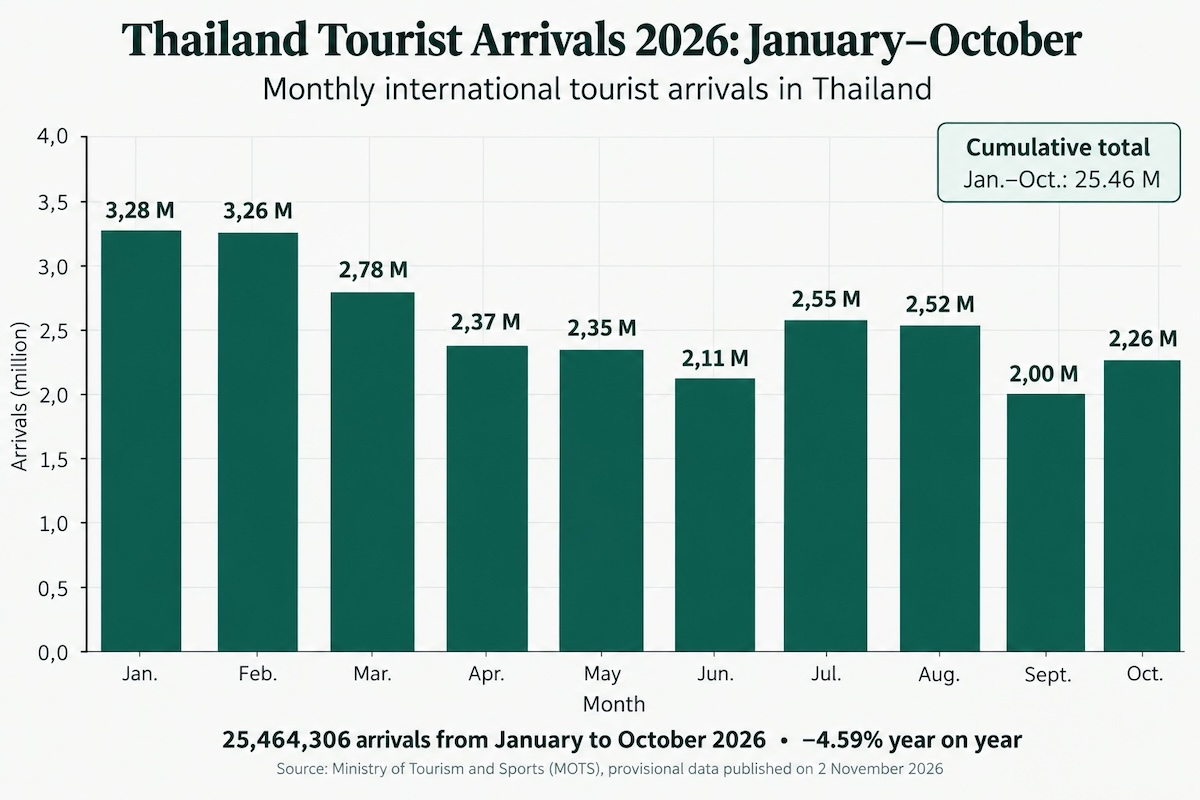
From January to October 2026, Thailand recorded 25,464,306 international arrivals, down 4.59% year on year. October accounted for 2,265,000 arrivals, an increase of 13.23% compared with September, according to provisional data from Thailand’s Ministry of Tourism and Sports (MOTS).
Thailand tourist arrivals 2026: key figures
| Indicator | Value | Period |
|---|---|---|
| Cumulative international arrivals | 25,464,306 | January to October 2026 |
| International arrivals | 2,265,000 | October 2026 |
| Month-on-month change | +13.23% | October versus September 2026 |
| Cumulative year-on-year change | −4.59% | January–October 2026 versus 2025 |
| Accommodation occupancy rate | 65.05% | September 2026 (BOT) |
| 3-month advance booking rate | 16.36% | September 2026 (BOT) |
| Average room rate | 1,786.53 baht | September 2026 (BOT) |
Editorial update: 9 November 2026. Arrivals: MOTS provisional October 2026 data, published on 2 November 2026. Accommodation: Bank of Thailand – Tourism Indicators, September 2026 data, with the table updated on 31 October 2026.
Monthly tourist arrivals in Thailand in 2026
| Month | Arrivals | Comment |
|---|---|---|
| January 2026 | 3,277,908 | Highest monthly total of the first ten months, during peak season. |
| February 2026 | 3,263,802 | Visitor numbers remained close to January’s level. |
| March 2026 | 2,775,199 | Slowdown following the first two months. |
| April 2026 | 2,368,895 | Monthly decline despite the Songkran celebrations. |
| May 2026 | 2,346,845 | Almost unchanged from April. |
| June 2026 | 2,105,383 | Further decline in international arrivals. |
| July 2026 | 2,545,616 | Recovery of 20.91% compared with June. |
| August 2026 | 2,515,319 | Slight decline compared with July (−1.19%). |
| September 2026 | 2,000,339 | Lowest monthly total from January to October (−20.47% month on month). |
| October 2026 | 2,265,000 | Up 13.23% month on month, but down 12.00% year on year. |
| November 2026 | Coming soon | Monthly data not yet published. |
| December 2026 | Coming soon | Monthly data not yet published. |
Source: MOTS – International Tourist Arrivals to Thailand, October 2026 (Excel); official 2026 tourism statistics archive. Provisional figures (2026P), subject to revision.
Thailand tourism from January to October 2026: what do the figures show?
Between 1 January and 31 October 2026, Thailand recorded 25,464,306 international arrivals, compared with 26,689,068 during the same period in 2025. This represents a 4.59% year-on-year decline, equivalent to 1,224,762 fewer arrivals.
After a strong start to the year, with more than 3.2 million arrivals in both January and February, visitor numbers gradually slowed during the spring. Arrivals fell below 2.2 million in June before recovering in July (+20.91%) and easing slightly in August.
September recorded 2,000,339 international arrivals, or 514,980 fewer than in August. This represented a 20.47% month-on-month decline and a 10.53% decrease compared with September 2025. September remained the least busy month of the first ten months of 2026.
October brought a recovery, with 2,265,000 arrivals, or 264,661 more than in September (+13.23%). However, this was still below the 2,573,743 arrivals recorded in October 2025, representing a 12.00% year-on-year decline.
The cumulative year-on-year decline therefore widened from 3.80% at the end of September to 4.59% at the end of October. The monthly recovery was not enough to close the gap with the previous year.
These fluctuations should be interpreted carefully because tourism is highly seasonal. Year-on-year comparisons generally provide a more meaningful picture of changes in international demand than consecutive monthly figures.
Accommodation in September 2026: the South leads in occupancy
The latest accommodation data available from the Bank of Thailand covers September 2026. Thailand’s national occupancy rate fell to 65.05%, down from 68.50% in August, a decrease of 3.45 percentage points.
Unlike the previous month, the South recorded the highest regional occupancy rate, at 68.01%, ahead of Central Thailand, including Bangkok, at 65.89%.
| Region | Occupancy | 3-month advance bookings | Average room rate |
|---|---|---|---|
| Total Thailand | 65.05% | 16.36% | 1,786.53 baht |
| Central, including Bangkok | 65.89% | 20.45% | 2,038.52 baht |
| South | 68.01% | 21.08% | 2,276.31 baht |
| North | 58.23% | 11.26% | 1,286.33 baht |
| Northeast | 62.09% | 7.59% | 743.19 baht |
Compared with August, occupancy declined across all major regions. Central Thailand fell from 70.77% to 65.89%, the South from 70.30% to 68.01%, the North from 60.25% to 58.23%, and the Northeast from 64.54% to 62.09%.
The South continued to record the highest average room rate, at 2,276.31 baht, ahead of Central Thailand at 2,038.52 baht. Nationwide, the average room rate remained almost unchanged, moving from 1,788.25 baht in August to 1,786.53 baht in September.
The national three-month advance booking rate also declined, from 18.63% in August to 16.36% in September, a decrease of 2.27 percentage points.
The South recorded the highest regional advance booking rate at 21.08%, narrowly ahead of Central Thailand at 20.45%. The North stood at 11.26%, while the Northeast recorded 7.59%.
Source: Bank of Thailand – Tourism Indicators, provisional September 2026 accommodation data, with the table updated on 31 October 2026. These indicators measure accommodation activity and should not be confused with international tourist arrival figures.
Thailand’s source markets: China still leads through October 2026
Detailed statistics from MOTS provide a breakdown of international arrivals by nationality through 31 October 2026. The ranking below covers the first ten months of the year.
| Rank | Country | January–October 2026 total |
|---|---|---|
| 1 | China | 4,244,376 |
| 2 | Malaysia | 3,226,484 |
| 3 | India | 1,924,417 |
| 4 | Russia | 1,414,341 |
| 5 | South Korea | 932,066 |
During the first ten months of 2026, arrivals from China increased by 12.44% year on year. By contrast, arrivals from Malaysia fell by 16.34%, while South Korea recorded a 26.86% decline.
In October alone, the five leading source markets were China (308,942 arrivals), Malaysia (276,157), India (196,980), Russia (143,638) and South Korea (83,419).
Arrivals from France reached 654,188 between January and October 2026, compared with 654,455 during the same period in 2025. The French market therefore remained almost unchanged year on year (−0.04%).
In October, Thailand recorded 51,881 arrivals from France, compared with 55,383 in October 2025, a decline of 6.32%.
Source: MOTS – International Tourist Arrivals to Thailand, October 2026, monthly and cumulative statistics by nationality.
Songkran 2026: a short-term boost for arrivals
The week from 6 to 12 April 2026 recorded 619,481 international arrivals, an increase of 8.76% compared with the previous week. The rise was supported in particular by nearby international markets during the Songkran celebrations.
However, the full-month figures add an important nuance. Despite the Thai New Year peak, April remained below March, with 2,368,895 international arrivals, compared with 2,775,199 in March.
Songkran therefore provided a short-term boost without immediately reversing the broader slowdown observed during the spring.
Source for the Songkran weekly report: Thailand’s Ministry of Tourism and Sports, data from 6 to 12 April 2026, relayed by ThailandPlus. Monthly totals: MOTS October 2026 statistical publication.
2025 vs 2026: a 4.59% decline over ten months
Thailand welcomed approximately 32.97 million international visitors in 2025. Arrivals remain substantial in 2026, but the first ten months show a decline compared with the previous year.
The table below uses the same MOTS publication for both years to ensure consistent comparisons.
| Month | 2025 | 2026 | Year-on-year change |
|---|---|---|---|
| January | 3,709,102 | 3,277,908 | −11.63% |
| February | 3,119,445 | 3,263,802 | +4.63% |
| March | 2,720,457 | 2,775,199 | +2.01% |
| April | 2,547,116 | 2,368,895 | −7.00% |
| May | 2,266,574 | 2,346,845 | +3.54% |
| June | 2,322,772 | 2,105,383 | −9.36% |
| July | 2,610,369 | 2,545,616 | −2.48% |
| August | 2,583,638 | 2,515,319 | −2.64% |
| September | 2,235,852 | 2,000,339 | −10.53% |
| October | 2,573,743 | 2,265,000 | −12.00% |
| Total January–October | 26,689,068 | 25,464,306 | −4.59% |
Over the first quarter, arrivals fell by approximately 2.43%, with 9,316,909 arrivals in 2026 compared with 9,549,004 in 2025. February (+4.63%), March (+2.01%) and May (+3.54%) were the only months from January to October 2026 to record year-on-year growth.
The decline was particularly pronounced in January (−11.63%), September (−10.53%) and October (−12.00%).
Overall, Thailand recorded 1,224,762 fewer international arrivals during the first ten months of 2026 than during the same period in 2025.
Source: MOTS, 2025P/2026P comparative table, October 2026. Provisional figures subject to revision.
Thailand tourism forecast and targets for 2026
In an update presented on 10 June 2026, the Tourism Authority of Thailand (TAT) projected approximately 33 million international arrivals for the full year. This was a forecast announced at the time, not a confirmed result.
TAT’s strategy places greater emphasis on the economic value of tourism rather than visitor growth alone. Priorities include wellness, gastronomy, events, sustainability and a broader distribution of tourism benefits across destinations.
Following 25,464,306 arrivals between January and October 2026, Thailand would need another 7,535,694 arrivals in November and December to reach the 33 million target.
That represents an average of approximately 3,767,847 arrivals per month during the final two months of the year, a level higher than any individual month recorded so far in 2026.
The year-end peak season will therefore play an important role in determining whether this projection is reached. These calculations illustrate the gap remaining to the June forecast and do not constitute a new official TAT projection.
Source: Tourism Authority of Thailand – Thailand Tourism Update, 10 June 2026. Portail Asie calculations based on MOTS arrivals through October 2026.
What Thailand tourism trends mean for travellers in 2026
- International tourism remains substantial: despite a 4.59% year-on-year decline, Thailand welcomed more than 25 million international arrivals between January and October.
- Crowd levels vary by destination: national arrival figures do not necessarily reflect conditions at individual beaches, temples or major tourist destinations.
- Arrivals recovered in October: visitor numbers rose from September’s low but remained below October 2025 levels.
- Accommodation trends differ by region: in September, the South recorded the highest regional occupancy rate and average room rate.
- Seasonality still matters: tourism statistics should be considered alongside weather, accommodation prices and local travel conditions when planning a trip.
To choose dates that suit your itinerary, read our guide to the rainy season in Thailand and its regional differences.
Methodology and sources
This article combines three types of official sources, with their reporting periods clearly distinguished:
- Monthly statistics from Thailand’s Ministry of Tourism and Sports (MOTS), used as the primary source for international arrivals, cumulative totals, nationality breakdowns and 2025–2026 comparisons, covering the period through 31 October 2026.
- Tourism Indicators from the Bank of Thailand (BOT), used here for accommodation occupancy rates, advance bookings and average room rates, with observations available through September 2026.
- Official communications from the Tourism Authority of Thailand (TAT), used for tourism forecasts and strategic priorities announced in June 2026.
MOTS figures refer to international tourist arrivals, not the number of overnight stays or the number of people present in Thailand at any given time.
Accommodation occupancy rates measure a different aspect of tourism and should not be confused with international arrival figures.
The 2026 figures are marked as provisional (2026P) and may be revised in later publications.
To ensure consistent comparisons, all international arrival statistics in this article come from the same official MOTS dataset covering January to October 2026. Figures may differ from those published by the Bank of Thailand at other dates.
Main sources: MOTS – International Tourist Arrivals, October 2026 (Excel file); official MOTS statistics archive; Bank of Thailand – Tourism Indicators; TAT – 10 June 2026 tourism update.
FAQ: Thailand tourism 2026
How many tourists have visited Thailand in 2026?
Between 1 January and 31 October 2026, Thailand recorded 25,464,306 international arrivals according to provisional MOTS statistics. This is not yet the full-year total.
How many tourists visited Thailand in October 2026?
MOTS recorded 2,265,000 international arrivals in October 2026, representing a 13.23% increase compared with September but a 12.00% decline compared with October 2025.
How many tourists visited Thailand in September 2026?
MOTS reported 2,000,339 international arrivals in September 2026, down 20.47% compared with August. September remained the least busy month of the first ten months of 2026.
What was Thailand’s accommodation occupancy rate in September 2026?
Thailand’s average accommodation occupancy rate was 65.05% in September 2026, according to BOT data. The South recorded the highest regional rate at 68.01%, followed by Central Thailand, including Bangkok, at 65.89%.
What was the average room rate in Thailand in September 2026?
According to the Bank of Thailand’s accommodation indicators, the national average room rate was 1,786.53 baht per room in September. The South recorded the highest regional average at 2,276.31 baht.
Which country is Thailand’s largest tourism source market in 2026?
At the end of October 2026, China remained Thailand’s largest source market with 4,244,376 arrivals since January, followed by Malaysia (3,226,484) and India (1,924,417).
How many visitors from France travelled to Thailand in 2026?
Between January and October 2026, Thailand recorded 654,188 arrivals from France, compared with 654,455 during the same period in 2025. This represents a year-on-year change of approximately −0.04%.
What is Thailand’s tourism forecast for 2026?
In its 10 June 2026 update, the Tourism Authority of Thailand projected approximately 33 million international arrivals for the full year. Following October’s figures, another 7.54 million arrivals in November and December would be needed to reach that level. This is a calculation, not a new official forecast.
Is tourism in Thailand increasing or decreasing in 2026?
During the first ten months of 2026, international arrivals fell by 4.59% compared with the same period in 2025. Although arrivals recovered in October compared with September, they remained below the previous year’s level.
Why do MOTS and Bank of Thailand tourist arrival figures sometimes differ?
The two organisations may display different figures depending on their publication dates. For June 2026, MOTS reports 2,105,383 arrivals, compared with approximately 1,841,550 in the BOT table consulted. The exact reason for this discrepancy is not explained in the MOTS spreadsheet. For monthly comparisons, this article consistently uses the MOTS series covering January to October 2026.
To compare with the previous year, you can also read our full review of Thailand tourism in 2025.