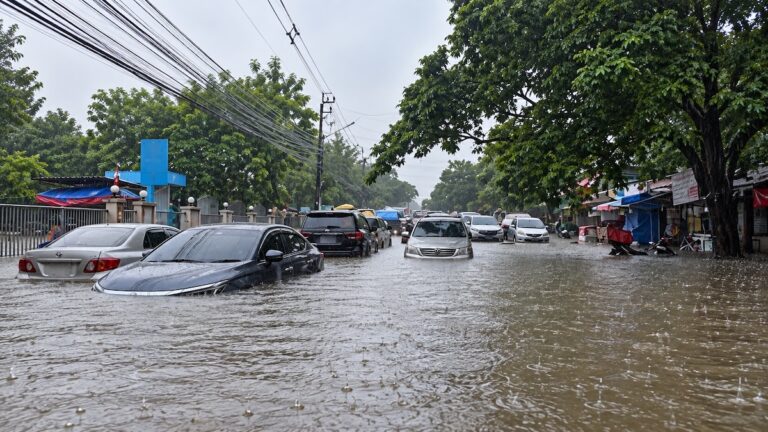
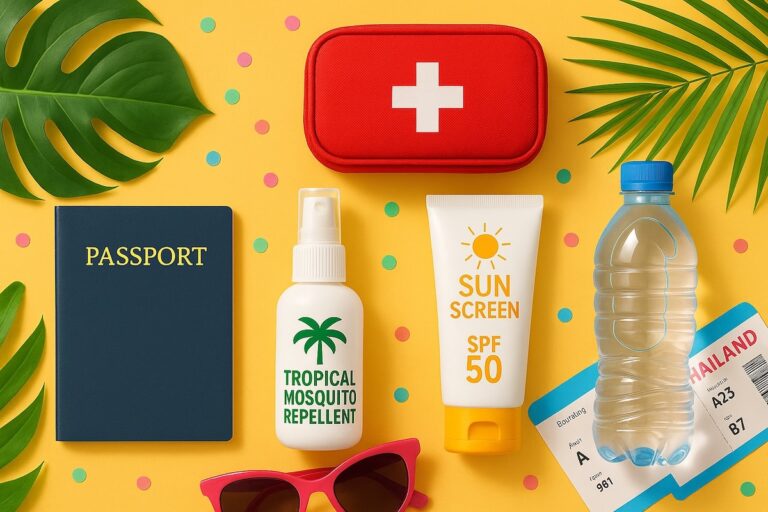
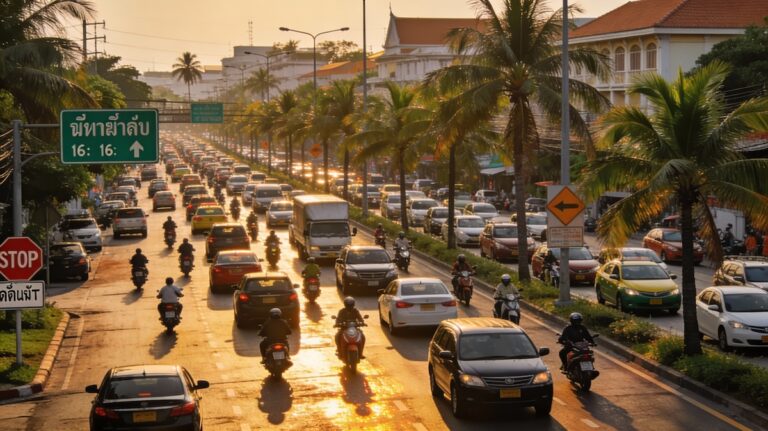
Yes, Thailand remains accessible to travellers in October 2026. Bangkok, Chiang Mai, Phuket, Krabi, Pattaya and Koh Samui are still welcoming visitors, although heavy rainfall has caused local disruption.
The main precautions concern the borders with Cambodia and Myanmar, parts of the Deep South and recent flooding. Thailand also introduced new visa-exemption rules on 15 September 2026, reducing visa-free tourist stays to 30 days for many nationalities.
Is Thailand Safe to Travel to Right Now?
Thailand remains generally accessible to international visitors in October 2026, particularly in its main tourist destinations. However, travellers should check local conditions, especially in border regions and areas affected by heavy rainfall.
Official travel advice varies according to nationality. For example, the United States Department of State currently classifies Thailand overall at Level 1, while the UK Foreign, Commonwealth & Development Office (FCDO) and Australia’s Smartraveller issue stronger warnings for certain regions.
Flood situation as of 9 October: heavy rainfall in late September caused flooding in Bangkok and several other provinces. According to an official Thai government assessment on 8 October, 80 communities across nine Bangkok districts were still affected, although conditions on major roads had improved.
For details about affected neighbourhoods, transport services and airport access, see our regularly updated guide to the Bangkok floods.
The Thai Meteorological Department (TMD) has also warned of potentially heavy rainfall in Bangkok and surrounding areas on 10 and 11 October. Other regions may experience heavy rain between 9 and 13 October, depending on their location.
Official sources: Thai Government – Bangkok flood report, 8 October 2026 (in Thai), and TMD Weather Advisory No. 4, 8 October 2026.
| Destination or area | Situation on 9 October 2026 | Practical advice |
|---|---|---|
| Bangkok | 🟢 Accessible, localised flooding | Check road conditions and rain warnings for 10–11 October |
| Chiang Mai | 🟢 Accessible | Monitor weather and road conditions following heavy rainfall |
| Phuket | 🟢 Accessible | Check sea conditions and beach warning flags |
| Krabi | 🟢 Accessible | Check weather forecasts before boat excursions |
| Pattaya | 🟢 Accessible | Allow for local flooding and traffic disruption after heavy rain |
| Koh Samui | 🟢 Accessible | Monitor local weather and ferry conditions |
| Thailand-Cambodia border | 🔴 Higher-risk area | Travel warnings vary by government; France, the UK and Australia apply different exclusion distances |
| Pattani, Yala, Narathiwat and parts of Songkhla | 🔴 Higher-risk areas | Avoid non-essential travel where your government’s advisory applies |
| Thailand-Myanmar border | 🔴 Sensitive border region | Check country-specific warnings, crossing restrictions and local security conditions |
| Satun and Phatthalung | 🟠 Special warnings from France | French authorities advise against travel unless essential; other national advisories may differ |
This table summarises the situation using Thai government reports and selected international travel advisories available on 9 October 2026. Warning levels are not identical across countries. Always consult the official travel advice issued for your nationality before departure.
Which Areas of Thailand Should Tourists Avoid?
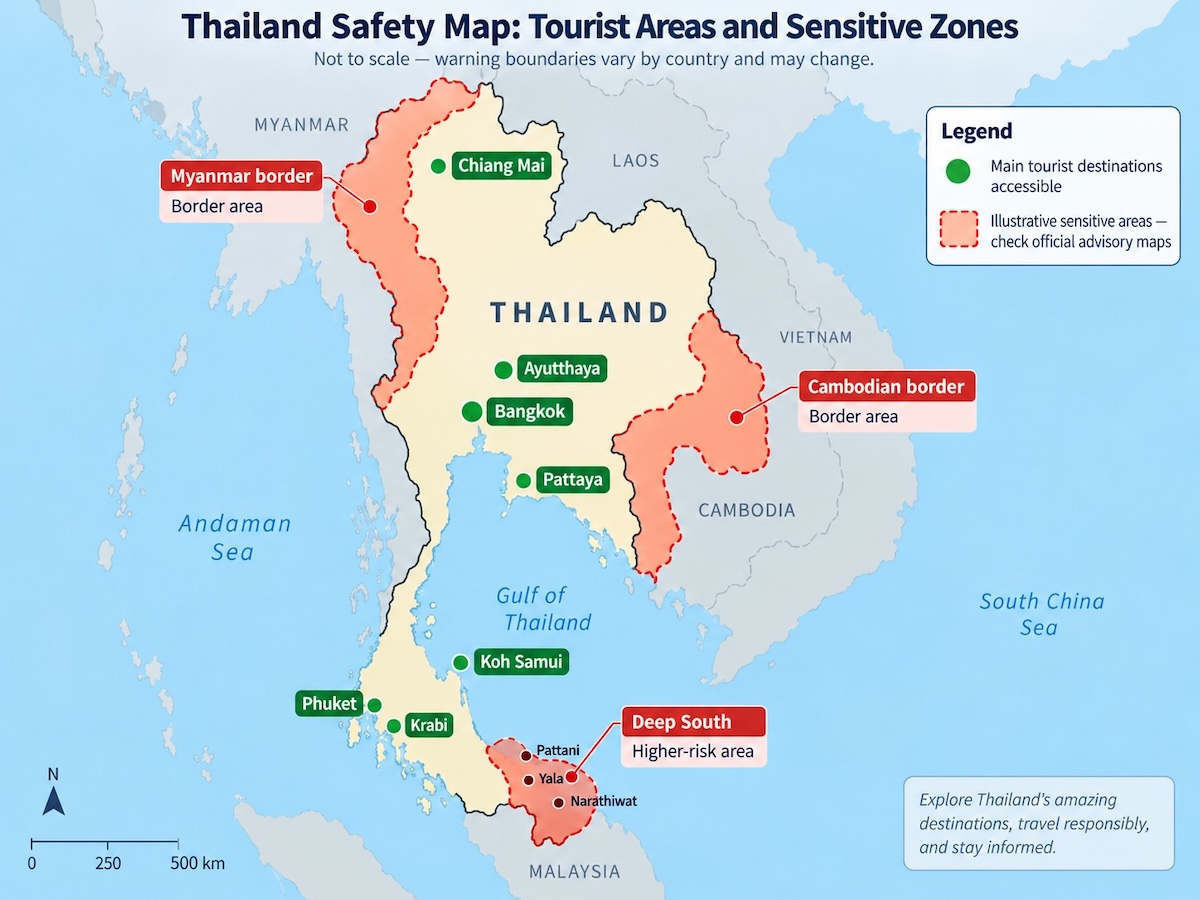
Most of Thailand is not subject to the highest levels of international travel warnings. The strongest warnings generally concern certain areas near the Cambodian and Myanmar borders and parts of the Deep South.
However, warning boundaries differ between governments, so a destination should not automatically be considered safe or unsafe solely because of its province or distance from a border.
Thailand-Cambodia Border
The Thailand-Cambodia land border remains one of the main regional security concerns for travellers.
Armed clashes took place in 2025 before a ceasefire came into effect on 27 December 2025. However, tensions remain and landmines or unexploded remnants of conflict may still present dangers in certain border areas.
Land border crossings between Thailand and Cambodia remain suspended. Several tourist sites close to the border are also closed.
Official travel advisories currently apply different warning distances:
- France: the French Foreign Ministry strongly advises against travelling within approximately 50 km of the border.
- United Kingdom: the FCDO advises against all but essential travel within 20 km of the land border.
- Australia: Smartraveller advises against travel within 10 km of the land border in specified Thai provinces.
- United States: the US Department of State recommends increased caution in the Cambodian border region because of the risk of armed conflict.
These differences reflect national travel-advice systems and should not be interpreted as a guarantee that areas outside a particular warning distance are risk-free.
Your travel insurance may also have exclusions when travelling against official government advice. Check the wording of your policy before making arrangements.
Thailand’s Deep South
Higher security risks persist in parts of Southern Thailand near the Malaysian border because of a long-running insurgency and occasional violent incidents.
Pattani, Yala and Narathiwat are identified as higher-risk areas by several major foreign governments.
Advice concerning Songkhla varies. For example, British warnings cover specific southern districts, while French guidance applies to Songkhla Province more broadly.
Foreign tourists are not generally the intended targets of these incidents, but they may still be affected by violence or security operations.
These regional warnings do not mean that major southern tourism destinations such as Phuket, Krabi and Koh Samui are subject to the same restrictions.
Thailand-Myanmar Border
The security situation in neighbouring Myanmar remains unpredictable. Fighting, criminal activity and cross-border incidents can affect some Thai border areas.
Official recommendations vary by nationality. France advises against travel along the entire Thailand-Myanmar border, with an exception for the city of Mae Sot. Other governments describe more specific local risks and crossing restrictions.
If your itinerary includes Mae Sot, Mae Hong Son, Mae Sai, Ranong or another border area, check the latest advice immediately before travelling.
Only use officially authorised border checkpoints. Crossings can close at short notice, and attempting to cross illegally may result in detention or other legal consequences.
What About Satun, Phatthalung, Koh Lipe and Tarutao?
Travel advice for these areas is not identical across countries.
France currently advises against non-essential travel to Satun and Phatthalung because of possible security incidents associated with armed separatist groups.
French guidance also recommends reaching Koh Lipe and Tarutao National Park by sea from Krabi or Koh Lanta.
Other governments may not use the same risk classification. If Koh Lipe is part of your itinerary, check the guidance issued for your nationality and confirm current transport arrangements before departure.
Thailand Entry Requirements in 2026
Thailand introduced revised visa-exemption rules on 15 September 2026, replacing its former general 60-day visa-exemption scheme.
Travellers should now check their passport validity, the Thailand Digital Arrival Card (TDAC), their nationality-specific visa arrangements and any restrictions affecting repeated entries.
How Long Must Your Passport Be Valid?
Passport validity requirements should be checked before booking international travel.
For example, the UK Government advises British passport holders that their passport must remain valid for at least six months after arrival and have at least one blank page.
Requirements and additional document checks can vary depending on your nationality, travel documents and airline. Confirm the conditions applicable to your passport before departure.
Is the Thailand Digital Arrival Card Mandatory?
Yes, for most foreign travellers entering Thailand through immigration control.
Since 1 May 2025, foreign nationals entering Thailand by air, land or sea have generally been required to complete the Thailand Digital Arrival Card (TDAC) before arrival.
The form can be completed free of charge within the three days before arrival.
Travellers transiting without passing through immigration and certain holders of border passes are among the exceptions.
The official application website is tdac.immigration.go.th.
Our step-by-step guide explains how to complete the Thailand Digital Arrival Card and avoid unofficial websites charging unnecessary fees.
How Long Can Tourists Stay in Thailand Without a Visa?
Thailand’s former general 60-day visa-exemption scheme ended on 15 September 2026.
Under the revised rules, ordinary passport holders from 60 eligible countries and territories can enter Thailand for tourism without a visa for up to 30 days.
The eligible list includes the United Kingdom, United States, Australia, Canada, France, Germany, Japan, India, Singapore and several other countries.
Other nationalities may qualify under separate bilateral agreements, shorter exemptions, Visa on Arrival arrangements or different visa categories.
If you entered Thailand before 15 September 2026 under the previous system, the period of stay already granted by Thai immigration normally remains valid.
For a full explanation of the changes, see our guide to Thailand’s 30-day visa exemption in 2026.
Official sources: Thailand Ministry of Foreign Affairs – September 2026 visa changes and Tourism Authority of Thailand – new visa-exemption rules.
Multiple visa-free entries: check before travelling.
Official sources currently differ on how broadly annual entry limits apply. The Tourism Authority of Thailand describes a general limit of two visa-exempt land-border entries per calendar year, subject to specified exceptions. However, the UK Government advises that visa-exempt entry is normally limited to two entries per calendar year without restricting that warning to land borders. If you plan repeated visits, particularly by air and land in the same year, confirm the applicable rules with Thai immigration or a Thai embassy before travelling.
If you intend to stay longer than the visa-free period, work, attend business meetings or undertake other activities not covered by the tourist exemption, check the appropriate visa category in advance.
Is Travel Insurance Mandatory?
Travel insurance is not generally a standard entry requirement for ordinary visa-exempt tourists.
However, it is strongly recommended.
Private medical treatment, hospitalisation, emergency evacuation, flight cancellations and motorcycle accidents can result in substantial costs.
Make sure your insurance covers your destinations, planned activities and any disruption that may result from severe weather.
Our guide to Thailand travel insurance explains the main coverage points to compare.
What Are the Main Risks for Tourists in Thailand?
For most visitors following a conventional tourism itinerary, the most common practical safety concerns are not related to armed conflict.
Road accidents, scooter crashes, petty theft, scams, nightlife incidents and weather-related disruption are generally more relevant to an ordinary holiday.
Motorcycles and Scooters
Road accidents are a significant safety concern in Thailand, particularly for riders of motorcycles and scooters.
Many visitors rent two-wheeled vehicles without sufficient experience or without checking whether they are legally authorised to ride them.
Before renting a scooter or motorcycle:
- check that your driving licence and any required international driving permit are valid for the vehicle category;
- confirm that your insurance policy covers motorcycle or scooter riding in Thailand;
- always wear a helmet;
- never ride after drinking alcohol;
- do not assume that a rental company accepting your passport means you are legally licensed.
Riding without the appropriate licence may result in an insurance claim being refused, depending on your policy’s terms.
For more information, read our guide to road safety in Thailand.
Theft, Scams and Rental Disputes
Petty theft and tourist scams can occur, particularly in busy tourist districts and nightlife areas.
Keep passports, bank cards, phones and valuables with you rather than placing them in the luggage compartment of an overnight bus or minivan.
Be particularly cautious about:
- motorcycle and scooter rental disputes;
- jet-ski rentals and damage claims;
- unlicensed taxis or inflated transport prices;
- excursions offered at unusually low prices;
- ATM skimming and bank-card fraud.
Avoid leaving your original passport as a rental deposit whenever possible.
Our guide to common scams in Thailand covers situations travellers should recognise.
Fake Jobs and Scam Centres
Travellers should be extremely cautious about job offers promising high salaries, free accommodation or easy work in Thailand or neighbouring countries.
Criminal networks operating near certain international borders have recruited foreign nationals through fraudulent employment offers.
Some victims have reported having their passports confiscated and being forced to take part in online fraud operations.
Do not travel to a remote border location to meet an employer whose identity and business activities you have not independently verified.
Nightlife, Drink Spiking and Methanol
Thailand’s nightlife can generally be enjoyed safely with sensible precautions.
Do not leave drinks unattended or accept opened drinks from strangers. Drink spiking and other nightlife-related incidents can occur in tourist areas.
Serious illness and deaths linked to alcoholic drinks containing methanol have also been reported.
Methanol cannot reliably be identified by taste or smell.
If someone develops visual disturbances, severe vomiting, confusion or rapidly worsening symptoms after drinking alcohol, seek emergency medical attention immediately.
Should Tourists Avoid Demonstrations?
Yes. Visitors are advised to avoid political demonstrations, marches and large gatherings, even when they appear peaceful.
Such events do not usually target tourists, but conditions can change quickly and disrupt road traffic or public transport.
Move away from gatherings and follow instructions issued by local authorities.
For updated country-specific advice, consult the UK Government’s Thailand travel guidance or the equivalent service provided by your own country.
Local Laws Tourists Often Overlook
Some Thai laws differ significantly from those in Europe, North America and Australia.
Are Vapes Legal in Thailand?
No.
Vapes, e-cigarettes, pods, e-liquids and related vaping products are prohibited in Thailand.
Importing, possessing or using these products can result in confiscation, fines and possible legal proceedings.
The restrictions apply to tourists as well as residents.
Do not assume vaping is permitted simply because you see these products being sold or used locally.
Is Recreational Cannabis Legal?
No.
Thailand’s cannabis regulations have changed substantially in recent years.
Recreational cannabis use is not permitted under the current rules. Medical access requires a prescription that complies with Thai regulations.
Smoking cannabis in public places can also lead to legal consequences.
Taking cannabis out of Thailand is strictly regulated and may result in serious penalties without the appropriate authorisation.
Never travel internationally with cannabis simply because it was purchased in Thailand.
What Are the Alcohol Sale Hours?
Under the rules introduced on 29 May 2026, alcoholic drinks may generally be sold between 11 a.m. and midnight by authorised retailers, restaurants and other licensed establishments.
Sales outside these hours remain restricted unless a specific legal exception applies.
Exceptions may cover certain hotels, international airport terminals and authorised entertainment venues.
Additional restrictions may apply on certain Buddhist holidays, election days or in specific locations.
If you are unsure whether alcohol can be sold or consumed at a particular venue, check with the establishment.
Source: Tourism Authority of Thailand – alcohol sales and consumption rules, 29 May 2026.
Is It Dangerous to Travel During the Rainy Season?
Thailand’s rainy season does not prevent people from travelling, but intense rainfall can create local hazards and disruption.
Heavy rain can cause:
- flash flooding and prolonged local flooding;
- landslides in mountainous areas;
- temporarily impassable roads;
- delayed or cancelled flights, ferries and buses;
- dangerous conditions near waterfalls, caves and hiking trails.
Conditions can differ considerably between regions on the same day.
A heavy rain warning in Northern Thailand does not necessarily mean that Bangkok, Phuket or Koh Samui is experiencing the same conditions.
In late September and early October 2026, flooding affected Bangkok and other provinces. According to the 8 October government assessment, 80 communities in nine Bangkok districts were still affected, while major road conditions had generally improved.
Further heavy rain is possible in Bangkok on 10 and 11 October, according to the TMD advisory issued on 8 October.
For seasonal information, read our guide to the rainy season in Thailand. For current disruption in the capital, consult our Bangkok flood situation report.
Before a long road journey, hike or boat trip, check the latest warnings from the Thai Meteorological Department.
Can Ferries and Boats Be Dangerous?
Yes, especially during rough weather.
Passenger ferries and excursion boats operate extensively between mainland Thailand and the islands, but rough seas, overloading or inadequate maintenance can increase the risks.
Before boarding:
- check the latest marine weather conditions;
- respect cancellations announced by operators or authorities for safety reasons;
- check that suitable life jackets are available;
- never pressure an operator to depart when an excursion has been cancelled because of dangerous conditions.
The TMD has warned that waves in the Andaman Sea and Gulf of Thailand may exceed two metres during thunderstorms associated with the October weather system.
On beaches, always respect red warning flags and lifeguard instructions.
What About Diving and Snorkelling?
Choose a reputable diving or snorkelling operator and check that safety equipment appears properly maintained.
For scuba diving, verify the operator’s qualifications, insurance arrangements and emergency procedures.
Weather and sea conditions can change rapidly, especially during the monsoon season.
Health Risks in Thailand
Most visitors do not experience serious health problems, but mosquito-borne diseases, heat and seasonal air pollution deserve attention.
Dengue and Mosquitoes
Dengue is present in Thailand, and mosquito activity can increase during and after periods of heavy rainfall.
Reduce your exposure by:
- using an effective mosquito repellent;
- wearing clothing that covers exposed skin when practical;
- choosing accommodation with air conditioning, window screens or mosquito nets;
- reducing exposure to areas with standing water where possible.
For additional precautions, see our Thailand travel health guide.
Air Pollution in Northern Thailand
Air quality can deteriorate significantly in Northern Thailand during the annual burning season, particularly around Chiang Mai, Chiang Rai and Mae Hong Son.
This issue is generally more significant during the early part of the year than during the main rainy season.
If you have respiratory problems or are planning strenuous outdoor activities, check the local Air Quality Index (AQI) before travelling.
Emergency Numbers in Thailand
Save these important numbers before your trip:
| Service | Number | Purpose |
|---|---|---|
| Tourist Police | 1155 | Assistance for foreign tourists |
| Police | 191 | Police emergencies |
| Medical emergency | 1669 | Emergency medical services and ambulances |
| Fire and rescue | 199 | Fire and rescue services |
The Tourist Police provide a dedicated assistance service for foreign visitors.
What Should You Check Before Travelling to Thailand?
Before departure, review these five essential points:
- Passport and visa: confirm your passport validity and check the entry rules for your nationality. Do not rely on outdated information about the former 60-day visa exemption.
- TDAC: complete the free Thailand Digital Arrival Card within the three days before arrival if it applies to you.
- Itinerary: review your government’s latest warnings if travelling near Cambodia, Myanmar or Thailand’s Deep South.
- Insurance: check medical coverage, weather-related disruption and activities such as scooter riding or diving.
- Local conditions: monitor official weather warnings, road conditions and transport services, particularly during the rainy season.
For a typical holiday in Bangkok, Chiang Mai, Phuket, Krabi, Pattaya, Koh Samui, Ayutthaya or other established tourism destinations, warnings concerning particular border regions do not mean that Thailand as a whole is closed to visitors.
The key is to distinguish specific regional risks from conditions elsewhere in the country.
Frequently Asked Questions
Is Thailand Safe to Travel to in 2026?
Yes, most major tourist destinations remain accessible in October 2026. Stronger travel warnings concern specific border regions and parts of Southern Thailand. Heavy rainfall has also caused localised flooding and disruption, particularly in Bangkok.
Is Bangkok Safe for Tourists?
Bangkok remains largely accessible. According to the official assessment of 8 October 2026, some communities in eastern and north-eastern Bangkok were still affected by flooding. Other practical risks include road traffic, petty theft, scams and possible disruption during severe weather. See our latest Bangkok flood update.
Is Phuket Safe to Visit?
Yes, Phuket remains accessible. During the rainy season, pay particular attention to rough seas, red warning flags on beaches and possible cancellation of boat excursions.
Is Chiang Mai Safe to Visit?
Yes, Chiang Mai remains accessible. Depending on the season, monitor heavy rain, local flooding, road conditions and air quality.
Is It Safe to Travel Near the Cambodian Border?
Several governments advise against travel or recommend increased caution near the Thailand-Cambodia border. France, the UK, Australia and the United States apply different warning levels or distances. Follow the advice issued by your own government and avoid restricted border areas.
Are the Thailand-Cambodia Land Borders Open?
No. According to official travel advice available on 9 October 2026, land border crossings between Thailand and Cambodia remain suspended. Check for new announcements before planning any cross-border journey.
Can I Still Stay in Thailand for 60 Days Without a Visa?
Not under the former general 60-day visa-exemption scheme, which ended on 15 September 2026. Eligible passport holders from 60 countries and territories can now enter for tourism without a visa for up to 30 days. Other nationalities may qualify under different arrangements. Travellers admitted before the change generally retain the stay period granted at entry.
Is the TDAC Still Required?
Yes. Most foreign travellers entering Thailand through immigration control must complete the Thailand Digital Arrival Card within the three days before arrival. The official online form is free.
Are Vapes Legal in Thailand?
No. Vapes, e-cigarettes, pods and related products are prohibited in Thailand. Possession, use or importation can result in confiscation, fines or legal proceedings.
Is Recreational Cannabis Legal in Thailand?
No. Recreational cannabis use is not permitted under Thailand’s current rules. Medical use requires a prescription complying with Thai regulations.
Is Thailand Safe for Solo Travellers?
Many people travel alone in Thailand without experiencing problems. Take normal precautions with transport, nightlife, drinks, valuables and isolated areas, particularly late at night.
Do I Need Travel Insurance for Thailand?
Travel insurance is strongly recommended, even when it is not a general entry requirement. Check that your policy covers medical expenses, your itinerary, severe weather and activities such as riding a scooter or scuba diving.
🔄 Last updated on October 8, 2026