Thailand dating scams can affect both travelers and expatriates looking for relationships online. Behind an attractive dating profile, there may sometimes be someone trying to obtain money, personal information or intimate images through deception.
How can you recognize a romance scam, check a suspicious profile and respond if you have already sent money? This guide explains the main warning signs, practical safety precautions and steps you can take if you believe you have been targeted.
How Do Romance Scams in Thailand Work?
A romance scam, also called a dating scam, involves emotional manipulation. The scammer attempts to establish trust and build a relationship before asking for money or obtaining personal information that could later be used for blackmail.
These scams can begin on dating websites, mobile apps, social media platforms or messaging services. Some scammers operate individually, while others are connected to organized criminal networks.
The Main Stages of a Romance Scam
Although every situation is different, romance scams often follow a recognizable pattern:
- Creating an attractive profile: the scammer may use stolen photographs, a false identity or an invented personal story to appear trustworthy.
- Building an emotional connection quickly: compliments, declarations of love and plans for a future together may appear unusually early in the relationship.
- Moving to private messaging: the person suggests continuing the conversation on WhatsApp, LINE or another messaging app, sometimes to avoid the dating platform’s moderation tools.
- Introducing an urgent problem: a medical emergency, accident, family problem or financial difficulty becomes the reason for requesting help.
- Asking for money: the scammer requests a bank transfer, gift card or cryptocurrency payment, sometimes promising to repay the amount quickly.
A romance scam may continue for weeks or months. Some victims receive repeated requests after making an initial payment, while others are targeted again by people claiming they can recover the lost money.
Why Can Thailand-Related Online Dating Be Targeted?
International relationships can involve additional challenges, including geographical distance, language differences, limited opportunities to meet in person and unfamiliarity with local circumstances.
Scammers may exploit these obstacles to make their stories more convincing. For example, someone claiming to live in Bangkok, Pattaya or Phuket might describe a family emergency or unexpected travel expenses to justify a financial request.
However, it is important to avoid generalizations. Someone using a dating app in Thailand is not suspicious simply because of their nationality, income or family situation. What matters is their behavior, inconsistencies in their story and unusual requests.
Organized scam networks also operate across several countries in Southeast Asia and beyond. The location displayed on a dating profile does not necessarily reveal where the person operating that account is actually based.
For information about other frauds affecting visitors and residents, read our guide to common scams in Thailand.
5 Warning Signs of a Romance Scam
One unusual behavior does not automatically prove that someone is a scammer. However, several warning signs appearing together should encourage you to slow down and verify the situation more carefully.
Warning signs to watch for
- An unusually perfect or inconsistent profile: highly polished photographs, contradictory information or a personal story that changes over time.
- Very early declarations of love: the person quickly discusses marriage, an exclusive relationship or a future together before you have had time to get to know each other.
- Repeated excuses to avoid verification: your contact consistently avoids video calls or changes their explanation whenever meeting in person is discussed.
- An unexpected financial emergency: medical bills, family difficulties or travel expenses suddenly become urgent problems requiring your assistance.
- Requests for money accompanied by pressure: the person repeatedly insists, tries to make you feel guilty or threatens to end the relationship if you refuse to pay.
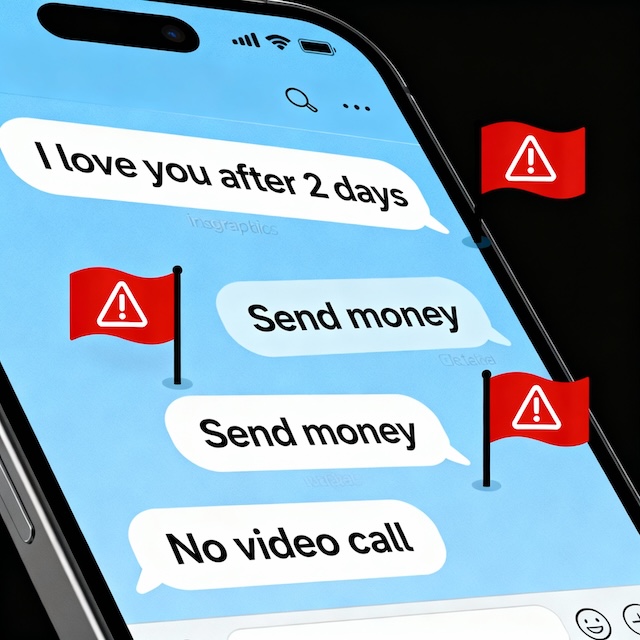
Refusing a video call is not automatically evidence of fraud. Some people have legitimate privacy concerns or personal reasons for avoiding video conversations. Repeated excuses, especially when combined with financial pressure or contradictory information, are more concerning.
Conversely, a successful video call does not guarantee someone’s identity or intentions. Manipulated images, artificial intelligence and other impersonation techniques can be used in increasingly sophisticated scams.
The Golden Rule: Never Send Money to Someone You Only Know Online
One of the most effective precautions against romance scams is straightforward: never transfer money to someone you know only through the Internet, even if they claim to be facing a serious emergency.
Meeting someone in person is not an absolute guarantee of trustworthiness either. Financial manipulation can sometimes continue after several face-to-face meetings.
Before making any financial decision, independently verify the circumstances and be especially cautious when requests involve secrecy, pressure or urgency.
Key takeaway
You are under no obligation to pay for the personal problems of someone you met online. If refusing leads to threats, guilt or repeated demands, stop the conversation and preserve the evidence.
Beware of Fake Investments and Intimate Blackmail
Not all romance scams involve a direct request for financial assistance.
Some scammers first build a relationship of trust before suggesting a supposedly profitable investment, often involving cryptocurrency or online trading. They may display fabricated profits or direct victims to fraudulent investment platforms to encourage further deposits.
This type of long-term investment fraud is sometimes called romance baiting or pig butchering. The apparent relationship is used to persuade the victim to invest money that may become impossible to withdraw.
Other scammers attempt to obtain intimate photographs or videos before threatening to share them with friends, relatives or colleagues. This form of blackmail is known as sextortion and may also involve manipulated or AI-generated images.
INTERPOL’s 2026 assessment of global financial fraud highlights the growing sophistication of these schemes, including the use of artificial intelligence, organized criminal networks and combinations of romance, investment and sextortion fraud.
Never share login codes, passwords, banking documents or intimate content under pressure. Be equally suspicious of promises of unusually high returns and people claiming they can recover stolen funds in exchange for an upfront fee.
How Can You Check a Suspicious Dating Profile?
Before becoming emotionally or financially involved, several practical checks can help you identify inconsistencies. However, no single verification method can guarantee that a dating profile is genuine.
Use Reverse Image Search
Google Lens and other reverse image search tools can help you determine whether a profile photograph appears elsewhere online.
If the same image appears under several names, on websites reporting fraud or in stock image collections, this may indicate that the photograph has been reused and should be investigated further.
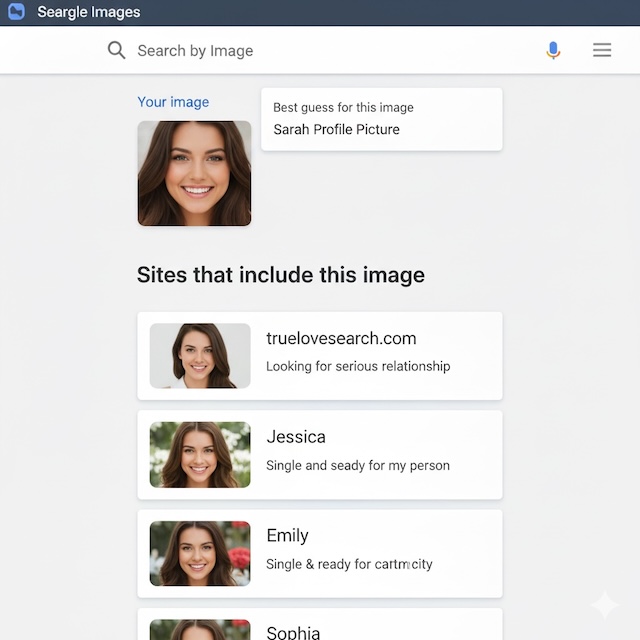
Keep in mind that finding no matching results does not prove a profile is authentic. Recent, private or modified photographs may not appear in search engine results.
Review Public Social Media Information
If your contact voluntarily shares a Facebook, Instagram or other social media account, look for consistency between their public information, posting history, interactions and personal story.
A new or inactive account is not necessarily fraudulent. Similarly, an older account with many posts could have been stolen or compromised. Focus on contradictions and suspicious behavior rather than relying on a single indicator.
Take Your Time Before Meeting in Person
Allow enough time to get to know the person and choose a public place for your first meeting. Tell someone you trust where you are going, arrange your own transportation and avoid sharing your home or accommodation address too early.
It is also sensible to keep control of your belongings, monitor your drink and leave if you feel uncomfortable or pressured.
What Should You Do If You Are a Victim of a Romance Scam?
If you believe someone has deceived or manipulated you, act quickly, particularly if you have already sent money. Some steps may limit further losses and help the relevant authorities investigate.
- Stop making payments: do not send additional money, even if the person promises a refund or claims there is one final emergency.
- Preserve the evidence: save conversations, screenshots, profile details, phone numbers, payment receipts and transaction references before blocking the person.
- Contact your bank or payment provider immediately: explain that you may have been scammed and ask whether the transaction can be recalled, disputed or reversed. Recovery is not guaranteed.
- Secure your accounts: change any compromised passwords, enable two-factor authentication and review suspicious login activity.
- Report the suspicious profile: use the reporting tools provided by the dating platform, social network or messaging service involved.
- Report the incident to the appropriate authorities: the correct procedure depends on your country, where the incident occurred and the nature of the fraud.
If the scam involves threats to publish intimate material, preserve evidence of the threats, stop responding to demands and seek assistance from the platform and the relevant authorities. Paying a blackmailer does not guarantee that the threats will stop.
Reporting a Romance Scam in the United States
In the United States, you can report romance scams and related financial fraud to the Federal Trade Commission (FTC).
The FTC also provides guidance on what to do if you were scammed, including contacting your bank, payment service or money transfer provider as soon as possible.
If money has been stolen or threats have been made, consider contacting your local law enforcement agency as well.
Reporting a Romance Scam in the United Kingdom
For England, Wales and Northern Ireland, fraud and cybercrime can be reported through Report Fraud, which replaced Action Fraud on 4 December 2025.
If you live in Scotland or the incident occurred there, contact Police Scotland on 101 for non-emergency assistance.
Reporting a Romance Scam in Australia
In Australia, you can submit information about a suspected scam to Scamwatch, operated by the National Anti-Scam Centre.
A Scamwatch report is not the same as an official police report. If you have lost money, experienced extortion or had personal information stolen, check the appropriate police reporting procedure and contact your financial institution immediately.
Reporting a Romance Scam in Canada
In Canada, suspected fraud can be reported to the Canadian Anti-Fraud Centre.
If you have been a victim, the Centre also recommends contacting your local police. Its reporting system helps authorities identify patterns and connect related fraud cases.
What If You Are in Thailand?
If you experience a romance scam while staying in Thailand, contact the local police to find out which reporting procedures apply to your situation.
Tourists can also contact the Thai Tourist Police by calling 1155 to request assistance or guidance towards the appropriate authorities.
If you transferred money from an account in another country, contact the bank or payment provider involved as quickly as possible, regardless of where you are currently staying.
Be especially cautious of anyone who contacts you after the incident claiming they can recover your money for an additional fee. This may be another scam targeting people who have already suffered financial losses.
Thailand Dating Scams FAQ
Are paid dating sites like ThaiCupid safer?
Not necessarily. Paying for a membership does not guarantee that every profile is genuine or that a platform is free from scammers. Safety depends on several factors, including moderation, reporting tools and how carefully users evaluate suspicious behavior.
What if someone asks for money to buy a plane ticket?
A request for money to arrange a first meeting should make you cautious. Avoid sending funds under pressure and independently verify the circumstances. Urgent deadlines, repeated excuses and promises of repayment are additional warning signs.
Is supporting family members financially common in Thailand?
Financial support between family members exists in Thailand, as it does in many other countries. This should not be confused with fraud. However, repeated or pressuring requests for money from someone you have only recently met online deserve caution, regardless of that person’s nationality.
Is a video call enough to verify someone’s identity?
No. A video call may help identify some inconsistencies, but it cannot guarantee someone’s identity or intentions. Manipulated images, AI-generated content and impersonation techniques make additional checks important.
How can I arrange a safe first date in Thailand?
Choose a busy public place, tell someone you trust where you are going and arrange your own transportation. Avoid sharing your accommodation address immediately, keep your belongings secure and never leave your drink unattended.
Can I recover money sent to a romance scammer?
It depends on the payment method, how much time has passed and the circumstances. Contact your bank or payment provider immediately to ask about possible recalls, disputes or refunds. Recovery is not guaranteed, and you should avoid anyone promising to retrieve lost money in exchange for upfront fees.
How to Stay Safe When Dating in Thailand
Thailand dating scams should not discourage you from meeting people online. The important thing is to take time to get to know someone, investigate inconsistencies and refuse financial pressure.
Whether you use a free dating app or a paid platform, no subscription can completely eliminate the risk of fake profiles or fraudulent behavior. Good judgment and independent verification remain essential.
If you are still comparing platforms, explore our guide to the best dating apps and sites in Thailand. Whatever service you choose, protecting your personal information and financial security should always come first.
Official sources and useful resources:
- US Federal Trade Commission – Looking for love? Watch out for scammers
- Report Fraud – England, Wales and Northern Ireland
- Scamwatch Australia – Report a scam
- Canadian Anti-Fraud Centre – Report fraud and cybercrime
- Thai Tourist Police – Contact and assistance
- INTERPOL – 2026 report on increasingly sophisticated global financial fraud