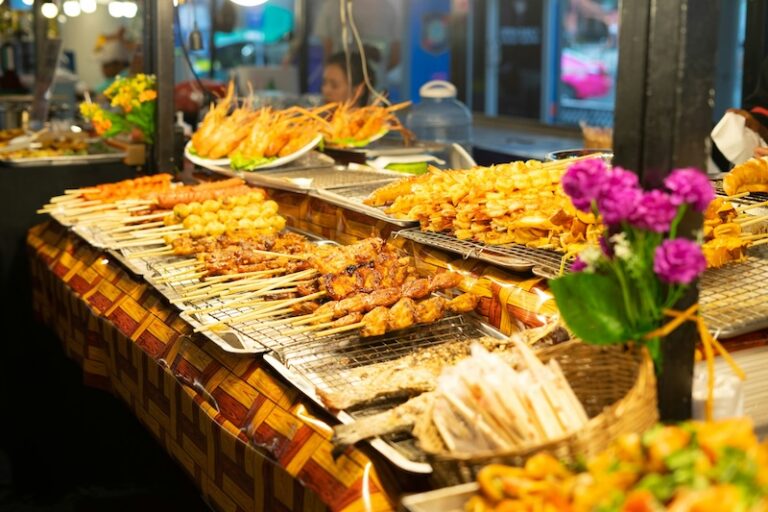
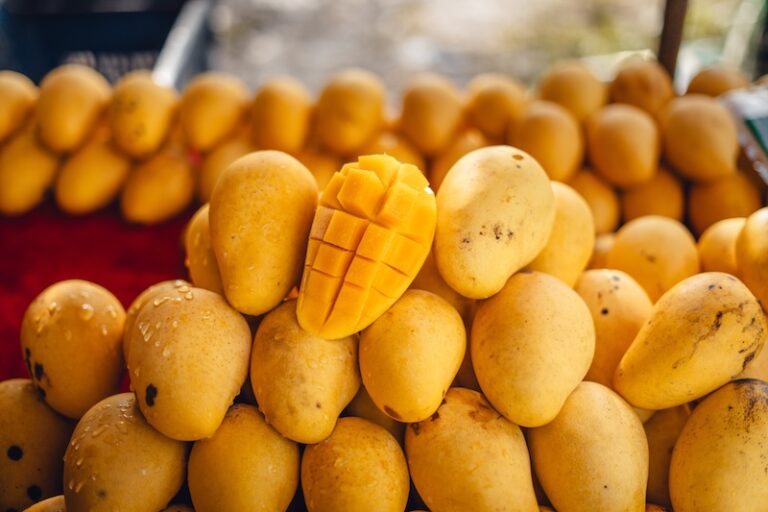
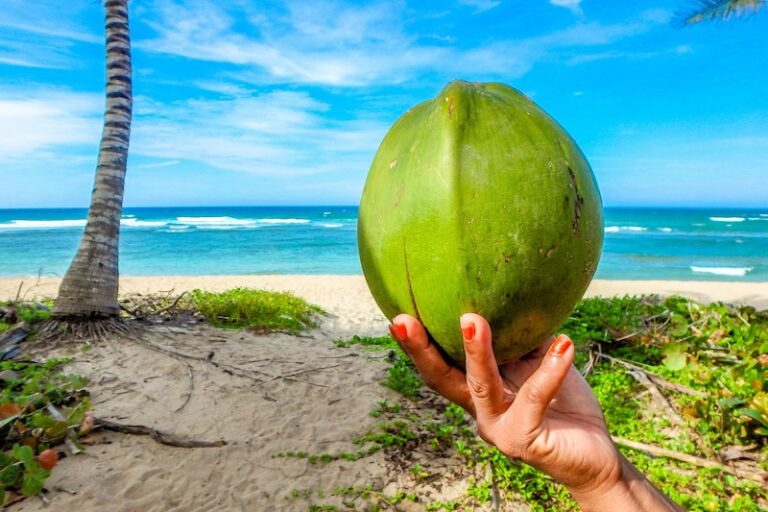
Mango sticky rice is one of Thailand’s most iconic desserts. Made with coconut sticky rice, ripe mango and a slightly salty coconut sauce, it is simple, sweet and unforgettable.
In Thai, it is called khao niao mamuang. You can find it in night markets, street food stalls, food courts, traditional dessert shops and even high-end hotels. But not every version is worth trying.
This guide explains where to eat mango sticky rice in Thailand, how much it costs, when mango season is, and how to recognize a really good version.
What is mango sticky rice?
Mango sticky rice is a Thai dessert made with three main ingredients: glutinous rice, coconut milk and ripe mango. The rice is steamed, then mixed with sweetened and lightly salted coconut milk. It is served with fresh mango slices, often topped with extra coconut cream and sometimes sprinkled with sesame seeds or crispy mung beans.
What makes this dessert so good is the balance. The sticky rice is warm or slightly warm, soft and rich from the coconut milk. The mango brings freshness, fragrance and natural sweetness. The salty note in the coconut sauce keeps the dessert from becoming too heavy.
In Thai, the dessert is called khao niao mamuang. Khao niao means sticky rice, and mamuang means mango. In English, “mango sticky rice” has become the common name used by travelers across Thailand.
Why is mango sticky rice so popular in Thailand?
Mango sticky rice is popular because it sums up Thai food in a very simple way: few ingredients, but a strong balance of sweetness, richness, freshness and texture.
It is also very visual. A bright yellow mango next to glossy white sticky rice and coconut sauce is easy to recognize and easy to love. For many travelers, it is one of the first Thai desserts they want to try.
The dessert is also part of the wider street food and dessert culture in Thailand. It is easy to find, easy to share, and often eaten in markets, small shops or takeaway boxes. If you enjoy discovering local food while walking around, mango sticky rice fits naturally alongside other Thai street snacks.
Still, in Thailand, mango sticky rice is not only a tourist dessert. Thai people eat it too, especially during mango season, when the fruit is at its best.
When is the best season to eat mango sticky rice?
You can find mango sticky rice almost all year round in Thailand, especially in tourist areas. But the best period is usually from March to May, during the hot season, when Thai mangoes are especially ripe, sweet and fragrant.
This is often when the dessert tastes best. Mangoes are more aromatic, juicier and sometimes cheaper. Some famous shops sell mango sticky rice throughout the year, but the quality can vary if the mangoes are less ripe or more expensive outside the main season.
In northern Thailand, especially around Chiang Mai, the mango season can also extend into June depending on the variety and harvest.
If you are planning a food-focused trip, it also helps to understand the weather in Thailand. The hottest months are not always the most comfortable for sightseeing, but they can be excellent for mangoes.
How much does mango sticky rice cost in Thailand?
The price depends mostly on where you buy it. A simple portion from a local market or street stall often costs between 40 and 80 baht. This is usually served in a takeaway box and is perfect if you want to eat it on the go.
In a tourist market, food court or central Bangkok area, the price is more often around 80 to 120 baht. In a restaurant, trendy café or hotel, it can cost 150 baht or more, especially if the presentation is more polished.
| Place | Typical price |
|---|---|
| Local market / street stall | 40–80 baht |
| Tourist market / food court / central Bangkok | 80–120 baht |
| Restaurant, café or hotel | 150 baht and more |
Price does not always guarantee quality. Some small shops serve excellent mango sticky rice, while some expensive versions are mostly made for photos. What really matters is the quality of the mango, the texture of the rice and the freshness of the coconut milk.
Where to eat good mango sticky rice in Bangkok
Bangkok is one of the best places to try several versions of mango sticky rice. You can find it in markets, dessert shops, tourist areas, shopping malls, food courts and long-running family businesses.
K. Panich: the historic address
K. Panich, sometimes written Kor Panich, is one of Bangkok’s most famous mango sticky rice shops. This family-run place is listed in the Michelin Guide, which highlights its recipe passed down through generations.
The shop is known for fragrant sticky rice, a consistent texture and coconut milk that is rich without being overwhelming. If you want to try a traditional and widely recognized version, this is one of the safest choices in Bangkok.
Mae Varee: a convenient classic in Thong Lo
Mae Varee is another well-known name in Bangkok, located near BTS Thong Lo. It is often recommended for ripe mangoes, generous portions and a version that is easy for travelers to find.
This is a practical stop if you are staying around Sukhumvit, Thong Lo or Ekkamai. It is not necessarily a hidden local secret, but it is convenient, recognizable and popular for good reason.
Or Tor Kor Market: the quality market option
If you want mango sticky rice in a cleaner and more organized market setting, Or Tor Kor Market is a strong option. Located near MRT Kamphaeng Phet, close to Chatuchak, this market is known for its fruit, fresh produce and prepared Thai food.
It is not the cheapest place in Bangkok, and it is not a secret market, but it is a good compromise for travelers. The market is easy to reach, more comfortable than many street markets, and the quality of the mangoes is often very good. It also works well if you plan to visit Chatuchak on the same day.
Bangkok night markets
Night markets are one of the easiest ways to try mango sticky rice in a casual setting. You can find it in many markets, especially around tourist areas or local food zones.
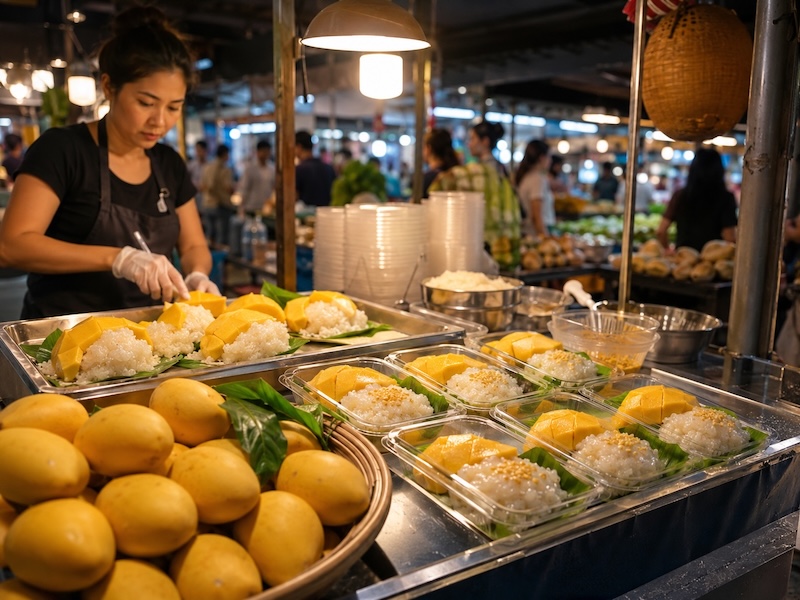
This is also where the dessert often makes the most sense: eaten standing up, from a simple box, between two street food stalls. Night markets in Thailand are among the best places to try this kind of dessert if you want a more local atmosphere than a restaurant. In Bangkok, Chatuchak Market can also be a good weekend option.
Food courts and shopping malls
Food courts in Bangkok malls are not always the most authentic places to eat, but they are practical. They are clean, air-conditioned and easy to navigate, especially on a first trip to Thailand.
If you have just arrived and want to try mango sticky rice without looking for a specific address, a food court can be a good introduction. It may not be the most memorable version, but it is simple and accessible.
If ordering food in markets or food courts feels intimidating at first, learning how to order food in Thailand can make the experience much easier.
Can you eat mango sticky rice in Chiang Mai, Phuket or the islands?
Yes. Mango sticky rice is easy to find in most major tourist destinations in Thailand.
In Chiang Mai, you will usually find it at night markets, especially around the Sunday Night Market and other street food areas in the old town. The atmosphere is often more relaxed than in Bangkok, with plenty of other local desserts and snacks to try.
In Phuket, mango sticky rice is common in markets, restaurants and stalls near popular beach areas. Quality varies a lot. In very touristy zones, you may pay more for a version that is only average.
On islands such as Koh Samui, Koh Phangan, Koh Tao, Koh Lanta or Koh Chang, you can also find it in Thai restaurants and night markets. Prices may be a little higher than in local areas on the mainland, but it remains an affordable dessert.
Mango sticky rice is only one entry point into Thai food. If you enjoy discovering a country through what you eat, Thai street snacks and local desserts can be just as memorable as famous dishes like pad thai or green curry.
How to recognize good mango sticky rice
A good mango sticky rice is easy to recognize. It should not be dry, bland or overly sweet.
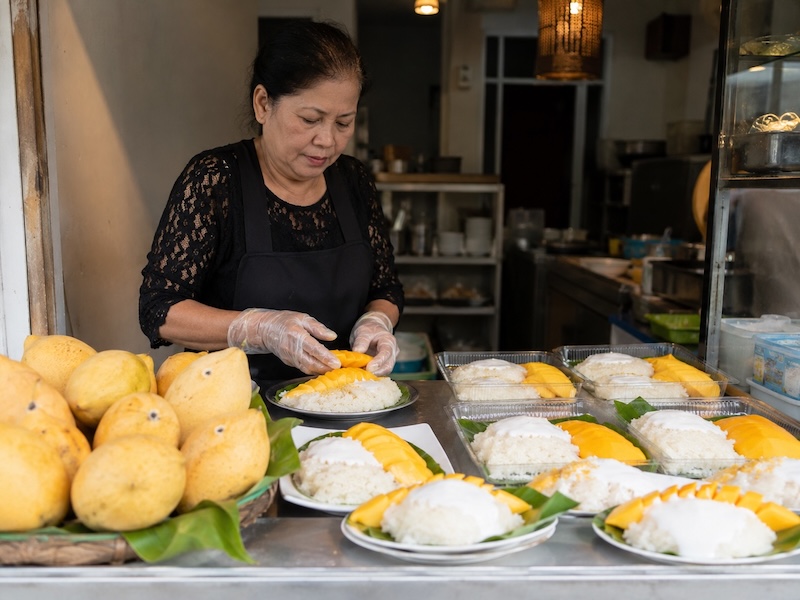
The sticky rice should be soft, slightly sticky, but not compact. It should have absorbed the coconut milk without becoming wet or mushy. If the rice is hard, dry or too dense, it is usually not a good sign.
The mango should be ripe, fragrant and soft. The best Thai mangoes are often very sweet, smooth and not too fibrous. If the mango is sour, firm or cold from the fridge, the dessert loses much of its charm.
The coconut sauce should be rich, fresh and slightly salty. That small salty note is what makes the dessert work. Coconut is central to many Thai desserts and dishes, and travelers quickly notice how important coconut in Thailand is once they start eating locally.
Finally, look at turnover. A stall that sells a lot of portions is more likely to serve fresh rice and freshly prepared mangoes.
Should you avoid touristy versions?
Not necessarily, but you should know what to expect. In very touristy areas, mango sticky rice can be more expensive, less fresh or prepared in advance. Some stalls focus more on presentation than taste, with colorful portions or very photogenic packaging.
That does not mean it is always bad. It just means it may not be the best version.
If you want a more authentic experience, look for places where Thai customers also buy it, local markets, specialized dessert shops or stalls that sell a lot during the day.
On the other hand, if you are in a tourist area and simply want a sweet dessert after dinner, there is nothing wrong with choosing the convenient option. Mango sticky rice is a simple pleasure, not a competition.
Is mango sticky rice very sweet?
Yes, mango sticky rice is a sweet dessert, but a good version should still feel balanced. The rice is flavored with sweetened coconut milk, the mango brings natural sugar, and the coconut sauce adds richness.
The difference is in the dosage. A well-made version keeps a slightly salty note that balances the sweetness. A poor version can become too heavy, especially if the coconut sauce is too sweet or too generous.
If you do not like very sweet desserts, share one portion. For many travelers, half a portion is enough to enjoy the taste without feeling too full.
Is mango sticky rice vegetarian and gluten-free?
Mango sticky rice is usually vegetarian because it is made with rice, coconut milk, sugar, salt and mango. It normally does not contain animal products.
It is also naturally gluten-free, even though the rice is called “glutinous rice”. The word refers to its sticky texture, not to gluten. If you have a strict allergy or intolerance, you should still be careful with cross-contamination, especially in markets or shared kitchens.
For vegan travelers, the classic version is usually suitable. However, it is always worth checking that no condensed milk or unexpected ingredient has been added in modern versions.
What kind of mango is used for mango sticky rice?
In Thailand, mango sticky rice is usually made with ripe yellow mangoes that are sweet, soft and fragrant. Varieties such as Nam Dok Mai or Ok Rong are often associated with Thai desserts.
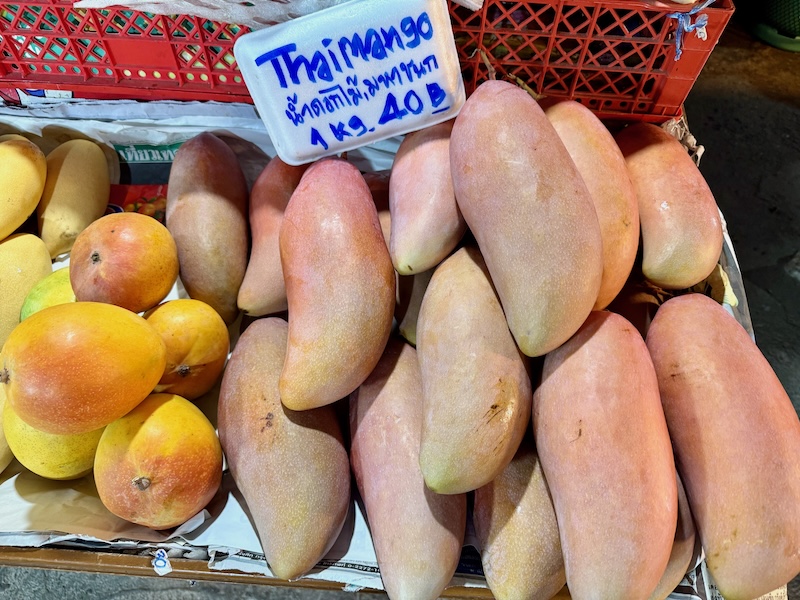
These mangoes have tender, sweet and low-fiber flesh, which makes them ideal with coconut sticky rice. This is also why the dessert can be less successful outside Thailand or outside the main season: it is difficult to find the same mango quality.
The fruit can completely change the dessert. That is why Thai mangoes deserve special attention: depending on the variety and the season, they can make the difference between an average dessert and an excellent one. More broadly, fruits in Thailand are one of the simplest pleasures of a trip to the country.
Should you try mango sticky rice on a first trip to Thailand?
Yes, definitely. Even if you are not usually a dessert person, mango sticky rice is worth trying at least once. It is one of the most representative sweet dishes in Thailand.
The best approach is to try more than one version: one from a market, one from a well-known shop, and maybe one in a more comfortable restaurant or café. You will quickly notice the differences in rice texture, mango quality and coconut sauce.
If you take a cooking class in Thailand, mango sticky rice may also be included among the desserts. It is a good way to understand how the rice is steamed, how the coconut milk is balanced and why a ripe mango matters so much.
Where to eat the best mango sticky rice in Thailand
The best mango sticky rice is not always the most expensive or the most famous. A historic shop like K. Panich in Bangkok is an excellent choice if you want a traditional and recognized version. Mae Varee is also a reliable option for travelers passing through Thong Lo.
But local markets should not be overlooked. Some small stalls serve very simple, very fresh and perfectly balanced versions. During mango season, this is often where you make the best discoveries.
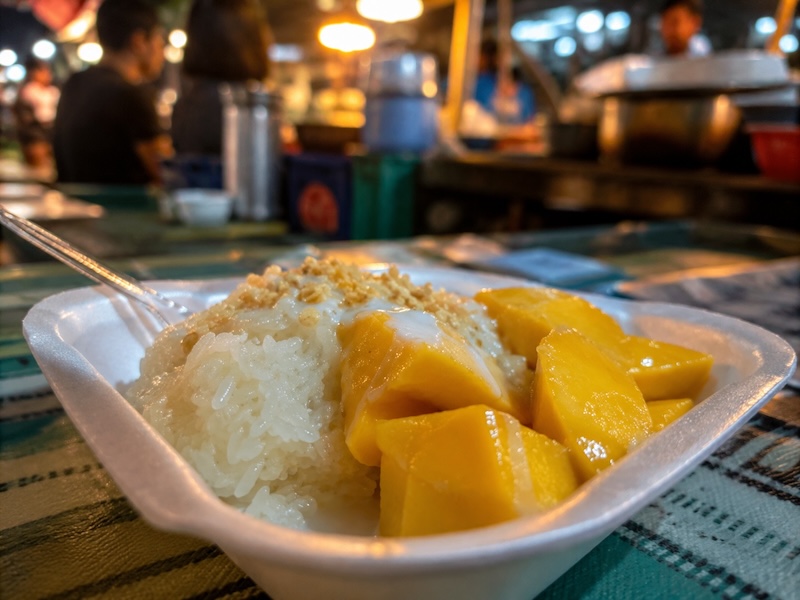
The mango sticky rice you remember most may not be the one from a famous address, but the one you eat one evening in a market, still slightly warm, with perfectly ripe mango and just enough salty coconut milk.
FAQ about mango sticky rice in Thailand
What is mango sticky rice called in Thai?
In Thai, mango sticky rice is called khao niao mamuang, which literally means sticky rice with mango.
When is the best time to eat mango sticky rice in Thailand?
The best time is usually from March to May, when Thai mangoes are sweeter, riper and more fragrant.
How much does mango sticky rice cost in Thailand?
At a local stall, it often costs 40 to 80 baht. In a café, restaurant or tourist area, it can be more expensive.
Where can I eat mango sticky rice in Bangkok?
K. Panich, Mae Varee and Or Tor Kor Market are good options. Night markets are also a simple way to try a local version.
Is mango sticky rice vegetarian?
Yes, the classic version is usually vegetarian. It is made with sticky rice, coconut milk, sugar, salt and mango.
Is mango sticky rice gluten-free?
Yes, sticky rice does not contain gluten. If you have a strict allergy, still check for cross-contamination.
Can you find mango sticky rice all year round?
Yes, especially in Bangkok and tourist areas. But it is usually better during mango season, from March to May.