🔄 Update (June 15, 2026):
Flights to Thailand are operating, but routes via the Middle East may still face delays, rerouting or schedule changes. Gulf hubs such as Doha, Dubai, Abu Dhabi and Kuwait remain areas to monitor. Always check your flight status directly with your airline before departure.
Are flights to Thailand being cancelled in June 2026? The situation is not a closure of Thailand, but a route and connection issue linked to Middle East airspace. The main risk concerns itineraries connecting through the region, especially via Doha, Dubai, Abu Dhabi or Kuwait. Depending on the airline and route, travelers may still face delays, rerouting, longer flight times or occasional cancellations.
Context: The most severe disruptions started in late February and March 2026, when tensions in the Middle East led to temporary airspace closures or restrictions in parts of the region.
Since then, the situation has improved, but some Europe–Asia routes can still be affected by operational changes. The EASA has extended its conflict-zone bulletin for the Middle East and Persian Gulf until June 24, 2026, which confirms that airlines may continue to adjust routes at short notice.
If you are traveling to another country in the region, check out our complete analysis of Southeast Asia flight disruptions, including a detailed country-by-country update (Vietnam, Bali, Singapore…).
Status of flights to Thailand in June 2026
Flights to Thailand are operating, but delays, rerouting and occasional cancellations remain possible depending on the airline and the route. The main risk for travelers comes from connections through the Middle East and from airspace restrictions that can force airlines to adjust Europe–Asia flight paths.
Current situation and recent developments
Compared with the severe disruptions seen in March 2026, the situation has improved. However, the regional context remains unstable enough for airlines to adjust flight paths, connection times or schedules when necessary.
- ✈️ Most flights to Thailand are maintained, with adapted routes when required.
- ⏱️ Delays can still occur due to airspace restrictions and longer detours.
- 🔁 Airlines may still adjust schedules at short notice depending on the route.
- 💸 Ticket prices may remain volatile as airlines manage fuel costs, route changes and capacity.
Disruptions mainly affect routes passing through the Gulf and the wider Persian Gulf region. Direct flights or those via alternative hubs in Asia or Europe, such as Singapore, Taipei or Istanbul, may be less exposed to the same operational constraints, although no route is completely immune to last-minute changes.
Since the situation can evolve quickly, always check the status of your flight directly with your airline before departure.
Why are Middle East tensions impacting flights to Asia?
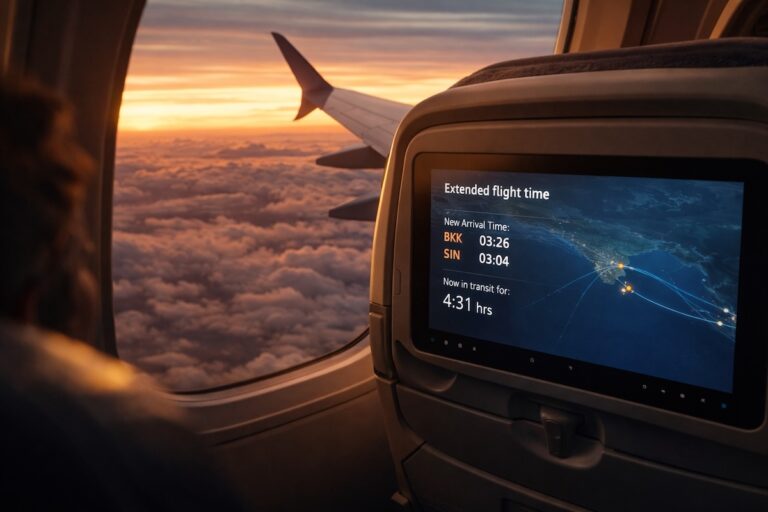
When airspaces such as those over Iran or Iraq close or become risky, airlines must avoid these corridors. They may need to bypass the area through alternative air routes, which can lengthen flight times between Europe and Asia.
These detours increase logistical complexity: they require more fuel, affect crew rotations, alter connection times and can sometimes lead airlines to preemptively cancel or reschedule flights if a route becomes too difficult to operate reliably.
The European Union Aviation Safety Agency (EASA) has extended its Conflict Zone Information Bulletin for the Middle East and Persian Gulf until June 24, 2026. The bulletin recommends avoiding the affected airspace of Iran, Iraq and Lebanon, and exercising caution in several other airspaces, including Bahrain, Kuwait, Israel, Jordan, Qatar, Oman, the UAE and Saudi Arabia.
Which airlines are affected (Emirates, Qatar Airways, Etihad)?
Travelers to Thailand are primarily exposed if they pass through Gulf hubs. Because their operations depend directly on regional airspace conditions, Qatar Airways (Doha), Emirates (Dubai), and Etihad (Abu Dhabi) are among the airlines most likely to experience rerouting, delays or schedule adjustments when the situation changes.
Kuwait should also be monitored. Recent aviation-related disruptions in Kuwait have highlighted that the risk is not limited to the main Gulf hubs usually used by travelers to Thailand.
European airlines are not immune either. For example, KLM states in its travel alerts that it is not currently flying through the airspace of Iran, Iraq and Israel, nor over several countries in the Gulf region. KLM has also suspended or adjusted several routes in the region, including flights to Dubai, Riyadh and Dammam.
Should I cancel my trip to Thailand?
If your airline is still operating your flight, there is generally no reason to cancel your trip solely because of the regional airspace situation. The issue is mainly logistical and concerns flight routes, connections and possible delays. It does not mean that Thailand is closed to travelers. To check the situation on site, you can also read our update on the current situation and safety in Thailand.
However, if your itinerary includes a short layover in the Middle East and you are traveling for a fixed-date event, such as a wedding, cruise departure or important appointment, contact your airline before departure. You may be able to evaluate whether an alternative route via another hub, such as Singapore, Taipei or Istanbul, is more suitable.
What to do if my flight is cancelled or delayed?
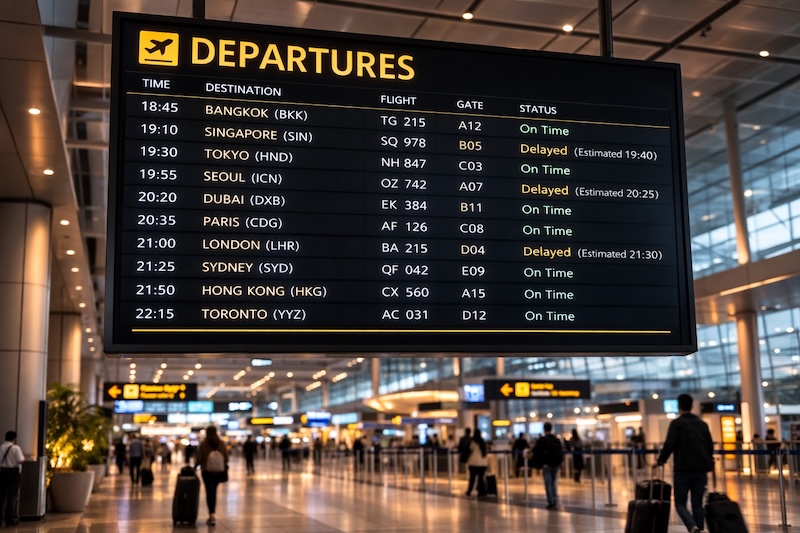
If your flight is cancelled, the airline must usually offer you either a refund or rerouting on another available flight, depending on the applicable rules, your itinerary and the airline’s conditions.
The European Regulation (EU261) and conflicts
Please note: under European law, a war, conflict-related disruption or sudden airspace closure may be considered an “extraordinary circumstance”. This means you may not be entitled to standard financial compensation, even in the event of severe disruption. However, the airline must still ensure your right to care, such as meals or hotel accommodation, if you are stranded during a layover. Note: EU261 applies if the flight departs from the EU/EEA/Switzerland/UK or if it is operated by a European airline on a flight arriving in the EU.
An update on travel insurance
Many credit card travel insurance policies or standard travel policies exclude events related to “acts of war”, hostilities or military operations. Check the “war / hostilities” clause of your policy carefully. If you decide to cancel your trip on your own because you fear delays, standard travel insurance will often not cover the cancellation unless you have a specific “Cancel for Any Reason” guarantee.
🛡️ Check your travel insurance before departure
In case of prolonged delays, missed connections or unexpected cancellations, coverage depends on the exact wording of your policy. Many standard travel insurance contracts and credit card policies exclude events related to war, hostilities or military operations.
Before relying on your insurance, check the cancellation, delay, missed connection and “war / hostilities” clauses carefully.
Will ticket prices for Asia increase?
Ticket prices may remain volatile as airlines adjust capacity, fuel costs and rerouting constraints. Longer flight paths can increase fuel consumption, while schedule changes or reduced seat availability on certain routes can also affect prices.
FAQ: The essentials to remember
Is the situation for flights to Thailand improving?
Yes, compared with the severe disruptions seen in March 2026, the situation has improved. Flights to Thailand are operating, but routes via the Middle East can still be affected by airspace restrictions, rerouting, delays or schedule changes. The safest approach is to check your flight directly with your airline before departure.
Is it dangerous to travel to Thailand right now?
No. Current concerns are primarily about airspace and flight routes in the Middle East. Thailand is not involved in the conflict, and tourist areas are functioning normally. For official and updated information, you can consult the UK Foreign Travel Advice or the US State Department Travel Advisory.
Are Bangkok and Phuket airports affected?
Airports in Thailand continue to operate normally. The impact is mainly on routes, connections and possible arrival delays if your aircraft had to follow a longer route from Europe or the Middle East.
Are direct flights (non-stop) impacted?
They are generally less exposed to missed connections than flights with a layover in Dubai, Doha or Abu Dhabi. However, even direct flights can be affected by longer flight times if aircraft need to avoid restricted airspace.
Should I avoid taking a layover in the Middle East?
Not necessarily. Many flights via the Gulf continue to operate. However, if you are buying tickets now and your dates are not flexible, a direct flight or a connection via another hub, such as Singapore, Taipei or Istanbul, may reduce the risk of missed connections.