Looking for basic Thai phrases for your trip to Thailand? This guide covers the essential words and expressions to greet people, order food, ask for directions, and handle everyday situations. Download our free PDF and communicate more easily during your trip.
Your travel phrasebook, ready to use!
Download our complete Thai-English phrasebook in PDF format. Perfect for keeping essential words with you at all times, even offline.
With these words and expressions, you will find it easier to connect with locals, avoid misunderstandings, and enjoy Thai hospitality even more. Remember: even a few words can go a long way and often bring a smile.
To prepare for your trip, you can also check out our maps of Thailand to get a better overview of the country’s regions and main travel routes.
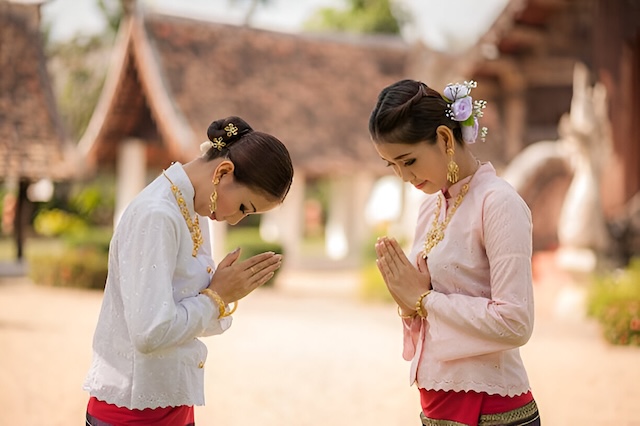
The Thai language: background, diversity, and useful tips
Thai, also called Siamese, is the national language spoken by more than 60 million people. Shaped by centuries of history, it has been influenced by Khmer, Sanskrit, Pali, and modern English. There are five main regional groups: Central Thai (the official language), Northern Thai, Northeastern Thai (Isan), Southern Thai, and several minority dialects. If you travel across the country, you will notice differences in accent and vocabulary.
There is even a special register called rachasap, reserved for the royal family and official ceremonies. For most travelers, standard Bangkok Thai is understood everywhere.
One of Thai’s main features is that it is a tonal language: the same word can have different meanings depending on the tone used (mid, rising, falling, high, or low). This may sound intimidating at first, but Thai people are usually very understanding with foreign speakers. The Thai alphabet has 44 consonants and 32 vowels, but for beginners, pronunciation and listening matter far more than writing.
Tips to make yourself understood:
- The letter “r” is often pronounced more like an “l” in everyday speech.
- “Ph” is pronounced as an aspirated “p,” never like the English “f” sound (for example, “Phi Phi” sounds closer to “Pi Pi”).
- Always add “kha” (if you are a woman) or “khrap” (if you are a man) at the end of your sentences to sound polite.
- Good manners go beyond words. A smile and respect for local customs are essential. To understand these cultural codes better, read our guide to Thai etiquette and customs.
Basic Thai Phrases for Everyday Travel Situations
- Thank you: ขอบคุณ (Khob khun kha/khrap)
- Hello: สวัสดี (Sawasdee kha/khrap)
- Goodbye: ลาก่อน (La korn)
- Hi!: หวัดดี (Waddee)
- Yes: ใช่ (Chai)
- No: ไม่ (Mai)
- Please: กรุณา (Karuna)
- Excuse me / Sorry: ขอโทษ (Khor thot)
- I don’t understand: ไม่เข้าใจ (Mai khao jai)
- What is your name?: คุณชื่ออะไร (Khun cheu a-rai?)
- My name is…: ฉันชื่อ… (Chan cheu… – woman) / ผมชื่อ… (Phom cheu… – man)
- Do you speak English?: พูดภาษาอังกฤษได้ไหม (Poot pasa angkrit dai mai?)
There are two main ways to say no. Mai (ไม่) is used to negate a verb or adjective (for example, mai khao jai = I don’t understand), while mai chai (ไม่ใช่) means “that’s not correct” or “no, that’s not the case,” and is used to answer a statement or deny a noun.
Example:
— Are you a doctor? → Khun pen mor chai mai?
— Yes: Chai | No: Mai chai
Thai people often use the word “sanuk” to describe something fun or enjoyable. Feel free to say that Thailand is “sanuk”!
Emergencies and health
- I am sick: ฉันป่วย (Chan puay)
- Help me!: ช่วยด้วย! (Chuai duay!)
- Emergency: ฉุกเฉิน (Chook chern)
- Doctor: หมอ (Mor)
- Pharmacy: ร้านขายยา (Raan khai yaa)
- Hospital: โรงพยาบาล (Rong phaya ban)
- Danger: อันตราย (An-ta-rai)
- I am allergic: ฉันแพ้ (Chan pae)
Getting around and asking for directions
- I am lost: ฉันหลงทาง (Chan long tang)
- Where is the toilet?: ห้องน้ำอยู่ที่ไหน (Hong nam yu tee nai?)
- Where is…?: …อยู่ที่ไหน (… yu tee nai?)
- Bank: ธนาคาร (Tha-na-khan)
- Downtown / city center: ใจกลางเมือง (Jai glang mueang)
- Hotel: โรงแรม (Rong raem)
- Supermarket: ซุปเปอร์มาร์เก็ต (Supermarket)
- Train station: สถานีรถไฟ (Sathani rot fai)
- Right: ขวา (Khwa)
- Left: ซ้าย (Sai)
- Straight ahead: ตรงไป (Trong pai)
In Northeastern Thailand (Isan), some words vary slightly. For example, “toilet” may be said as “hong nam” or “hong suam.”
At the restaurant & food
To go further, check out our dedicated guide on how to order food in Thailand for useful phrases, tips, and menu vocabulary.
- I’m hungry: ฉันหิว (Chan hiu)
- I’m thirsty: ฉันกระหายน้ำ (Chan kra hai nam)
- Water: น้ำ (Nam)
- Not spicy: ไม่ใส่เผ็ด (Mai sai phet)
- Breakfast: อาหารเช้า (Ahan chao)
- Lunch: อาหารมื้อเที่ยง (Ahan meu thiang)
- Dinner: อาหารมื้อเย็น (Ahan meu yen)
- Enjoy your meal: ทานให้อร่อยนะ (Tan hai aroi na)
- Very delicious: อร่อยมาก (Aroi mak)
- The bill, please: ขอเช็คบิล (Khor chek bin)
- Cheers!: ไชโย (Chai yo)
Questions, time, and days of the week
- When?: เมื่อไหร่ (Meua rai)
- What time is it?: กี่โมงแล้ว (Gee mong laew)
- Today: วันนี้ (Wan nee)
- Tomorrow: พรุ่งนี้ (Phrung nee)
- Yesterday: เมื่อวาน (Meua wan)
- Weekend: สุดสัปดาห์ (Sud sap da)
- Monday: วันจันทร์ (Wan jan)
- Tuesday: วันอังคาร (Wan angkhan)
- Wednesday: วันพุธ (Wan phut)
- Thursday: วันพฤหัสบดี (Wan phreuhasabodee)
- Friday: วันศุกร์ (Wan suk)
- Saturday: วันเสาร์ (Wan sao)
- Sunday: วันอาทิตย์ (Wan athit)
Days of the week are often associated with colors in Thailand (for example, Monday is yellow and Tuesday is pink), a tradition influenced by astrology.
The Thai alphabet and its special features
Thai writing is unique in Southeast Asia. It is written from left to right, with no spaces between words. Each character represents a syllable. The alphabet may look complex at first, but many travelers start simply with phonetics and spoken expressions.
Basic Thai grammar and sentence structure
Thai grammar is considered relatively simple for many foreign learners: there are no verb conjugations, no articles, no plural endings, and no grammatical gender. Words stay the same, and sentence order is generally Subject-Verb-Object (SVO), just like in English.
- No conjugation: the verb never changes, whatever the tense or the subject. Time is indicated with words such as today (wan nee), yesterday (meua wan), or tomorrow (phrung nee).
- No plural or grammatical gender: a word like khon can mean “person,” “people,” “man,” or “woman,” depending on context.
- Negation: place mai (ไม่) before the verb to say “not.” Example: mai khao jai = I don’t understand.
- Politeness: add kha (woman) or khrap (man) at the end of the sentence to be polite.
- Questions: add mai at the end of an affirmative sentence to turn it into a question. Example: khun sabai dee mai? = Are you well?
Subject + verb + object
Chan gin khao = I eat rice.
Phom mai gin phet = I don’t eat spicy food.
Complete sentence examples for common situations
- Greeting someone: สวัสดี คุณสบายดีไหม (Sawasdee, khun sabai dee mai?) – Hello, how are you?
- Asking the price: อันนี้ราคาเท่าไหร่ (An ni rakha thaorai?) – How much is this?
- Ordering at a restaurant: ขอข้าวหนึ่งจานครับ/ค่ะ (Khor khao neung jan khrap/kha) – I would like one plate of rice, please.
- Asking for directions: สถานีรถไฟอยู่ที่ไหน (Sathani rot fai yu tee nai?) – Where is the train station?
- Emergency: ช่วยด้วย! (Chuai duay!) – Help me!
- Introducing yourself: ผมชื่อปอล (Phom cheu Paul) / ฉันชื่อปอล (Chan cheu Paul) – My name is Paul (man/woman).
- Closing politely: ไม่เป็นไร ขอบคุณ (Mai pen rai, khob khun) – It’s okay, thank you.
- That’s too expensive: แพงไป (Phaeng pai) – That’s too expensive.
- Can you lower the price?: ลดได้ไหม (Lot dai mai?) – Can you lower the price?
Regional variants and idiomatic expressions
- Isan (Northeast): people often say “Sawasdee der” (สวัสดีเด้อ) instead of the standard “Sawasdee.”
- North (Lanna / Chiang Mai): the word “jao” (เจ้า) may be used instead of “kha/khrap” for politeness.
- South: the accent is more melodic, and some words change slightly. For example, some speakers may use regional variants for common everyday terms.
- Popular expression: “Sabai sabai” (สบายๆ) means “relaxed, all good,” and is used all over the country.
- Idiomatic expression: “Kin len” (กินเล่น) means “to snack” (literally “to eat for fun”).
- Very common phrase: “Mai pen rai” (ไม่เป็นไร) = “Never mind / It’s okay,” something you hear all the time in Thailand.
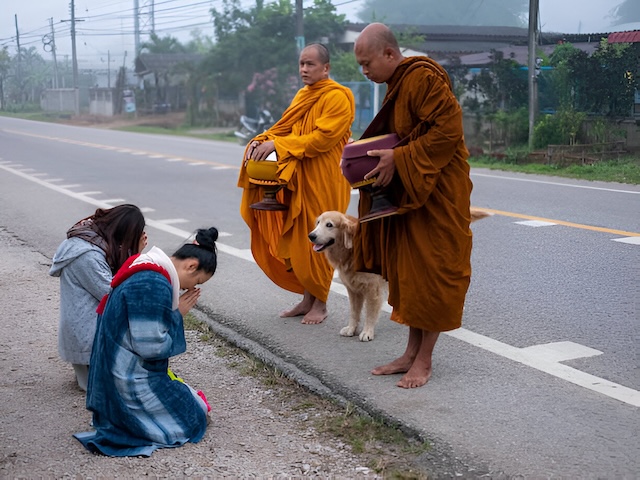
What to remember for better communication in Thailand
- One word and one smile can be enough: even with an accent, the effort is always appreciated.
- Add “kha” or “khrap” for politeness — it is one of the keys to successful interaction.
- This phrasebook is only a starting point: feel free to complement it with apps, videos, or real conversations on the ground.
- Do not hesitate to ask people to repeat or clarify: Thai people are often patient and happy to help curious travelers.
This phrasebook is a great starting point for your trip. If you want to learn in a more structured and authentic way, discover Olivia Thai and her method in our article: Learn Thai with Olivia Thai.
Enjoy your trip and have fun discovering the Thai language with this Thai-English phrasebook!
Useful resource:
- Lexilogos Thai-English dictionary: useful for looking up more words and exploring additional online language tools.